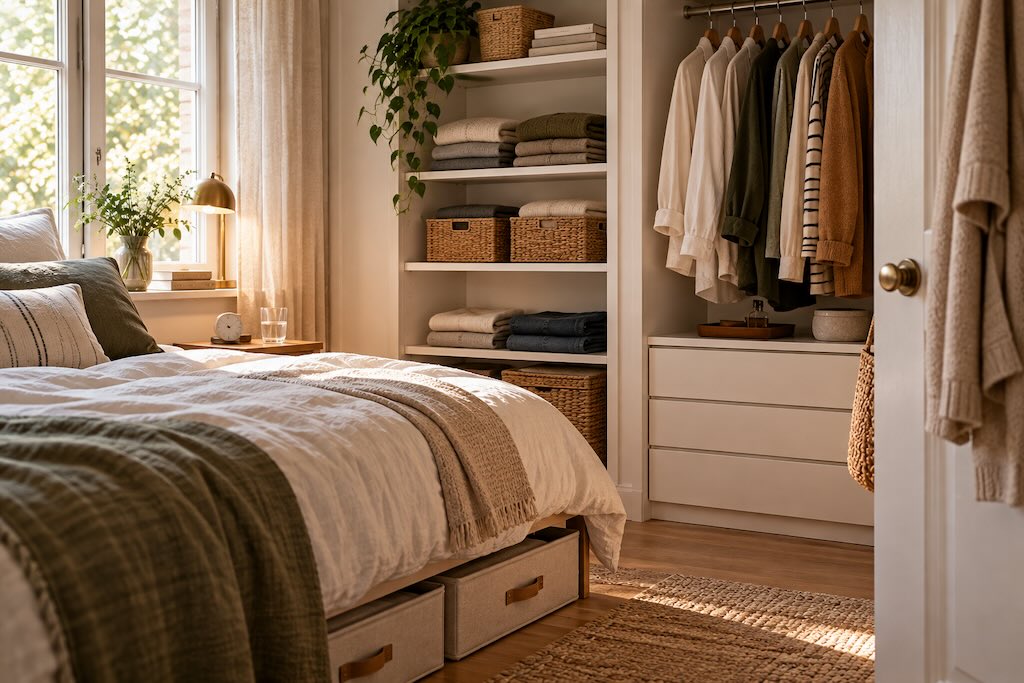
A bedroom can be large enough for a bed, a wardrobe and a little breathing room, yet somehow have nowhere sensible to put folded clothes. T-shirts end up on a chair. Jeans accumulate at the foot of the bed. Socks live in a basket that was supposed to be temporary.
The obvious answer is a dresser. But what if there isn’t room for one? Perhaps the wardrobe doors would hit it, the bed takes up most of the floor, or you’re renting a bedroom where adding furniture isn’t practical.
The solution isn’t necessarily to squeeze in another cabinet. It’s to work out which clothes need drawers, which can be hung, and which don’t need to occupy your most accessible storage space. Once you’ve done that, a surprisingly small amount of additional storage may be enough.
First, work out what actually needs storing
Before looking for storage solutions, gather the clothes that would normally go into a dresser. You don’t have to empty your entire wardrobe. Start with the things currently piled on chairs, shelves or the floor.
Separate them into three groups: everyday clothes you fold, smaller items such as underwear and socks, and clothes you don’t expect to wear for several months.
These groups don’t all need the same kind of storage. Socks benefit from a contained space where they won’t get mixed up. Jumpers need enough room to sit folded without being crushed. Seasonal clothing can usually go somewhere less convenient.
Also check whether anything could be stored elsewhere. Heavy winter accessories might belong near your coats, while occasional sportswear may fit with other exercise equipment. As we explored in our guide to organising a small entryway, giving frequently used belongings priority often works better than simply adding more storage.
1. Make the existing wardrobe work harder
If you already have a wardrobe, look beneath the hanging clothes. Is there an empty section below your shirts? Are several shelves occupied by items you rarely use?
A few fabric boxes or baskets may turn an underused shelf into practical storage for folded T-shirts, underwear or sleepwear. A hanging organiser can also be useful where the wardrobe has enough vertical space, although it will take up some of the rail normally available for hanging clothes.
Measure before buying. A storage box that fits the width of a shelf may still be too deep to pull out comfortably. Hanging organisers need enough clearance beneath them, particularly if you keep shoes or other belongings on the wardrobe floor.
IKEA’s clothes organiser range illustrates several approaches, including shelf boxes, hanging compartments and drawer dividers. You don’t need to buy a matching system, though. Existing containers may do the job just as well.
2. Use the space under your bed for clothes you don’t need every day
The space beneath a bed can be useful, especially for seasonal clothes, spare bedding and items you don’t reach for every morning.
Low, lidded containers help keep belongings together and protect them from ordinary household dust. If the bed is particularly low, soft storage bags may fit where rigid boxes won’t.
But under-bed storage is not automatically the best place for your everyday wardrobe. If retrieving a clean T-shirt means kneeling on the floor and dragging out a heavy container, the arrangement may become frustrating quite quickly.
Reserve the easiest storage for clothes you wear regularly. Keep seasonal items clean and completely dry before packing them away, and avoid storage areas that are damp or poorly ventilated. Check the bed manufacturer’s guidance before placing containers beneath a frame with moving parts or mechanical components.
3. Turn an existing bookcase into folded-clothes storage
A narrow bookcase can sometimes do the work of a dresser without taking up as much floor space. It is particularly useful for folded clothes that don’t require hanging.
Rather than stacking everything openly, use baskets or boxes to keep categories separate. One could hold T-shirts, another sleepwear, and a smaller container could accommodate socks.
Choose containers that are easy to remove without pulling neighbouring items down. The highest shelves are better reserved for things you don’t use frequently, especially if reaching them would otherwise require climbing onto furniture.
Not every shelf needs a box. A few neatly folded jumpers can sit directly on a shelf if they’re easy to reach and unlikely to topple over.
For a bookcase that also holds books or personal belongings, our guide to styling a bookshelf with what you already own offers ideas for making mixed storage feel considered rather than crowded.
Make sure the bookcase is suitable for the intended load and anchored against tipping according to the manufacturer’s instructions.
4. Consider a clothes rail, but only if you need hanging space
Freestanding clothes rails often appear in small-bedroom inspiration photographs. They can be useful, particularly in rooms without built-in wardrobes, but they don’t solve every clothing-storage problem.
If most of your clothes are T-shirts, jeans and knitwear, another rail may not help much. You could end up with more hanging space while the folded clothes remain in piles.
For shirts, dresses and jackets, however, a compact rail can be practical. Some models also have a lower shelf for shoes or storage boxes.
Measure the full depth of the rail with clothes hanging from it, not just the frame. Sleeves and hangers extend beyond the metal structure, and a rail that looks narrow when empty can take up considerable space once loaded.
Apartment Therapy’s guide to bedrooms with little or no closet space includes examples of rails, shelves and alternative storage arrangements. The useful lesson is that the best solution depends on the clothing you own, not simply the amount of empty wall.
5. Use the back of a door for small accessories
The back of a bedroom or wardrobe door can provide a little extra storage without occupying floor space.
An over-door organiser may work for belts, scarves, small accessories or other lightweight belongings. Some have pockets that can hold socks or similar items, provided the compartments are suitable.
Check the door clearance before buying. An organiser that fits over the top of a door may prevent it from closing properly, particularly if the gap around the frame is tight.
Don’t overload the organiser or use it in a way that damages the hinges. If the door opens against a wall, make sure the added storage won’t obstruct its movement.
This is a useful addition for small categories, but it probably won’t replace an entire dresser. Think of it as a way to free up shelf space for larger folded items.
6. Choose a storage bench only if the room can accommodate one
A storage bench at the foot of the bed can hold spare bedding, seasonal clothes or other items you don’t need to access constantly.
It may also provide somewhere to sit while getting dressed. But in a genuinely small bedroom, a bench can obstruct the route around the bed or make drawers and wardrobe doors difficult to open.
Before buying one, mark out its dimensions on the floor with removable tape. Walk around the bed, open the wardrobe and check whether you can still move comfortably.
If it makes the room harder to use, skip it. Furniture that performs two functions isn’t automatically space-saving when there isn’t enough room for either.
7. Look beyond the bedroom for seasonal storage
Not every piece of clothing needs to live in the bedroom throughout the year.
If you have suitable storage elsewhere in your home, consider moving clean, dry seasonal clothes out of the bedroom. A hallway cupboard, a spare shelf or another accessible storage area may be enough.
The important thing is to avoid transferring clutter from one room to another. Keep seasonal clothing grouped and labelled so you can find it when the weather changes.
Avoid storing clothes in damp, excessively hot or otherwise unsuitable spaces. If you use a basement, loft or external storage area, consider whether its conditions are appropriate for textiles.
This approach works particularly well for bulky coats and jumpers that occupy valuable wardrobe space for months when they’re not being worn.
Which clothes-storage solution is right for your bedroom?
The answer depends less on the size of your bedroom than on the storage you already have and the clothes you need to access regularly.
| Your problem | What to try first |
|---|---|
| Wardrobe has unused shelf space | Baskets, shelf organisers or existing boxes |
| Seasonal clothes take up too much room | Suitable under-bed or alternative storage |
| Plenty of wall height but little floor space | A narrow, securely anchored shelving unit |
| Not enough space for hanging clothes | A compact rail, if clearance allows |
| Socks and accessories are scattered | Small organisers or door-mounted pockets |
| No space for additional furniture | Reorganise existing storage and relocate seasonal items |
Before you buy another storage solution
Measure the space carefully, including the room needed to open doors and pull out containers. Think about whether the storage will be comfortable to use every day, not just whether it technically fits.
It’s also worth checking what you already own. An unused basket, a spare shelf or a small piece of furniture from another room might solve the problem without another purchase.
And don’t expect a small bedroom to conceal every belonging. Some clothes may remain visible, especially if you rely on open shelves or a hanging rail. That’s not necessarily a failure of organisation.
The real test is whether you can find what you need, put clean laundry away without difficulty and move around the room comfortably. A bedroom without a dresser can work perfectly well when the storage follows the way you actually live.