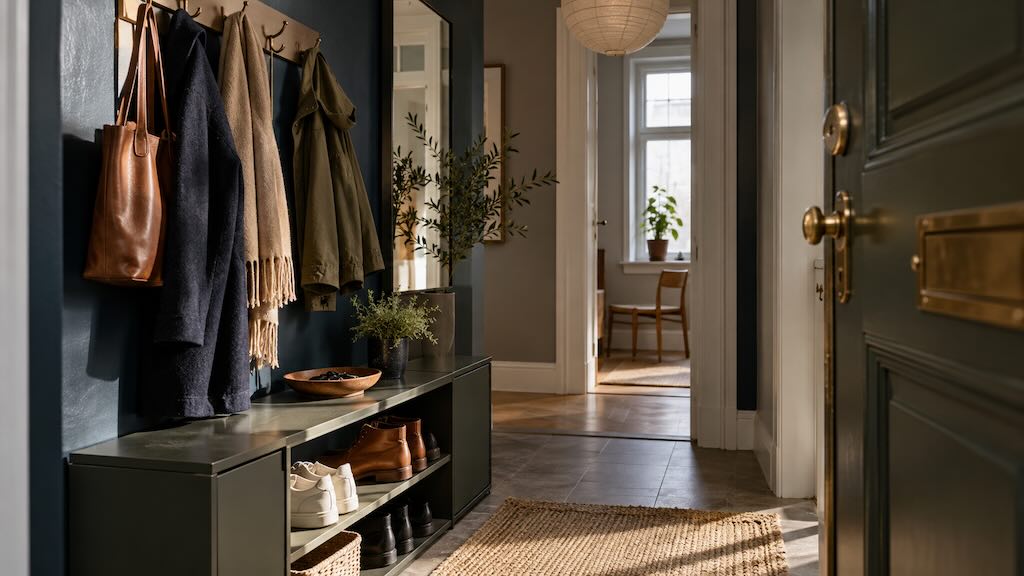
The hallway is often the smallest space in a home and the one expected to hold the most. Coats, shoes, bags, keys, umbrellas and parcels all arrive here, sometimes within minutes of one another. By late October, add heavier jackets and wet boots, and even a reasonably tidy entrance can begin to feel crowded.
The usual advice is to buy more storage. But in a narrow hallway, another cabinet or basket can make moving around more difficult. Before adding anything, it’s worth looking at what actually needs to live by the door.
A useful entryway doesn’t have to look immaculate. It needs somewhere to put your things when you come home, enough room to leave comfortably and a system that works on busy mornings as well as quiet Sundays.
Start by removing what doesn’t belong
Before measuring for furniture or browsing storage solutions, take everything out of the hallway that can reasonably be moved. You may discover three pairs of shoes you haven’t worn for months, an old shopping bag full of other bags or a coat that belongs in a wardrobe elsewhere.
Sort what remains into three groups: things you use daily, things you need occasionally and things that don’t need to stay by the entrance.
For many households, the daily essentials are surprisingly few: one or two coats per person, regularly worn shoes, keys and perhaps a bag. The rest can be stored somewhere less accessible.
Seasonal rotation makes a difference. In autumn, move lightweight summer footwear out of the way and bring forward the boots and jackets you actually wear. When the weather changes again, switch them back.
There’s no need to impose a strict number of belongings on everyone. A family with children will have different requirements from someone living alone. The point is to give frequently used items priority rather than letting the entrance become permanent storage for everything.
Use the walls without crowding the floor
When floor space is limited, walls can be useful, but only if the storage doesn’t interfere with how you move through the hallway.
A row of sturdy hooks may be more practical than a freestanding coat rack. Hooks at different heights can make it easier for children to hang up their own jackets, while a small shelf above can hold lightweight items that aren’t needed every day.
Before installing anything, check what the wall can support and use fixings suitable for its construction. Heavy coats and loaded bags can put considerable strain on hooks. Adhesive fittings should only be used within their stated limits and on suitable surfaces.
If you rent, check your tenancy agreement before drilling. A freestanding rail or a narrow piece of furniture may be a better choice where permanent fixings aren’t permitted.
Pay attention to depth as well as width. A cabinet that looks compact in a showroom can feel intrusive in a hallway where people need to pass one another. Measure the available space with doors open, not just the empty wall.
And don’t forget safety. Tall or unstable furniture may need to be anchored according to the manufacturer’s instructions, particularly in homes with children. The U.S. Consumer Product Safety Commission’s Anchor It initiative offers guidance on preventing furniture tip-over injuries.
Give shoes a realistic amount of space
Shoes are often the biggest source of hallway clutter because they’re used frequently and rarely put away immediately.
A narrow shoe cabinet can work well if there’s enough clearance to open it comfortably. Open shelving may be easier for households where shoes are constantly coming and going, although it also leaves everything visible.
Choose a solution based on how people actually behave. If everyone drops their shoes beside the door, a low rack or designated tray may be more effective than a cabinet that requires several steps to use.
Wet footwear needs particular attention during autumn and winter. A boot tray with a raised edge can help contain water and dirt, provided it’s large enough for the shoes you regularly wear. Empty collected water and allow footwear to dry before placing it in enclosed storage.
If you have room, a small bench can make putting on shoes easier. But don’t squeeze one into a hallway simply because entryway photographs often include seating. In a genuinely narrow space, an unobstructed floor may be more valuable.
Create one place for the things you always lose
Keys, gloves, headphones and transit cards are small enough to disappear but important enough to delay your morning.
Give these items a consistent home near the entrance. A shallow tray on an existing shelf, a small drawer or a wall-mounted organiser can be enough. Avoid creating several different places for the same things; that usually makes them harder to find.
Think about the sequence of arriving home. Where do you naturally put your keys? Where does your bag land? Rather than trying to change every habit, place storage where it will actually be used.
For shared households, individual hooks or clearly assigned spaces can reduce confusion. Children may benefit from a lower hook and a simple place for school bags. Adults may need somewhere to keep work essentials ready for the following morning.
The best system is usually the one that requires the least thought.
Make the entrance pleasant without adding clutter
A practical hallway doesn’t have to feel purely functional. Good lighting, a durable floor covering and a little visual order can make the space more welcoming without filling it with decorative objects.
Lighting matters particularly during darker months. If the entrance has no natural light, choose a fixture that illuminates the floor, coat storage and any steps clearly. A motion-activated light may be useful where reaching a switch is awkward, provided it is suitable for the location.
A washable, non-slip mat can help manage dirt and moisture. Make sure it doesn’t catch beneath the door or create a tripping hazard. In a very small entrance, one well-sized mat is often better than several overlapping rugs.
A mirror can be useful for checking your appearance before leaving and may make the space feel more open. Choose a position where it won’t interfere with coats, doors or passing traffic, and secure it appropriately.
Resist the temptation to fill every remaining surface. An empty section of wall or a clear shelf isn’t wasted space. It gives the hallway room to function.
Keep the system simple enough to maintain
Even a well-organised entryway will become messy occasionally. Someone comes home carrying groceries, a parcel arrives, or wet coats need somewhere to dry. The aim isn’t to prevent everyday life from happening.
Instead, make it easy to restore order. Put shoes back on the rack, return keys to their usual place and move anything that doesn’t belong in the hallway to another room.
A quick reset once or twice a week is usually more realistic than expecting everyone to maintain a perfectly arranged entrance at all times.
And before buying another organiser, give the existing arrangement a little time. You may find that removing a few unnecessary items solves more than adding another piece of furniture.
A small entryway will always have limits. But when the things you use have somewhere sensible to go, coming home becomes a little easier—and leaving on time does too.