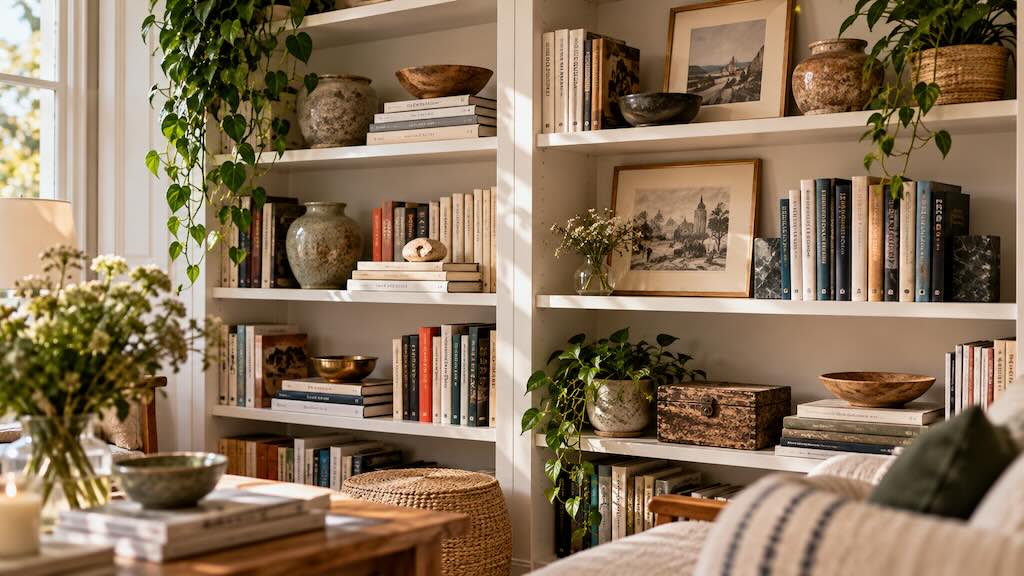
A bookshelf can look perfectly good when it’s full of books. It doesn’t need a ceramic vase, an expensive lamp or a carefully arranged collection of objects to justify its place in a room.
Still, there are times when a bookcase doesn’t look quite right. Perhaps everything is crowded onto one shelf while another feels strangely empty. Maybe the books are arranged neatly, but the whole piece looks heavy. Or perhaps you’ve accumulated enough small objects that it’s difficult to see the things you actually like.
Before buying anything new, try rearranging what you already have. A few changes to the placement of books, artwork and personal belongings can make a bookshelf feel more considered without making it less useful.
Start with the books, not the decorations
The easiest mistake to make when styling a bookshelf is treating the books as background decoration. If you regularly take books down to read, lend or refer to, they should remain easy to find.
Begin by removing objects that don’t belong on the shelves. You don’t necessarily need to empty the entire bookcase, especially if it’s large. Working one shelf at a time is often enough.
Arrange books in a way that suits you. That might mean keeping favourite authors together, separating fiction from reference books or grouping titles by subject. A beautiful arrangement quickly becomes frustrating if you can never find what you’re looking for.
Once the books are organised, look at their placement. Most can stand upright, but a short horizontal stack can be useful for oversized titles or books that won’t fit comfortably elsewhere.
Try placing a small stack at one end of a shelf and a row of upright books at the other. The difference in height changes the appearance of the shelf without requiring a single decorative purchase.
One practical caution: large, heavy books are generally better stored on lower shelves, and a bookcase should be secured against tipping where appropriate, particularly in homes with children.
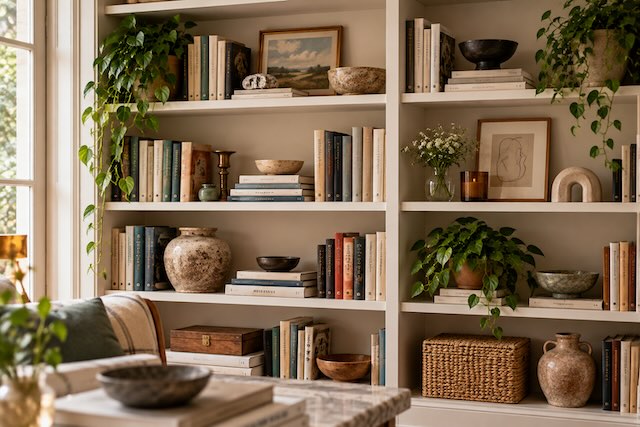
Give the shelves some variation
Stand back and look at the bookcase as a whole. Are all the tallest objects on one side? Does every shelf have exactly the same arrangement? Is one section noticeably more crowded than the others?
You don’t need perfect symmetry, but a little variation can make the arrangement more interesting.
If you have a tall vase on the left of one shelf, try placing a shorter object towards the right of the shelf below. If one section contains a horizontal stack of books, let the next shelf be mostly upright volumes.
Different materials can also help. A wooden box, a glazed bowl, a small framed photograph and the paper spines of books each bring a different texture.
Don’t worry about following a strict arrangement of three objects here or five books there. Those formulas can be useful starting points, but they aren’t rules. The goal is to create a bookcase that looks natural in your home, not a display that needs constant maintenance.
Use the things you’ve collected over time
One of the nicest things about a bookshelf is that it can hold more than books. It can also be a place for the objects that don’t have an obvious home elsewhere.
Perhaps you have a small piece of pottery bought on holiday, a photograph in an old frame, a decorative box inherited from a relative or a stone picked up during a memorable walk.
These objects tend to be more interesting than decorations purchased simply to fill a space. They also make the bookshelf personal without requiring everything to match.
Try placing one meaningful object beside a group of books. If it’s small, give it enough space to be noticed rather than surrounding it with several other things of similar size.
Collections can work particularly well together. Three pieces of pottery, for example, might share a material or colour while differing in height and shape. They don’t need to be identical.
There’s no obligation to display everything you own. Sometimes putting a few objects away makes the remaining pieces more enjoyable to look at.
Try adding a small piece of art
Artwork doesn’t always need a dedicated wall. A small framed print, photograph or drawing can look good resting against the back of a deep bookshelf.
Choose something that fits comfortably within the shelf, leaving enough clearance above it. A smaller object placed to one side can add interest, but avoid layering so many things in front that the picture becomes difficult to see.
This works particularly well on shelves that contain relatively few books. A framed photograph beside a short row of novels can make the space feel less like storage and more like part of the room.
Use a stable position and suitable supports so the frame cannot easily slip or fall. For valuable or fragile artwork, proper mounting may be preferable to leaning it on a shelf.
You can also experiment with colour. If the books and objects already contain a mixture of colours, a print that picks up one or two of those shades may help the arrangement feel connected. There’s no need to turn every book spine around or organise an entire collection by colour unless that’s something you genuinely enjoy.
Leave some room for the bookshelf to change
Interior photographs often show shelves with carefully measured spaces between objects. Real bookcases have a more complicated job. New books arrive. Others are borrowed. A favourite photograph gets replaced. Something comes home from a trip and needs somewhere to live.
That is why it’s useful not to fill every centimetre.
If you have the space, leave a small section open for future books. Avoid arranging objects so tightly that removing one item means disturbing everything around it.
And don’t feel that every shelf must contain decorative pieces. A shelf filled entirely with books can sit happily beside another displaying a photograph and a few objects.
For a bookcase that is already overflowing, styling alone won’t solve the problem. You may need to move less frequently used books to another room, add suitable storage or accept that a well-loved collection will look full. Full shelves aren’t inherently unattractive.
The final check: step back, then use it
When you’ve finished rearranging, step back far enough to see the entire bookcase. Look for areas that feel crowded, objects that disappear behind others and shelves where everything sits at the same height.
Make one or two adjustments, then stop. It’s easy to spend an afternoon moving the same vase from shelf to shelf in pursuit of an arrangement that looks perfect from every angle.
More importantly, live with the result for a few days. Take a book down. Put it back. Notice whether the things you use remain accessible and whether the arrangement still works when everyday life intervenes.
A bookshelf should be allowed to look lived in. Its best feature is not how closely it resembles a styled photograph, but how naturally it holds the books and belongings that matter to you.