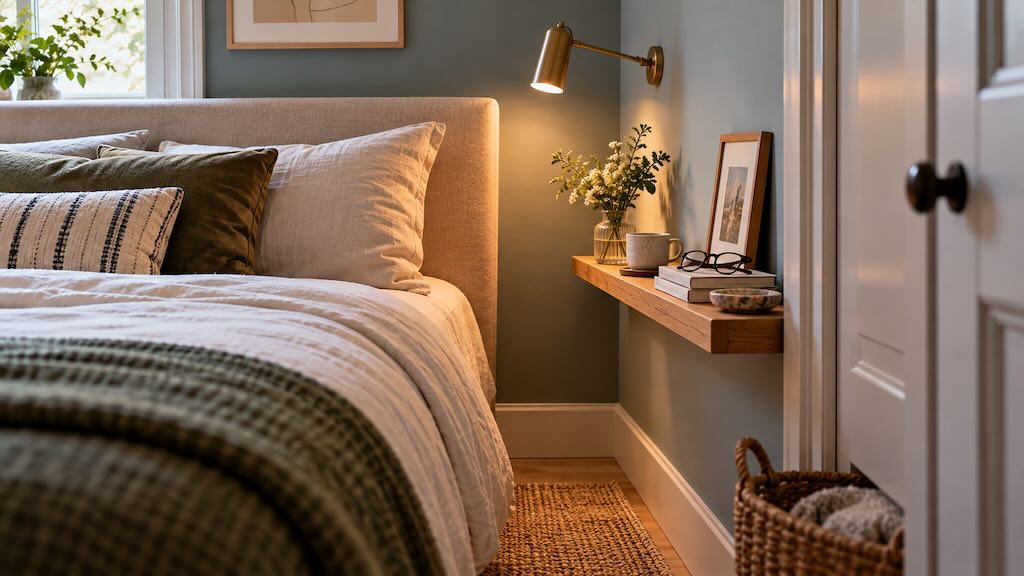
There’s a particular kind of bedroom frustration that begins when you’ve finally found the right position for your bed, only to discover there’s nowhere to put a bedside table.
The wardrobe door needs room to open. The radiator occupies the only available wall. Or the gap between the mattress and the wall is barely wide enough for your hand, let alone a piece of furniture.
Fortunately, a bedside table isn’t the only way to keep your glasses, book, water and other essentials within reach. The better solution depends on what you need to store, how much space you have and whether you’re allowed to fix anything to the wall.
1. When there’s almost no floor space: try a wall shelf
A small wall-mounted shelf is one of the most practical alternatives when a conventional bedside table would obstruct the room.
Because it doesn’t need legs, the floor underneath remains clear. That can make a difference in a narrow bedroom, particularly if the bed sits close to a wardrobe or doorway.
Before choosing a shelf, consider what you’ll actually put on it. A glass of water, glasses and an alarm clock need relatively little space. A table lamp, several books and a collection of skincare products require something more substantial.
A narrow picture ledge can work for small essentials, provided it is deep and stable enough for the intended objects. IKEA demonstrates this approach in its small-bedroom storage ideas.
Position the shelf where you can reach it comfortably from bed without stretching or twisting. Follow the manufacturer’s installation instructions, use fixings suitable for your wall and observe the stated weight limit. Avoid positioning heavy or breakable objects where they could fall onto someone sleeping.
2. When you can’t drill into the wall: use a compact stool
If you’re renting, or simply don’t want to install shelves, a small stool can provide a useful bedside surface.
Look for a flat, stable seat rather than an upholstered or curved one. A simple wooden or metal stool may be enough for a book, glasses and a glass of water.
The advantage is flexibility. You can move it to another room when it’s no longer needed, and you may already own something suitable.
But check the footprint carefully. A stool with outward-angled legs may occupy more floor space than its seat suggests. It should also be sturdy enough for its intended use and positioned where it won’t become a nighttime trip hazard.
3. When you need more storage: use furniture you already own
Sometimes the problem isn’t that you need a smaller bedside table. It’s that the room already contains too much furniture.
If there’s a chest of drawers close to the bed, could its top serve as your bedside surface? If you have a desk, might it work better positioned beside the bed rather than against another wall?
Combining functions can be more useful than squeezing another piece of furniture into the room. A dresser provides storage for clothes while leaving room on top for a lamp or the things you reach for at night.
Pay attention to height and access. A tall chest may be awkward to reach from bed, and furniture with drawers needs enough clearance to open properly. Secure furniture against tipping where required.
Before rearranging the room, measure the space with drawers and doors fully open. A layout that looks efficient on paper can be irritating to use every morning.
4. When the bed is against a wall: consider a bedside organiser
A fabric bedside organiser that hangs from a compatible bed frame or slips securely into an appropriate part of the bed setup can provide pockets for smaller items without occupying floor space.
This can be particularly useful for glasses, a paperback, headphones or a remote control.
It isn’t the right solution for everything. A soft organiser won’t safely hold an open glass of water, and bulky items may cause it to sag or slip.
Check how the organiser attaches and whether it is suitable for your bed. Don’t use an attachment that compromises the mattress, bed frame or a manufacturer’s safety instructions.
If you need only two or three small objects nearby, however, pockets may be more practical than a surface that gradually fills with clutter.
5. When there’s space behind the bed: create a narrow storage ledge
Not every bedroom has space beside the mattress, but some have enough room behind the headboard for a shallow shelf or suitable storage unit.
A narrow ledge behind the bed can provide a place for small items without requiring separate tables on either side. IKEA includes this idea in its small-bedroom storage advice.
There are trade-offs. Moving the bed away from the wall reduces the usable floor area elsewhere, and reaching behind the headboard may be uncomfortable. A ledge also needs to be securely installed or supported, with objects arranged so they cannot fall onto the bed.
This approach works best when the room has a little spare depth but very little width beside the bed.
6. When you only need a place for one or two things: choose a tiny table
A conventional nightstand often offers more storage than someone actually needs. If your bedside essentials amount to a book and a glass of water, a small drink table or compact plant stand may be sufficient.
The important measurement isn’t just the width of the tabletop. Check the base, too. Some small tables have wide or projecting feet that make them difficult to position in tight gaps.
Make sure the surface is level and the table is stable. A tall, narrow stand can be easier to knock over, especially beside a bed where you’re reaching for things in the dark.
If you already own a suitable piece, try it in the bedroom for a few nights before buying anything specifically marketed as bedside furniture.
7. When the bedroom is extremely narrow: rethink what needs to be beside the bed
Sometimes the most effective solution is not to replace the bedside table at all.
If there’s genuinely no usable space, start with a smaller question: what must be within arm’s reach?
For one person, the answer might be glasses and a book. For another, it could be medication, a phone or a glass of water. Keep essential items accessible and move things you rarely use to a dresser, shelf or another appropriate location.
A wall-mounted reading light can eliminate the need for a tabletop lamp, provided it is installed safely and suits the room. If you use a phone as an alarm, think about where it can charge safely without trailing cables across a walkway or placing it under bedding.
The aim isn’t to create a minimalist bedroom for its own sake. It’s to avoid adding furniture that makes an already small room harder to navigate.
How to choose the right alternative
Before buying or installing anything, measure the available width, depth and height beside your bed. Include the clearance needed for doors, drawers and walking around the room.
Then match the solution to the problem:
- No floor space: A properly mounted shallow wall shelf.
- No drilling allowed: A compact, stable stool or freestanding table.
- Need hidden storage: An existing dresser or suitable narrow cabinet.
- Only small essentials: A compatible bedside organiser.
- Space behind the headboard: A securely installed shallow ledge.
- Very limited room: Reduce what needs to stay beside the bed.
It’s also worth considering whether you can repurpose something you already own. A bedside solution doesn’t need to be expensive, decorative or permanent to work well.
A small bedroom has to accommodate the ordinary movements of daily life: getting dressed, opening a wardrobe, making the bed and finding your way around at night. The best bedside arrangement is the one that makes those things easier, even if it looks nothing like a traditional nightstand.