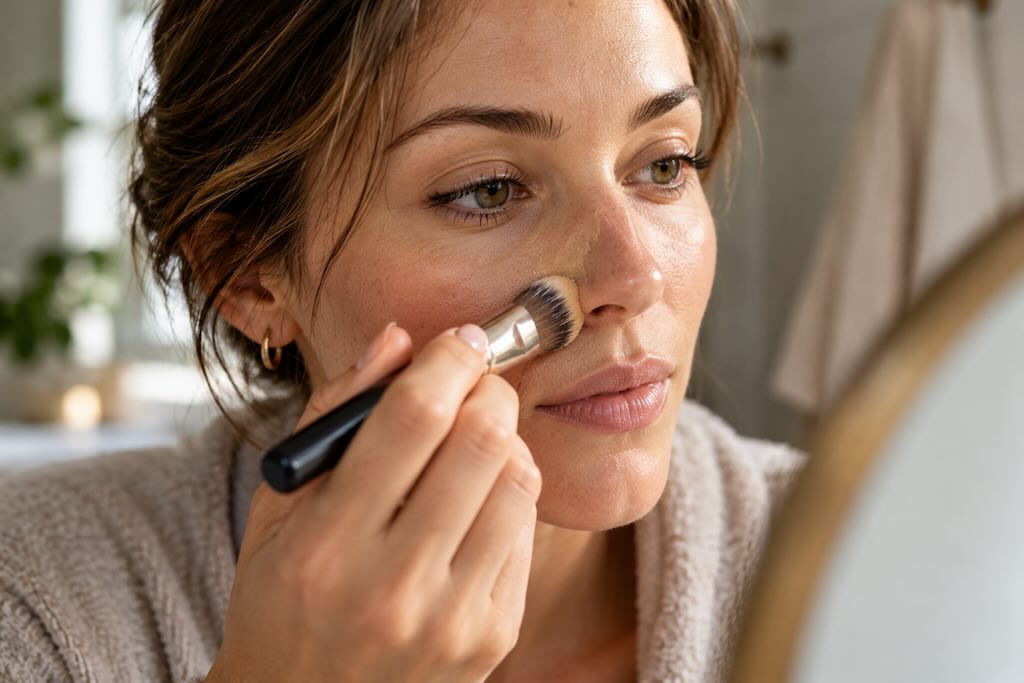
Your foundation looks fine in the bathroom mirror. The coverage is even, your skin looks smooth, and everything seems to have blended properly. Then, sometime before lunch, you notice it: foundation has disappeared from the sides of your nose, gathered around your nostrils or turned patchy across your chin.
Adding more foundation seems like the obvious solution, but it can leave those areas looking heavier without making the makeup last any longer.
The first thing to understand is that not every patchy-looking foundation problem is actually separation. Oil, dry skin, product layering and everyday friction can produce similar results. Once you identify what’s happening, you can make a smaller, more useful change instead of replacing your entire makeup routine.
First, identify what’s happening to your foundation
Take a close look at the affected area in natural light, if possible. The appearance of the makeup can offer clues about what’s going wrong.
- Foundation has broken into uneven patches: The makeup may be separating as it wears.
- Small rolls or crumbs appear during application: This is more likely to be product pilling.
- Foundation catches on visible flakes: Dryness or irritation may be affecting how the makeup sits.
- Coverage has simply disappeared: Rubbing, touching or normal wear may have removed it.
- Makeup looks thick and textured: Too many layers of foundation or powder may be contributing.
These descriptions are useful starting points rather than definitive diagnoses. Several things can happen at once, particularly on combination skin.
Why the nose and chin are often the first places to look patchy
The nose and chin can be challenging areas for foundation. Oil production, facial movement, touching and friction can all affect how makeup wears there.
The sides of the nose also have small contours where foundation can collect. Around the chin, speaking, eating and resting your face against your hand may gradually disturb coverage.
Makeup artist Billie Gene, speaking to Makeup.com, identifies excess product and the interaction between moisturiser, primer and foundation as possible contributors to separation around the nose.
That doesn’t mean everyone needs a mattifying primer or a new foundation. It means the problem may be localised enough to solve without changing the makeup that works perfectly well on the rest of your face.
1. If foundation separates after a few hours, look at oil and friction
If your foundation initially looks smooth but becomes patchy later, pay attention to whether the affected area also becomes shiny.
Natural skin oils can affect how foundation wears, particularly around the centre of the face. A formula that stays comfortable on your cheeks may not perform the same way around your nose.
Try applying slightly less foundation to the area rather than building full coverage immediately. You can also experiment with a small amount of setting powder where you tend to become shiny.
If you wear glasses, frequently touch your nose or rest your chin on your hand, consider whether friction is removing the product. Powder and primer may improve wear, but neither can make foundation completely resistant to repeated rubbing.
2. If it looks flaky, adding more foundation may make it worse
Foundation clinging to dry skin can look like separation, even when the product hasn’t actually broken apart.
This is particularly noticeable around the nostrils, where skin can become dry or irritated, and around the chin if there are rough patches.
Start with gentle skincare rather than trying to cover the texture with more makeup. A suitable moisturiser can help the skin feel more comfortable, while a lighter application of foundation may make existing flakes less noticeable.
Avoid aggressively scrubbing or exfoliating irritated skin just to improve your makeup. If you experience persistent redness, cracking, itching or scaling, seek advice from a qualified healthcare professional rather than repeatedly covering the area.
3. If your makeup forms little balls, you’re probably dealing with pilling
Pilling happens when skincare or makeup rolls into tiny particles on the surface of the skin. You may notice it while blending foundation, particularly after applying several products underneath.
Unlike foundation that breaks apart during the day, pilling can appear almost immediately.
Research published in the International Journal of Cosmetic Science investigated pilling in 528 volunteers and found that skin characteristics and application methods could influence the results. Rubbing products across the skin was associated with more pilling events in the study.
This doesn’t establish one universal cause for every product combination. But it gives a good reason to experiment with gentler application and fewer unnecessary layers.
Try applying foundation with a pressing or tapping motion instead of repeatedly rubbing the same area. If pilling continues, test your foundation with a simpler skincare routine to identify which combination may be contributing.
Don’t reduce the recommended amount of sunscreen to make makeup apply more smoothly. Instead, look for a sunscreen and foundation combination that works better together.
4. Check whether you’re applying too much underneath
Moisturiser, sunscreen, primer and foundation can all have a place in a morning routine. But adding multiple layers without allowing them to settle may make blending more difficult.
The American Academy of Dermatology recommends cleansing first, applying any appropriate treatments, then moisturiser and/or sunscreen before makeup.
If your foundation becomes streaky as soon as you apply it, try allowing your skincare to settle before beginning your makeup. Follow each product’s directions rather than assuming every formula needs the same waiting time.
Primer is also optional. If you suspect it may be contributing to separation, compare how your foundation wears with and without it on different days.
You don’t necessarily need to avoid every combination of water-based and silicone-containing products. Cosmetic formulations are more complicated than a simple ingredient label suggests, and how products behave together is often best assessed through careful testing.
5. Change how you apply foundation around the nose
The nose doesn’t always need the same amount of foundation as the cheeks or forehead.
Try applying foundation to the larger areas of your face first, then using the small amount remaining on your brush or sponge around the nose and chin.
Press the product gently into the skin, paying attention to the sides of the nostrils. If you need additional coverage, build it in small amounts rather than applying another thick layer.
For someone who experiences separation around the nose but dryness elsewhere, targeted application may work better than using the same primer and powder across the entire face.
There’s also no rule that says every part of your face needs identical coverage. Leaving a little natural skin visible around the nose may look more even throughout the day than attempting to maintain a heavy layer of foundation there.
How to fix foundation that’s already separating
When your foundation starts looking patchy halfway through the day, resist the temptation to apply more product directly over the problem.
First, check whether the area is oily. If it is, gently blot away excess shine with a clean tissue or blotting paper.
Next, use a clean sponge or fingertip to lightly press the remaining foundation into place. If the coverage is still uneven, add a very small amount of concealer or foundation only where needed.
If the makeup has become thick, flaky or visibly pilled, removing the affected product and reapplying a thin layer may give a better result than adding more on top.
Be gentle around irritated skin, and avoid sharing or using unclean makeup tools for touch-ups.
A simple way to find out what’s causing the problem
Rather than changing your foundation, moisturiser, primer and powder at the same time, try a small experiment over several days.
- On the first day, apply your usual routine but use less foundation around your nose and chin.
- On another day, keep the foundation application the same but omit an optional primer.
- If pilling is the problem, try a simpler skincare combination while keeping appropriate sunscreen protection.
- Notice when the problem appears: during application, shortly afterwards or several hours later.
Changing one variable at a time makes it easier to see what helps. You may discover that your foundation performs well with a different application technique, or that one skincare product doesn’t layer comfortably beneath it.
If the product itself has changed consistency, smells unusual or appears spoiled, don’t keep using it. Makeup that has deteriorated is a separate issue from foundation wearing unevenly on the face.
Frequently asked questions
Why does foundation separate on my nose but not my cheeks?
Different areas of your face may have different levels of oiliness, texture and exposure to friction. Try using less foundation around the nose and adjusting powder or primer only where needed.
Can moisturiser make foundation separate?
Some moisturiser and foundation combinations may not layer comfortably, especially if products are applied heavily or before previous layers have settled. That doesn’t mean you should skip moisturiser if your skin needs it.
Is foundation pilling the same as separating?
No. Pilling produces small rolls or particles of product, often during application. Separation generally describes coverage breaking into uneven patches or wearing away. The distinction matters because the solutions can differ.
Should I use more powder to stop foundation separating?
A small amount of powder may help in areas that become oily, but too much can make foundation appear dry or heavy. Start with targeted application rather than powdering your entire face.
Foundation doesn’t need to remain completely unchanged from morning until evening to look good. Some wear is normal. If one small area consistently causes trouble, identifying whether it’s oil, dryness, friction or pilling is usually more useful than buying another bottle of foundation and hoping for a different result.