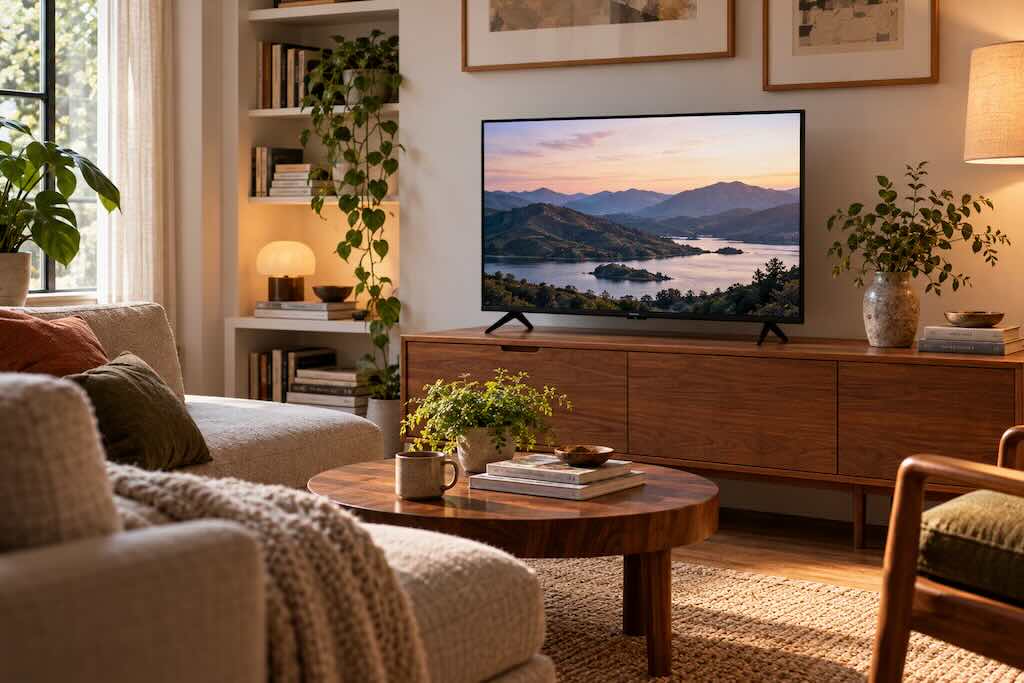
A 43-inch television can look enormous in a shop and surprisingly modest once it’s sitting across your living room. Meanwhile, a 32-inch screen might fit perfectly on a bedroom cabinet but leave you squinting at subtitles from the bed.
Choosing a TV for a small room isn’t simply about buying the smallest screen available. The right television depends on where you sit, how much daylight enters the room, what you watch and how much space you actually have.
A small bedroom television used occasionally has different requirements from the main screen in a compact apartment. And while manufacturers offer plenty of reasons to spend more, not every feature will make a noticeable difference in everyday use.
Before comparing brands or prices, start with the room itself.
Start with viewing distance, not room size
The most useful measurement isn’t the size of your living room. It’s the distance between your usual seat and the television.
Someone sitting 1.5 metres from a screen may find a 43-inch television comfortable, even in a small room. Someone watching from three metres away may find the same screen rather small.
Television sizes are measured diagonally, not horizontally. A 43-inch television therefore isn’t 43 inches wide.
For a conventional 16:9 display, these are the approximate screen dimensions:
| TV size | Screen width | Screen height |
|---|---|---|
| 32 inches | 71 cm | 40 cm |
| 40 inches | 89 cm | 50 cm |
| 43 inches | 95 cm | 54 cm |
| 48 inches | 106 cm | 60 cm |
| 50 inches | 111 cm | 62 cm |
The independent television testing site RTINGS provides a viewing-distance calculator based on how much of your field of vision the screen occupies.
For mixed everyday viewing, its guidance suggests approximately 1.3 metres for a 32-inch television, 1.8 metres for a 43-inch television and 2.1 metres for a 50-inch screen.
These aren’t strict rules. Some people prefer a more immersive picture, particularly for films. Others want a smaller television that doesn’t dominate the room.
Measure the distance from your sofa or bed to the proposed screen position, then use the figures as a starting point.
Is a 32-inch TV big enough?
For some rooms, absolutely.
A 32-inch television can be a sensible choice for a kitchen, guest bedroom or compact space where you sit relatively close to the screen.
It is less convincing when you’re watching films from a sofa several metres away. Subtitles, programme guides and small details may become difficult to read.
If the television will be your main screen, consider whether a 40- or 43-inch model would provide a more comfortable experience.
Don’t dismiss 48- and 50-inch televisions automatically, either. A larger screen can work in a small living room when the viewing distance and furniture arrangement are suitable.
One simple trick is to mark the proposed screen dimensions on your wall using removable painter’s tape. Sit where you normally watch television and see how the outline looks.
It is easier to judge the proportions of a screen in your own home than beneath the bright lights of an electronics shop.
Do you need 4K on a small TV?
Not necessarily, although 4K is increasingly standard on larger televisions.
Full HD has a resolution of 1,920 × 1,080 pixels. A 4K UHD television has 3,840 × 2,160 pixels, providing four times as many pixels.
Whether you notice that additional detail depends on screen size, viewing distance, eyesight and the quality of what you’re watching.
On a 32-inch television viewed from across the room, Full HD may be perfectly adequate. At closer distances, or on a larger screen, 4K can become more worthwhile.
For a 43-inch television, 4K is a reasonable choice, particularly if the price difference is small.
But resolution is only one part of picture quality. A television with more pixels isn’t automatically better at displaying dark scenes, handling reflections or making ordinary broadcasts look natural.
Picture quality matters more than impressive specifications
Television specifications can become confusing quickly. OLED, QLED, Mini LED, HDR and local dimming all describe different aspects of a display.
Rather than comparing every technical term, think about when and where you usually watch television.
For a bright living room
If your television faces windows or receives plenty of daylight, brightness and reflection handling deserve attention.
A screen that looks excellent in a dark showroom may struggle with reflections during a sunny afternoon.
Some LCD televisions with Mini LED backlighting offer strong brightness, while certain models include anti-reflective screen treatments.
However, the effectiveness varies. Check independent reviews of the specific model rather than assuming that a display label guarantees good daytime performance.
For films and evening viewing
If you mainly watch films at night, contrast and black levels may matter more.
OLED televisions can switch individual pixels off, allowing very dark parts of an image to appear black. Some LCD televisions also deliver strong contrast through effective local dimming.
A good OLED can be appealing for films, but it usually costs more than a basic LCD television. It may not be a worthwhile expense for someone who mainly watches the news or occasional streaming programmes.
Choose the picture characteristics that suit your viewing habits, not simply the most expensive display technology.
Do you need a 120Hz television?
Refresh rate describes how often a television can update the image on its screen.
Many televisions have 60Hz panels, while some more expensive models offer 120Hz or higher refresh rates.
For ordinary television programmes, streaming and casual viewing, a good 60Hz screen may be entirely sufficient.
If you regularly play games on a modern console or gaming PC, a 120Hz panel may be worth considering. Features such as variable refresh rate can also improve the appearance of games when their frame rate changes.
Check the native panel refresh rate. Marketing descriptions of motion enhancement don’t necessarily mean a television can display genuine 120Hz content.
And if you’re comparing HDMI 2.1 connections, verify the features supported by the exact television. Not every HDMI 2.1-labelled input provides identical gaming capabilities.
Don’t overlook sound quality
Small televisions don’t leave much space for speakers. That doesn’t mean every compact model sounds poor, but dialogue clarity can vary considerably.
If possible, listen to spoken dialogue before buying. Can you understand quieter voices without turning up the volume? Does the sound become harsh or thin?
A compact soundbar can improve clarity and provide fuller sound, but it also takes up space and adds to the cost.
For a bedroom television used occasionally, the built-in speakers may be perfectly adequate.
If you’re planning to connect external audio equipment, check for HDMI ARC or eARC support. For wireless headphones, verify Bluetooth audio compatibility rather than assuming it is included.
The smart TV system matters more than you think
A television can have a perfectly good screen and still become frustrating to use.
Slow menus, complicated remotes and missing streaming apps can affect everyday enjoyment more than a small difference in picture specifications.
Before buying, check whether the television supports the services you use, whether the interface is straightforward and what the manufacturer says about software updates.
Also consider how many HDMI inputs you need. A streaming device, game console and soundbar can quickly occupy the available connections.
Privacy settings deserve a look during setup. Smart televisions may include personalised advertising, viewing-data collection and content recommendations. Review the options rather than automatically accepting every default.
An external streaming device can sometimes extend the useful life of an older television when its built-in software becomes outdated.
Where should the TV go in a small room?
Even a carefully chosen television can be uncomfortable to watch if it’s positioned badly.
For seated viewing, a screen positioned around eye level is generally more comfortable than one mounted unusually high.
A low cabinet is often the simplest arrangement. Wall mounting can free up furniture space, but it requires appropriate fixings and a suitable wall.
Check the television’s weight, VESA mounting pattern and manufacturer instructions before buying a bracket.
Leave the recommended ventilation clearance, particularly when placing a television inside a cabinet or shelving unit.
And think about windows. Moving a television away from direct reflections can sometimes improve daytime viewing more than paying for a brighter screen.
Best small TVs to consider in 2026
If you’re comparing televisions between 32 and 43 inches, these four models represent different approaches to compact-screen viewing.
Editor’s note: Good Hours has not tested these televisions. This is a research-based shortlist informed by published manufacturer specifications, not a hands-on ranking or live price comparison. Availability, features and model numbers can vary by country. Check independent reviews, local pricing and retailer stock before purchasing.
| Television | Size | Reason to consider it |
|---|---|---|
| LG C6 OLED | 42 inches | Premium picture quality for films and gaming |
| Samsung QN90F Neo QLED | 43 inches | Bright rooms and reflection handling |
| Sony BRAVIA 3 II | 43 inches | Everyday viewing with Google TV |
| Samsung Q8F QLED | 32 inches | Limited space; regional availability needs checking |
LG C6 OLED, 42 inches: For films and gaming
The 42-inch LG C6 OLED is a premium candidate for a small living room where picture quality matters.
Its OLED display is particularly appealing for dark scenes, while its high-refresh-rate capabilities make it worth considering for gaming.
The main drawback is cost. If you mainly watch ordinary television programmes, a less expensive model may meet your needs.
Samsung QN90F Neo QLED, 43 inches: For bright rooms
Samsung’s 43-inch QN90F combines Mini LED backlighting with a screen treatment intended to reduce reflections.
It is worth comparing if your television sits in a room with large windows or considerable daylight.
However, it is a premium model. Check whether its advantages justify the price compared with less expensive alternatives.
Sony BRAVIA 3 II, 43 inches: For everyday viewing
The 43-inch Sony BRAVIA 3 II is an option for buyers who want a conventional 4K television with Google TV.
It may appeal to households looking for familiar streaming features and a straightforward entertainment setup.
Compare independent picture-quality reviews and local pricing before deciding whether it offers better value than similarly sized alternatives.
Samsung Q8F QLED, 32 inches: When space is genuinely limited
Samsung’s 32-inch Q8F QLED is a compact 4K option listed in the manufacturer’s US range.
Its smaller size may suit spaces that cannot accommodate a 42- or 43-inch television.
However, European availability and specifications need confirmation. Do not assume the US model is available locally or that its tuner, applications and warranty are appropriate for your country.
A simpler Full HD television may be a more sensible purchase if the screen is used occasionally.
Consider energy use and the total cost
Two televisions of similar size can have different electricity requirements, depending on their display technology and settings.
In the European Union, television energy labels provide standardised consumption information, including figures expressed in kilowatt-hours per 1,000 hours of use.
Compare the labels of the actual models you’re considering rather than assuming that the smallest screen is always the most efficient.
The ENERGY STAR television guide also provides useful information about energy efficiency and buying considerations.
Remember to include any additional costs. A wall bracket, soundbar, installation, streaming device or delivery charge can change the final price considerably.
A small-room TV buying checklist
Before making a final decision, check these details:
- Viewing distance: Is the screen comfortable to watch from your usual seat?
- Physical dimensions: Will the television and its stand fit the available space?
- Picture quality: Does it suit the lighting conditions in your room?
- Resolution: Will 4K make a useful difference at this size and distance?
- Sound: Can you hear dialogue clearly without additional speakers?
- Connections: Are there enough HDMI inputs for your devices?
- Smart features: Does it support the streaming services you use?
- Placement: Can it be positioned safely at a comfortable height?
- Total cost: Have you included accessories, installation and electricity use?
You don’t need to pay for every advanced feature. A comfortable screen, reliable software and sound you can hear clearly may matter more than an impressive specification sheet.
Frequently asked questions
What size TV is best for a small living room?
A 40- to 43-inch television can be a useful starting point for a compact living room, but viewing distance matters more than floor area. If you sit farther away, a 48- or 50-inch screen may be more comfortable.
Is a 32-inch TV big enough for a bedroom?
It can be, especially when the screen is relatively close to the bed. If you watch from a greater distance or regularly use subtitles, a larger television may be easier to see.
Is OLED worth buying for a small TV?
OLED may be worthwhile if you watch films regularly and value strong contrast and deep black levels. For occasional television viewing, a good LCD model may offer better value.
Do I need HDMI 2.1 on a small television?
Not for ordinary streaming and television viewing. It becomes more relevant for gaming features such as 4K at 120Hz and variable refresh rate. Check which features the exact model supports.
The right TV is the one that fits your room and your habits
A small room doesn’t automatically need a small television. Nor does a compact screen need to be expensive to provide a good everyday experience.
For occasional viewing in a bedroom or kitchen, a simple 32-inch model may be enough. For regular films and streaming from a sofa, a 43-inch or larger screen may be more comfortable.
Measure first, decide which features matter and compare televisions against those requirements.
The best purchase isn’t necessarily the television with the most impressive specifications. It’s the one that feels right in your home long after you’ve stopped thinking about buying it.