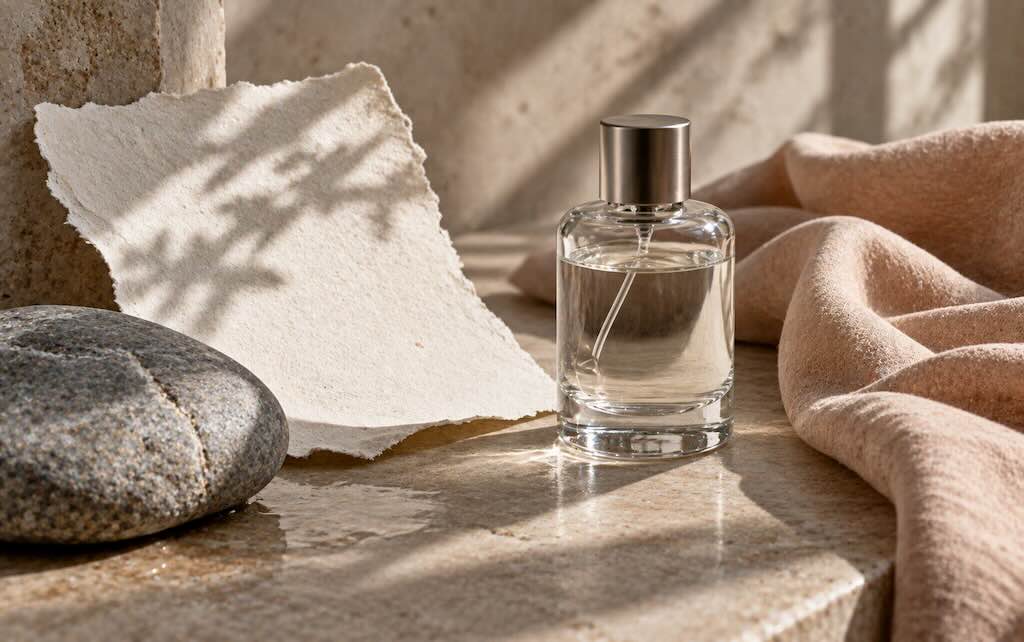
Perfume used to be relatively easy to describe badly.
It smelled of roses. Or vanilla. Citrus, perhaps. Sandalwood. Jasmine. Something recognisable could be pulled from the air and named.
Now read the description of a fragrance and you may encounter something quite different.
Skin. Paper. Wet pavement. Dust. Ink. Steam. Salt. Concrete. Cold air.
These words sound less like ingredients than fragments of a room, a body or a place. Which is precisely what makes them useful.
Modern perfume has not stopped using flowers, woods, spices and citrus. It has simply become increasingly comfortable describing what those materials can create together: not only a smell, but a texture, temperature or atmosphere.
A perfume can smell like something that was never put into it
There is no bottle of paper essence sitting on a perfumer’s shelf.
Nor does a perfume described as mineral necessarily contain anything extracted from a stone.
Perfumery has long worked through accords: combinations of materials arranged to produce an impression that may be different from any of the individual components.
The principle is familiar from colour. Blue and yellow remain themselves, but together they allow us to see green.
Scent can work similarly.
Diptyque’s L’Eau Papier is explicitly built around the idea of paper, yet its stated materials include white musks, mimosa, blonde woods and a rice steam accord. The brand describes the rice steam as helping evoke the grain of paper.
The interesting part is not whether the result provides a chemically exact reproduction of a sheet from a notebook. It is whether your mind recognises something papery in the softness, dryness and faint warmth of the composition.
The perfume gives you clues. Your memory completes the object.
Skin became a fragrance in its own right
Skin scents are perhaps the clearest example of how perfume vocabulary has changed.
The term is slightly confusing because all perfume becomes a skin scent once you put it on. In contemporary fragrance language, however, it generally describes something intimate: a composition that remains relatively close to the body and suggests warm, clean or softly musky skin rather than announcing itself across a room.
Musks are common. So are modern aroma molecules with woody, amber-like or difficult-to-place qualities.
One of the most influential examples strips the idea almost to nothing. Escentric Molecules’ Molecule 01, launched in 2006, contains a single aroma molecule: Iso E Super.
The material itself was created in a laboratory decades earlier and had long been used within fragrance compositions. Perfumer Geza Schoen’s unusual decision was to put it centre stage.
Its character is usually described as woody, smooth and velvety, but those words only get so far. On skin it can seem present, disappear from your own perception, then become noticeable again.
That ambiguity is part of the appeal.
A skin scent does not necessarily give you an obvious object to identify. It may simply make the person wearing it smell subtly different from the air around them.
Paper is really a collection of memories
Think about what paper actually smells like.
A new book is different from an old paperback. Printer paper is different from a sketchbook. A cardboard box, a library and a sheet just touched by wet ink all occupy slightly different territory.
This is why “paper” works so well as a perfume description. It is specific enough to create an image but loose enough to allow interpretation.
Commodity’s Paper fragrances take another route from Diptyque. The compositions use Iso E Super alongside woods such as cedar and sandalwood, with different versions changing the weight and warmth of the idea.
Again, paper is not the ingredient.
It is the destination.
Stone is even stranger
Smell a dry pebble and there may be very little to report.
Put water on it and the situation changes.
Mineral is one of perfume’s more suggestive words because we often recognise the idea through association rather than a literal stone smell: rain on pavement, a damp cellar wall, salt drying on skin, cool concrete, wet earth, the air near rock after weather has passed through.
Le Labo’s Baie 19, for example, is built around petrichor—the smell associated with rain arriving after a dry period. Its listed composition includes juniper berry, patchouli and green leaves rather than a substance called rain.
Calling a perfume mineral therefore tells you less about its ingredient list than about the sensation it is trying to produce.
Cool. Dry. Wet. Salty. Metallic. Smooth. Chalky.
The vocabulary begins to sound almost tactile.
We increasingly describe perfume by texture
This may be the more interesting change.
People still ask what a perfume smells like. But increasingly, the answer describes how it seems to feel.
Powdery. Creamy. Sheer. Velvety. Dry. Milky. Metallic. Airy.
None is literally a smell.
Yet most of us understand something immediately when a fragrance is described as dry rather than syrupy, or translucent rather than dense.
Perfume houses themselves now use this language. Escentric Molecules describes Iso E Super through ideas such as smooth wood grain, velvet and warmth on skin. Diptyque uses rice steam to suggest the grain of paper.
The language crosses senses because smell is difficult to hold still with words.
Texture gives us another way in.
The note list has become less useful
Traditional perfume notes are not disappearing. They remain helpful, particularly when you already know that iris tends to interest you or that a heavy dose of patchouli usually does not.
But a list can create false confidence.
Bergamot, mimosa, musk, cedar.
Four recognisable words can still tell you surprisingly little about what happens when they are arranged together.
The newer language sometimes does a better job because it describes the finished impression rather than inventorying its components.
Paper tells you something different from “white musk and woods.” Skin tells you something different from “ambroxan.” Wet pavement creates an expectation that “patchouli and green leaves” does not.
Neither vocabulary is more correct. One describes materials. The other describes an idea.
Try perfume before deciding what it smells like
The downside of evocative language is that it can become very good marketing.
A fragrance called paper may not smell remotely papery to you. Someone else’s clean skin is your laundry detergent. A description of wet stone may become sharp woods the moment it reaches your wrist.
This is not necessarily a failure of the perfume.
Smell is interpreted through experience as well as chemistry. The words around a bottle can suggest what to notice, but they cannot dictate what you will perceive.
So smell it before reading too much.
Put it on skin if you can. Leave the shop. Give the opening twenty minutes to become something else.
Then find your own word for it.