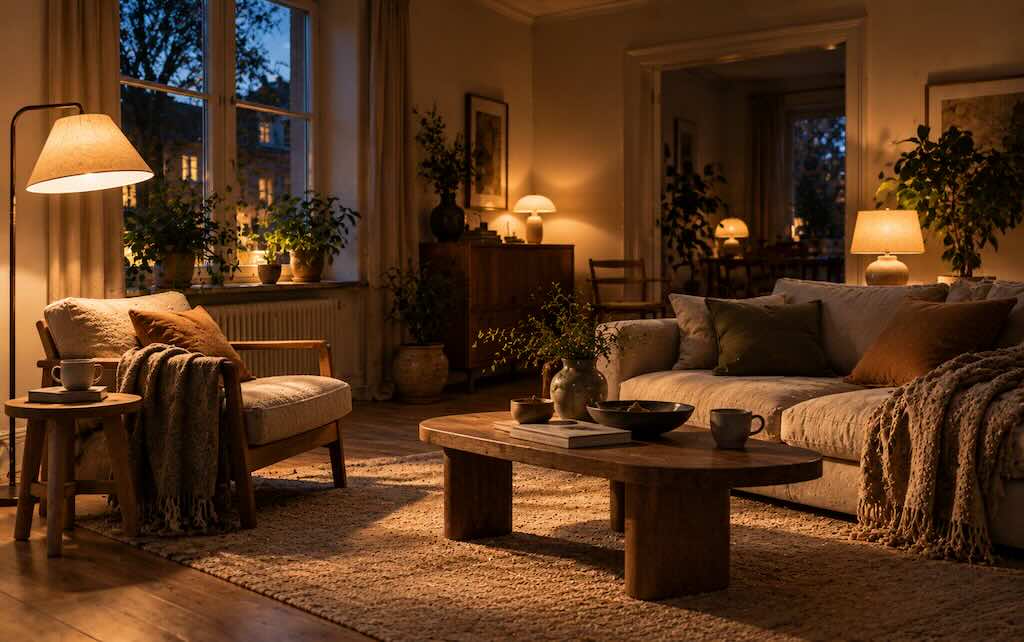
There comes a point in the evening when the ceiling light begins to feel like too much.
Nothing about the room has changed. Dinner is finished. Someone is reading. There might be a cup on the table and a television on quietly. Yet the light that was perfectly useful an hour ago now seems to flatten everything beneath it.
Turn it off and switch on two lamps instead.
The room is suddenly different.
Not merely darker. A corner becomes somewhere to sit. The wall behind the sofa recedes. Wood looks warmer. The book in your hands is illuminated while the ceiling is allowed to disappear.
This is the simple case for lamps: they let you decide where the light goes.
The big light asks one source to do everything
A central ceiling fixture has an obvious advantage. Press one switch and the room is visible.
That is useful when cleaning, finding something on the floor, packing a suitcase or trying to work out which earring has rolled under the sofa.
It is less convincing as the only way to light a room for the rest of the evening.
One bright source has to reach the sofa, the chair, the shelves and the far corner. It provides general illumination whether those places need equal amounts of light or not.
Lamps divide the problem.
A floor lamp can make a chair comfortable for reading. A table lamp can put softer light beside a sofa. A small lamp on a shelf can keep a dark corner from disappearing completely without illuminating the entire room.
Instead of asking how bright the living room should be, you can ask a more useful question: where do we need to see?
Put the light near the thing you are doing
This sounds almost too obvious, but many rooms are arranged the other way around.
The light is fixed first. Life happens wherever it happens underneath.
Try starting with the chair.
If you read there, put a lamp close enough that the page is comfortably visible. If the sofa is where people talk in the evening, give it a nearby source rather than relying on light travelling from the middle of the ceiling. If you regularly work at one end of the dining table, that activity may need more light than the rest of the room.
This is task lighting in its least technical form: light where a task happens.
It also means the rest of the room does not have to be equally bright just because one person wants to read.
A little darkness helps the room
Good evening lighting does not require every corner to be equally visible.
In fact, some of what makes lamplight pleasant is the contrast between illuminated areas and the quieter space around them.
A lamp beside a chair creates a pool of light. Another on the opposite side of the room prevents the space from feeling lopsided. What remains between them can be softer.
This is particularly useful in open-plan rooms. Light can establish small territories without a wall. The dining table has one atmosphere; the sofa has another. A chair in the corner becomes its own place once there is a lamp beside it.
The furniture has not moved.
The room has acquired several centres.
Evening light is different from daytime light
There is a biological reason not to light late evening exactly as we light the middle of the day, although it is easy to overstate it.
Light is one of the signals involved in regulating the body’s circadian system. Research on indoor lighting has found that evening exposure can affect melatonin and circadian timing, but the effect depends on several things: how much light reaches the eyes, its spectrum, how long the exposure lasts, when it occurs and how sensitive the individual is.
One study measuring people in their own homes found striking differences in sensitivity. The same home lighting environment could have a much larger biological effect on one person than another.
An international group of researchers has consequently proposed indoor-light recommendations for healthy adults that favour much brighter light during the day and substantially lower light exposure during the hours before sleep.
This does not mean a table lamp is automatically healthy and a ceiling light unhealthy. A powerful lamp pointed towards your face can produce plenty of light at the eye. A dimmed ceiling fixture may produce much less.
But lamps make lower, more selective evening illumination easier to arrange.
Warm light is useful, but brightness still matters
The bulb matters too.
For evening rooms, warmer white light often feels more natural than the cooler white associated with offices, kitchens and daytime work. Recent laboratory analysis of common household lamps also found substantially lower estimated melatonin-suppressing effects from warm-white LEDs than comparable cool-white LEDs.
Colour temperature is only part of the picture, though.
A very bright warm lamp is still bright. A lower-output source positioned thoughtfully can be more useful than buying an especially warm bulb and then flooding the entire room with it.
For an ordinary home, the practical combination is uncomplicated: enough light for what you are doing, warmer light where you prefer it in the evening, and dimmers where they genuinely make a fixture more adaptable.
You probably need fewer lamps than you think
Once the idea of layered lighting takes hold, it can quickly become another decorating formula: three lighting levels, five sources, one lamp in every corner.
There is no reason to furnish a room with lamps merely to prove that it has been properly lit.
Start with the places that are actually used after dark.
The chair where someone reads probably deserves a lamp. The sofa may need one at one end rather than both. A dark corner may benefit from a small source if its absence makes the room feel unbalanced. A lamp on a sideboard can sometimes provide enough general evening light for everything else.
Then stop.
You can always add another after living with the room for a week.
Keep the big light
The ceiling light has become an easy object of domestic ridicule, but it does not need removing.
Sometimes you want the whole room bright.
You want to vacuum. Build something. Sort laundry. Look for a missing button. Welcome people into a room where nobody has yet decided where to sit.
The mistake is not having a big light.
It is expecting one switch to produce the right light for every hour and every activity.
Later tonight, try leaving it off.
Switch on the lamp beside the place where you actually are.