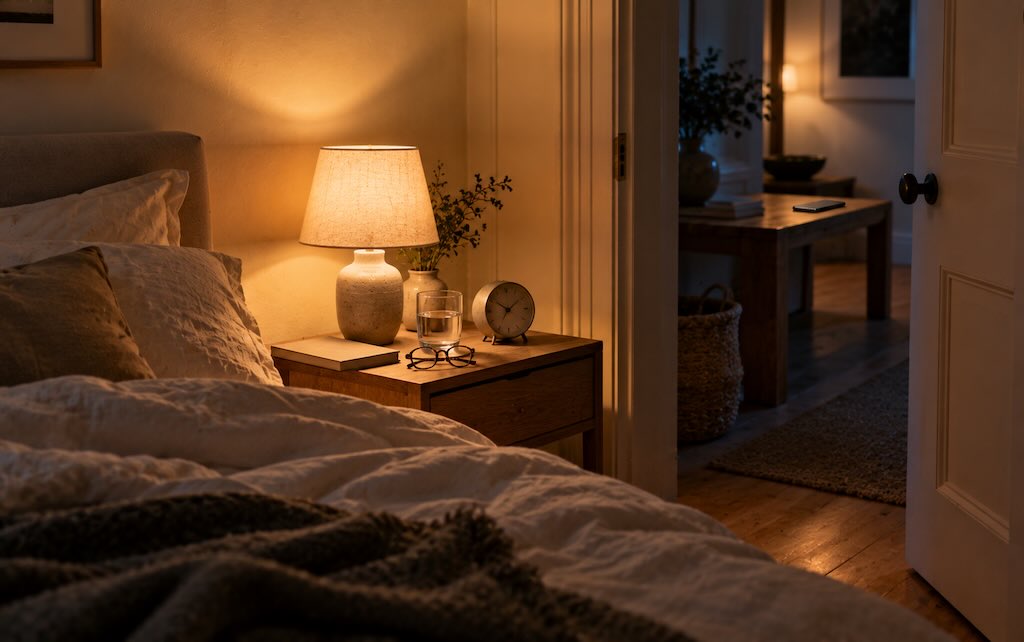
The first problem is the alarm clock.
Move the phone out of the bedroom and suddenly you need something else to wake you up. An actual clock, perhaps. The kind with one job.
Then there are the smaller absences.
You cannot check tomorrow’s weather from under the duvet. You cannot look at the message that just arrived. You cannot open something for thirty seconds and discover, considerably later, that you are still awake.
Putting a phone outside the bedroom sounds like a rule about technology. In practice, it is mostly a rule about what happens during the last few minutes of the day.
The phone can make bedtime later without changing the clock
There is a difference between going to bed and going to sleep.
A phone fits neatly into that gap.
In a large 2025 study of more than 122,000 US adults, daily screen use during the hour before bed was associated with later bedtimes, slightly shorter sleep and a higher prevalence of self-reported poor sleep quality. Daily users went to bed roughly 19 minutes later than people reporting no screen use before bed.
That study was observational, so it cannot tell us that the screen itself caused the difference. People who stay up late may simply be more likely to use screens. Stress, work patterns and other habits can also sit behind both behaviours.
Still, the timing is worth noticing.
The phone does not need to keep you awake until two in the morning to matter. It can simply make 10:45 become 11:05 often enough for those minutes to accumulate.
In bed appears to matter more than somewhere near bed
Some research suggests that the location of screen use may be more important than broad rules about avoiding every screen before bedtime.
A small Finnish study combined phone-use records from 75 adults with sleep measurements from a wearable ring. Smartphone use in bed was associated with longer sleep latency and more awake time. Phone use outside bed was not associated with poorer sleep quality in the same way.
Research in younger people has produced a similar distinction. In a 2024 study of 11- to 14-year-olds, screen use during the two hours before bed was not associated with most measures of sleep that night. Screen use once they were actually in bed was associated with delayed sleep onset and shorter sleep, particularly when the activity was interactive.
Adults and adolescents are not interchangeable populations, and neither study proves that every person should remove a phone from the bedroom.
But they point towards a more useful boundary than “screens are bad after a certain hour.”
The bed itself may be a good place to draw the line.
Light is part of the story, but not all of it
Blue light has become the standard explanation for why phones interfere with sleep.
It is a real mechanism, but an incomplete explanation.
Light reaching the eyes in the evening can affect the circadian system, and the spectrum of that light matters. So do its intensity, duration and timing.
But a phone also does something that a bedside lamp does not.
It gives you things to do.
A message asks for a response. A news story leads to another. A video starts automatically. An email reminds you of tomorrow. None requires much time individually, which is partly why it is so easy to continue.
This is sometimes called cognitive or emotional arousal: the mind remains occupied when the intended activity is sleeping.
A small randomized trial offers some support for this explanation. Thirty-eight participants were assigned either to stop using their phones 30 minutes before bedtime for four weeks or to continue as usual. Those restricting their phones reported falling asleep about 12 minutes sooner, sleeping about 18 minutes longer and experiencing less pre-sleep arousal.
The study was small and relied heavily on self-reported sleep, so those numbers should not be treated as a guaranteed result.
They do suggest that the screen’s light is not the only thing worth removing. The activity on the screen matters too.
The useful part may be the inconvenience
Leaving the phone on a dresser across the room is different from leaving it in the kitchen.
In the first case, it remains available.
In the second, checking it requires getting out of bed.
That small inconvenience changes the decision. Not because walking to another room is difficult, but because the action becomes deliberate.
You are less likely to pick up the phone without remembering that you picked it up.
This is one reason physical distance can be easier than relying on restraint. You do not have to repeatedly decide not to check something that is not within reach.
It also removes the possibility of checking the time every time you wake during the night, then noticing a notification, then becoming interested in something entirely unrelated to the fact that it is 3:17 in the morning.
The experiment is simpler than the rule
There is no good reason to turn this into a test of discipline.
If your phone stays untouched on the bedside table and you sleep well, moving it to another room may solve a problem you do not have.
If you routinely find yourself using it after you intended to sleep, the experiment is more interesting.
Find another alarm. Leave the phone charging somewhere outside the bedroom. Keep whatever you genuinely need beside the bed—a book, water, medication, glasses—where it already belongs.
Then give it several nights rather than judging the first one.
The first evening may feel unusually empty. Reaching towards a phone that is not there can reveal just how automatic the movement has become.
After that, pay attention to something more useful than whether you feel virtuous about it.
What time did you actually try to sleep?
That may be where the difference begins.