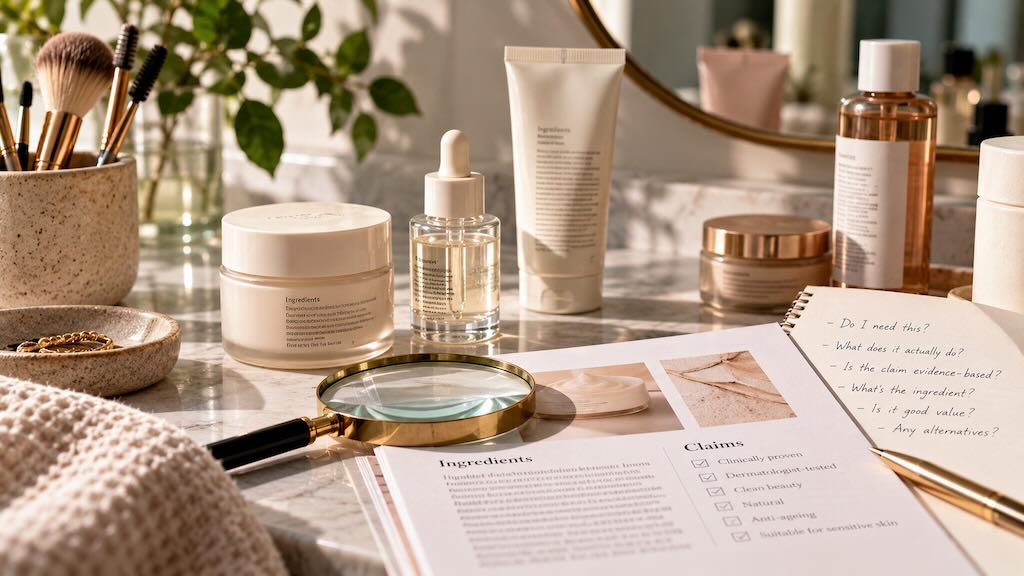
Search for a moisturiser, and within minutes you can find a dozen products described as essential, transformative or worth every penny. One promises a healthier skin barrier. Another claims to deliver visible results in days. A third appears in a list of products that everyone supposedly needs. By the time you’ve finished reading, the simple task of replacing an empty jar can feel like a research project.
Beauty product guides can be genuinely helpful. They introduce unfamiliar ingredients, compare formulas and explain which products might suit different needs. But a useful guide should help you make a decision, not leave you convinced that your current routine is inadequate.
Learning to read beauty recommendations critically doesn’t require a chemistry degree or a distrust of every brand. It starts with a few straightforward questions: Who is recommending this? What evidence supports the claims? And would the product solve a problem you actually have?
What makes a beauty product guide worth trusting?
A good beauty guide does more than arrange attractive products beneath enthusiastic descriptions. It explains the purpose of the products, identifies meaningful differences and helps readers understand which option, if any, might be appropriate for them.
Consider a guide to facial cleansers. One that simply calls five products “amazing” provides little help. A more useful comparison explains whether each cleanser removes makeup, how it feels after rinsing, whether it contains fragrance, what it costs and which skin types might find it comfortable.
It should also acknowledge limitations. A rich cleansing balm may be pleasant for removing makeup but inconvenient for someone who prefers a quick wash. A strongly fragranced product may appeal to one reader and irritate another. A formula can perform well without being right for everyone.
Look for evidence that the writer has considered the reader’s needs rather than simply repeated a manufacturer’s description. Useful details include testing methods, ingredient information, price comparisons, practical drawbacks and clear explanations of what a product is designed to do.
A guide does not have to be negative to be independent. But if every product is described as exceptional, with no meaningful differences between them, it becomes difficult to understand how the recommendations were made.
Learn to recognise the language of beauty marketing
Beauty packaging often uses words that sound scientific, reassuring or luxurious. Some refer to genuine product characteristics. Others are broad descriptions that tell you surprisingly little without further explanation.
“Clean beauty”
Clean beauty is not a single, universally defined scientific category. Different brands and retailers use their own standards, sometimes excluding particular ingredients or emphasising a certain approach to formulation.
That doesn’t make every clean-beauty product ineffective or misleading. It means the label alone is insufficient information.
Ask what the company means by clean. Does it refer to a published ingredient policy, packaging choices, manufacturing practices or something else? Are the criteria available to read?
Most importantly, don’t assume that a product is safer simply because another ingredient has been excluded. Safety depends on the substance, its concentration, how it is used and the exposure involved.
“Natural” and “plant-based”
Natural ingredients can be useful, pleasant and well suited to skincare. They can also cause irritation or allergic reactions. Essential oils, for example, are naturally derived but may be unsuitable for some sensitive skin types.
Synthetic ingredients are not automatically harsh, just as plant-derived ingredients are not automatically gentle. Both can be formulated responsibly or poorly.
Rather than using natural origin as a shortcut for quality, consider what the ingredient does, whether it suits your skin and how it behaves in the finished product.
“Dermatologist-tested”
This phrase sounds reassuring, but it raises an important question: what was actually tested?
Was the product assessed for irritation, evaluated in a consumer-use study or examined for a specific outcome? How many people participated, and what were the results?
A dermatologist’s involvement does not, by itself, establish that a product is superior to alternatives. The quality and relevance of the testing matter more than the phrase on the packaging.
“Hypoallergenic”
Hypoallergenic is another term that requires care. In the United States, the Food and Drug Administration explains that there is no federal definition governing the term on cosmetics.
Rules differ between markets, so a US regulatory explanation should not be treated as a complete account of European requirements. In any market, however, the label should not be interpreted as a guarantee that nobody will experience a reaction.
If you have known allergies, checking ingredients and seeking appropriate professional advice is more useful than relying on one reassuring word.
An ingredient list is useful, but it isn’t the whole formula
Beauty discussions often concentrate on individual ingredients: niacinamide, ceramides, vitamin C, retinoids, peptides and hyaluronic acid. These ingredients can have legitimate uses, but their presence on a label does not guarantee a particular result.
Formulation matters. Concentration, stability, packaging, compatibility with other ingredients and the way a product is used can all influence performance.
Take vitamin C as an example. A guide that identifies vitamin C as an ingredient tells you something about the product, but not necessarily which form it contains, how stable the formula is or whether the finished product has been evaluated for the claimed benefit.
Similarly, a moisturiser containing ceramides may be a reasonable choice for dry skin, but it is not automatically more suitable than every moisturiser without them. A simpler formula may work perfectly well for someone else’s needs.
Ingredient lists are particularly valuable when you’re trying to avoid a known allergen, compare fragrance content or understand the broad composition of a product. They are less useful as a way of ranking products by counting fashionable ingredients.
Be wary of guides that describe a single ingredient as though it determines the entire product’s performance. A finished cosmetic is more than its most marketable component.
How to judge claims about visible results
Promises such as “visibly smoother skin in seven days” or “clinically proven hydration” deserve a closer look. The question isn’t necessarily whether the claim is false. It’s what the evidence actually demonstrates.
A study might measure skin hydration using an instrument, collect participants’ opinions or compare photographs taken before and after treatment. These are different kinds of evidence, and they don’t support identical conclusions.
When a guide cites impressive results, look for answers to several questions:
- What was measured? Hydration, appearance, texture, wrinkles or participants’ impressions?
- How many people were involved? A small study may provide useful preliminary information without establishing that everyone will see the same result.
- How long was the product used? Immediate moisturising effects and longer-term changes are not interchangeable.
- Was there a comparison? Results are easier to interpret when the product has been compared with an appropriate control or alternative.
- Who conducted the research? Manufacturer-funded research is not automatically invalid, but funding and methods are relevant context.
Also consider the size of the claimed improvement. A percentage can sound dramatic without telling you whether the difference would be noticeable in everyday life.
Photographs deserve similar scrutiny. Lighting, camera angle, facial expression and makeup can change how skin appears. Consistent photography helps, but images alone rarely explain how a result was achieved.
Who benefits when you buy the recommended product?
Beauty journalism, retailer recommendations and influencer content can all involve commercial relationships. Understanding those relationships helps you assess the information without automatically dismissing it.
An affiliate link allows a publisher or creator to earn a commission when a reader makes a qualifying purchase. A product may have been supplied free of charge for review. A brand may pay for sponsored content or a promotional partnership.
These arrangements are not all the same, and none automatically proves that a recommendation is dishonest. What matters is whether the relationship is disclosed and whether the recommendation remains useful and independently evaluated.
The US Federal Trade Commission’s endorsement guidance explains why financial and other material relationships should be clearly disclosed when they could affect how audiences assess an endorsement. Specific disclosure requirements vary by jurisdiction.
As a reader, look for a straightforward explanation near the recommendation. Does the article tell you whether links generate commissions? Are gifted products identified? Is sponsored content clearly distinguished from independent editorial coverage?
Then look beyond the disclosure. Does the guide include affordable options? Does it explain why one product is preferable to another? Does it acknowledge when a purchase may be unnecessary?
A transparent commercial relationship is better than a hidden one. But transparency and editorial quality are separate questions. A disclosure tells you about the relationship; the article still has to earn your trust.
The problem with “best” beauty products
Search for the best moisturiser, foundation or hair serum, and you’ll find countless rankings. The difficulty is that best is rarely a meaningful category without further explanation.
The best foundation for someone who wants sheer coverage and a natural finish may be entirely unsuitable for someone who needs long wear under studio lighting. A rich moisturiser that feels comfortable on very dry skin might be unpleasant for someone who prefers lightweight textures.
Price complicates matters further. A product can be excellent and still represent poor value for a particular reader. A less expensive alternative may meet the same practical need.
Useful guides should explain the criteria behind their rankings. Best for whom? Under what conditions? Compared with which alternatives?
Headlines are necessarily short, and “best” can be convenient shorthand. The body of the article should provide the qualifications that the headline cannot.
Five questions to ask before buying something from a beauty guide
You don’t need to investigate every purchase as though you were preparing a scientific review. For everyday shopping, a brief check can prevent unnecessary spending and disappointment.
1. What problem am I trying to solve?
Be specific. “My skin feels dry after washing” is more useful than “I need better skincare.” “My hair becomes tangled after shampooing” gives you a clearer starting point than deciding you need whichever hair treatment is currently popular.
If you cannot identify a need, you may simply be responding to an appealing recommendation. That’s not inherently wrong, but it’s worth recognising before spending money.
2. Do I already own something that does this?
Check your bathroom shelf. A new serum may promise hydration, but you might already have a moisturiser that keeps your skin comfortable. A styling cream may offer benefits similar to a leave-in product you use regularly.
Different product categories sometimes overlap. More steps do not automatically produce better results.
3. Is the recommendation relevant to me?
Look for details about skin type, hair texture, sensitivities, desired finish and everyday habits. A product that performs well for the reviewer may not suit your needs.
Pay particular attention if you have reactive skin or known allergies. A positive review is not a substitute for checking whether the formula is appropriate for you.
4. What does the evidence actually support?
Separate the product’s advertised benefits from what the guide has independently observed or verified.
“Feels comfortable under makeup” may be a legitimate first-hand observation. “Repairs damaged skin in three days” is a stronger claim that needs appropriate evidence.
Both statements may appear in a review, but they should not be treated as equally substantiated.
5. Is the price reasonable for what I’m getting?
Compare the cost per millilitre or gram when products are sold in different sizes. Consider how quickly you’ll use the product and whether its packaging suits your routine.
A cheaper product isn’t automatically better value if you dislike using it. Equally, attractive packaging and a luxurious texture don’t guarantee superior performance.
Sometimes the sensible decision is to buy the product. Sometimes it’s to choose a simpler alternative. And sometimes it’s to finish what you already have.
A quick checklist for evaluating beauty recommendations
Before relying on a product guide, check whether it provides the information you need to make an informed decision.
- Does the guide explain who the product is suitable for?
- Does it describe how products were selected or evaluated?
- Are claims about results supported by relevant evidence?
- Does it identify limitations or potential drawbacks?
- Are prices, sizes and meaningful alternatives discussed?
- Are sponsorships, gifted products and affiliate relationships disclosed?
- Does it help you decide whether you need the product at all?
Not every guide will answer every question. A short review of a lipstick doesn’t need the same level of scientific detail as an article assessing products that claim to treat persistent skin concerns.
The more significant the claim, the more important the evidence becomes.
When beauty advice crosses into medical territory
Cosmetic products can improve appearance, comfort and aspects of skin condition. But some claims go beyond ordinary cosmetic care.
A product marketed as treating a skin disease, for example, raises different questions from a moisturiser that simply promises softer-feeling skin. Regulatory categories differ internationally. In the United States, the FDA explains the distinction between cosmetic claims and claims that may make a product subject to drug regulation.
Be especially cautious when a product guide suggests that cosmetics can resolve persistent acne, eczema, unexplained rashes or other conditions that may require diagnosis and treatment.
A beauty guide can help you understand product types and ingredients. It should not encourage you to ignore symptoms that need professional assessment.
Frequently asked questions
Can you trust beauty product reviews?
Beauty reviews can be useful when they explain testing methods, describe specific results, acknowledge limitations and disclose commercial relationships. Compare information from more than one credible source when making an expensive purchase or assessing significant performance claims.
Does dermatologist-tested mean a skincare product is safe?
Not necessarily. The phrase alone does not explain what was tested, how the study was conducted or whether the product is suitable for your individual skin. Look for details about the testing and remember that any cosmetic may cause irritation or an allergic reaction in some users.
Are expensive beauty products better than affordable ones?
Not automatically. Price may reflect ingredients, formulation, packaging, research, branding and other costs. Judge products by their suitability, performance, tolerability and value rather than assuming a higher price guarantees better results.
Are affiliate beauty reviews unreliable?
An affiliate relationship does not automatically make a review unreliable, but it creates a financial interest that readers should understand. Look for clear disclosures, transparent evaluation methods and meaningful discussion of drawbacks and alternatives.
Should I avoid products with ingredients I don’t recognise?
No. An unfamiliar chemical name does not mean an ingredient is harmful. Cosmetic formulas contain substances with many different functions, including preservation, texture and stability. Focus on credible safety information, known allergies and whether the finished product is appropriate for your needs.
Good beauty advice should leave you better informed, not more dissatisfied
The most useful beauty writing doesn’t need to persuade you that your skin, hair or routine is a problem waiting to be fixed. It can explain why a particular product works, who might benefit from it and when spending more money is unlikely to make much difference.
There is room for pleasure in beauty shopping. A lipstick can be worth buying because you love the colour. A moisturiser may appeal because you enjoy its texture. Not every purchase needs to be justified by a measurable improvement.
But enjoyment is different from pressure. A trustworthy guide gives you enough information to make your own choice, including the choice to buy nothing.
That may be the most useful thing a beauty product guide can offer: not another item for the bathroom shelf, but a clearer sense of what is worth your attention.