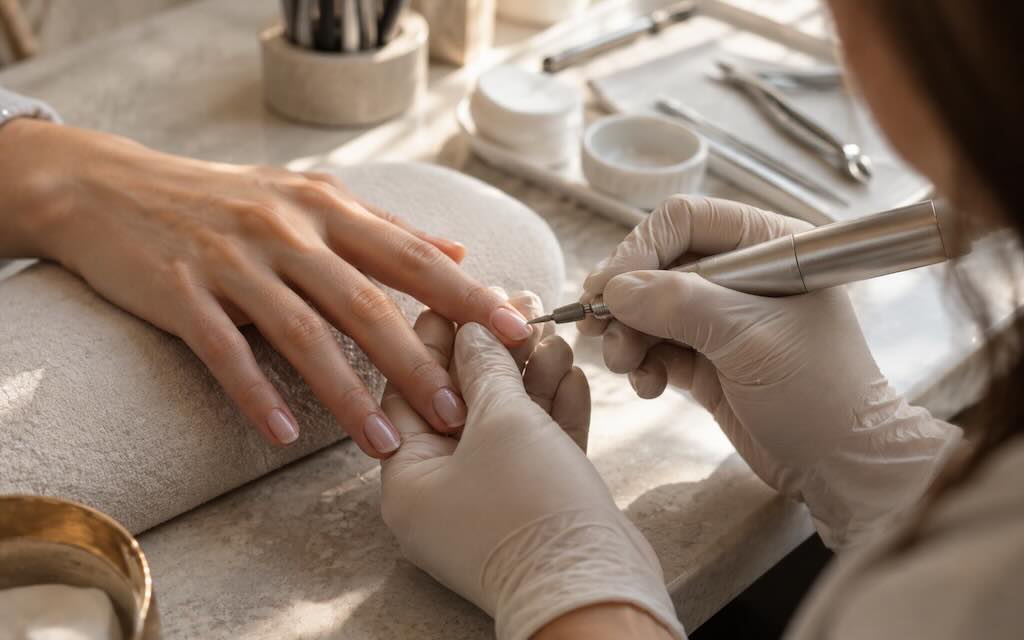
A Russian manicure is easy to recognise once you know what you are looking at. The polish appears to begin almost impossibly close to the skin. The outline around each nail is crisp. There is little of the visible cuticle or slightly uneven edge that can make even a fresh conventional manicure look less exact in a close-up photograph.
That precision is the point. It is also the part worth understanding before you book one.
Often described as a dry or waterless manicure, the technique uses specialised tools, including an electric nail file with small rotating bits, to work closely around the nail and surrounding skin. The result can create more exposed nail plate and allow colour to be applied very close to the base of the nail.
But this is not simply a particularly meticulous version of an ordinary manicure. How the skin around the nail is treated matters, and the very feature that produces the characteristic finish is also where dermatologists have concerns.
What actually happens during a Russian manicure?
There is no soaking bowl at the beginning. The manicure is performed dry, which gives the technician a clear view of the nail and surrounding skin.
An electric file is typically used with fine bits to clean and work around the nail folds and cuticle area. Depending on the technician and method, additional tools may be used to remove skin. The nail itself is shaped and prepared before polish or another nail coating is applied with considerable attention to the line at its base.
This detailed preparation is what produces the very neat, almost seamless appearance associated with the style. Because colour can be placed so close to the base of the nail, there may also be less immediately visible regrowth than with polish applied farther away from the surrounding skin.
It is worth asking exactly what a salon means by “Russian manicure,” rather than assuming every appointment bearing the name follows an identical procedure.
The cuticle is not just untidy skin
This is the part that can disappear in photographs of exceptionally tidy nails.
The cuticle has a job. It helps form a protective seal between the nail and surrounding skin, making it harder for microorganisms to enter. The American Academy of Dermatology advises against cutting or forcefully pushing back cuticles because doing so can increase the risk of infection.
The organisation has addressed Russian manicures specifically. In guidance about beauty trends, dermatologist Dr Samantha Karlin cautions that removing the cuticle breaches this protective barrier and can leave the area vulnerable to bacterial and fungal infection. One possible complication is paronychia, which causes inflammation around the nail.
That does not mean everyone who has a Russian manicure will develop a problem. It does mean that the health of the skin around the nail should not be treated as incidental to achieving a cleaner-looking line.
A precise result calls for precise questions
If you are considering the technique despite those concerns, the person performing it matters.
Before booking, ask what the appointment involves. Does the technician remove living tissue? How are electric-file bits and other reusable instruments cleaned between clients? What is sterilised, what is disinfected and which items are single-use? What training does the technician have in this particular technique?
A salon should be able to answer hygiene questions without making them feel unusual. The American Academy of Dermatology recommends checking that manicure stations are clean and asking directly how tools are cleaned. Licensing and salon requirements vary depending on where you live, so local rules are also worth checking rather than treating the phrase “Russian manicure” as a qualification in itself.
Pay attention to what your nails are telling you
A manicure should not require you to ignore pain in exchange for precision.
If work around the nail causes significant discomfort, bleeding or visible injury, that is not something to dismiss simply because the finished manicure is supposed to look exceptionally clean.
Afterwards, increasing redness, swelling, tenderness or discolouration around a nail deserves attention. The American Academy of Dermatology identifies redness and swelling around the nail as possible signs of paronychia and recommends having concerning nail changes assessed by a dermatologist.
It is also sensible to arrive with healthy skin around the nails. An existing cut, inflamed area or unexplained nail problem is a poor starting point for an intensive manicure. Cosmetic coverage should not be used to disguise something that may need medical attention.
There is another consideration if gel is part of the appointment
The preparation technique and the coating placed on top of the nail are separate parts of the appointment. A Russian manicure can be discussed for its cuticle work, while the finished look you see online may also involve gel or another long-wearing product.
If gel is cured under a lamp, that introduces its own considerations. The American Academy of Dermatology recommends applying a broad-spectrum, water-resistant SPF 30 or higher sunscreen to the hands before a gel manicure or wearing dark, opaque fingerless gloves to reduce ultraviolet exposure. It also notes that repeated gel manicures can contribute to brittleness, peeling and cracking.
Nail products can cause irritation or allergic reactions in some people too. The U.S. Food and Drug Administration’s nail-product guidance advises following product warnings and notes that infections and allergic reactions can occur with some nail products.
Decide what you actually want from the appointment
The appeal of a Russian manicure is understandable. If you like nails with an extremely exact outline and almost no visible gap between colour and surrounding skin, conventional polish application may not produce quite the same effect.
But a close finish is an aesthetic preference, not a measure of how well a nail has been cared for.
If protecting the cuticle is more important to you than achieving that particular look, ask for it to be left intact. A good appointment should leave room for that conversation. You can also choose a more conventional manicure with careful shaping, moisturised surrounding skin and polish applied without aggressive cuticle work.
The photograph you save before an appointment shows you the finish. It does not show you what happened to the skin underneath it.
That is the part worth asking about before you book.
Russian manicure: the questions worth asking first
- What does your Russian manicure procedure include?
- Do you cut or remove the cuticle or other living skin?
- How are reusable tools and electric-file bits cleaned between clients?
- Which tools are single-use?
- What training do you have specifically in dry electric-file manicures?
- Can I ask you to leave my cuticles intact?
- If gel is being used, what curing lamp will be used?