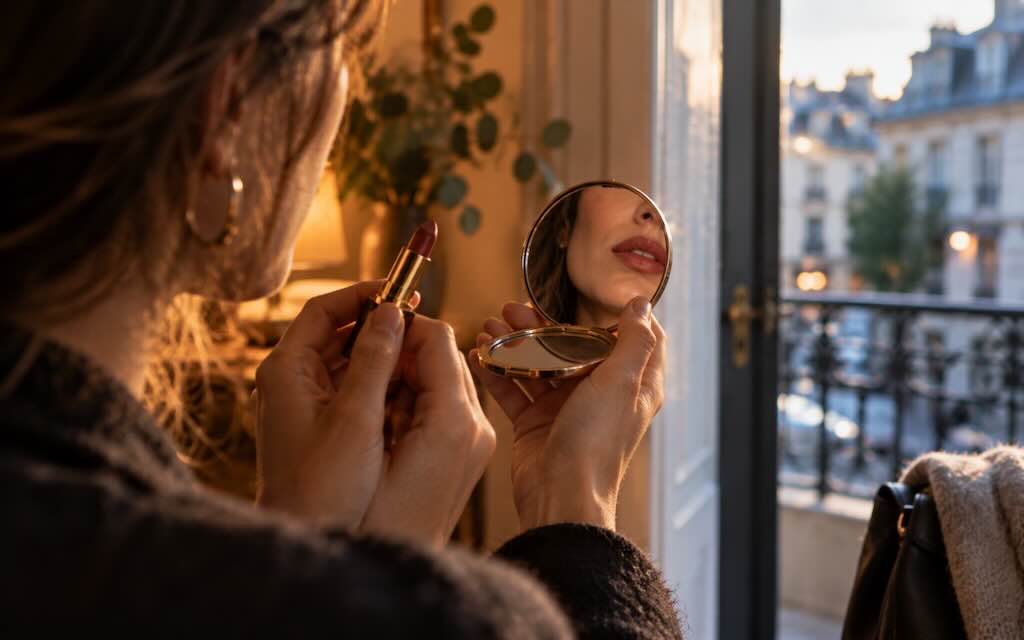
You apply a lipstick in the bathroom and it looks exactly right: muted brick, perhaps, or a soft berry that seems unusually compatible with your skin. Ten minutes later, you catch yourself in the mirror of a lift and it has become considerably pinker. Outside, it changes again. By the window at lunch, the colour you thought was restrained suddenly looks bright.
The lipstick has not necessarily changed very much. The conditions in which you are seeing it have.
Colour is never perceived entirely on its own. What reaches the eye depends on the light falling on an object, what wavelengths that object reflects and the visual context around it. A lipstick shade chosen under one set of conditions can therefore become surprisingly different once it meets daylight, office lighting, a restaurant bathroom or the front-facing camera on a phone.
It helps explain one of beauty’s more persistent small mysteries: why the lipstick that looked perfect before leaving home sometimes appears to be a different purchase altogether once you are out in the world.
Your bathroom is part of the colour
Consider where lipstick is usually applied. Often it is a relatively small room, illuminated by a particular combination of bulbs, mirrors and reflected surfaces. There might be warm light above the mirror, cool daylight entering from one side, cream tiles, a white wall or no natural light at all.
That environment is not neutral.
Different light sources have different spectral characteristics. In practical terms, the mixture of wavelengths reaching your face under a warm domestic bulb is different from the mixture under daylight or another artificial light source. The objects we look at can consequently appear different as illumination changes.
The International Commission on Illumination (CIE), the international authority responsible for standards and technical work concerning light and colour, treats the illuminant as a fundamental part of colour measurement. Colour cannot simply be separated from the conditions under which it is viewed.
This is familiar outside beauty. A paint sample that looked beige in a shop can appear grey at home. A navy jumper can seem almost black in a dim restaurant. Lipstick is subject to the same problem, except that it sits directly against another complicated colour surface: your face.
Daylight is particularly revealing
Stepping outside can feel like the decisive test because daylight is often much stronger than the illumination around a bathroom mirror. It also changes continuously with weather, season, latitude, time of day and whether you are standing in direct sun or shade.
A colour checked beside a window on an overcast morning is therefore being seen under different conditions from the same colour worn outside in late-afternoon sun.
This is one reason a shade can seem warmer, cooler, brighter or duller without anything dramatic having happened to the lipstick itself.
It is also why “check it in natural light” is useful beauty advice but not a guarantee of one definitive answer. Natural light is not a single lighting condition.
The colour in the tube is only the beginning
Lipstick itself is more complicated than a block of one colour.
Cosmetic lip products typically combine colouring agents with a base that can include waxes, oils and other ingredients. According to the U.S. Food and Drug Administration’s description of cosmetic lip formulations, waxes and oils commonly account for more than half of their weight, while colouring agents can include dyes, lakes, pigments, inorganic oxides and minerals. Different ingredients perform different visual functions: dyes can stain, pigments provide colour and coverage, and materials such as mica can create sparkle.
That helps explain why two lipsticks that look close in colour in their packaging can behave quite differently when applied.
Opacity matters. So does sheen. A glossy lipstick reflects light differently from a flat matte surface. A sheer formula allows more of the natural lip colour underneath to remain visible. A highly pigmented opaque formula covers more of it.
The finish is part of the shade you perceive.
Your lips are part of the shade too
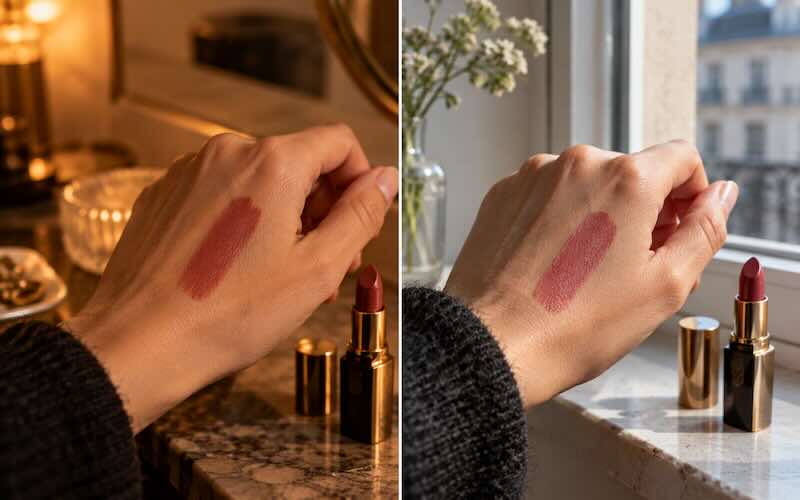
A lipstick swatched on a pale forearm is not being shown under the same conditions as lipstick applied to lips.
Lips have their own colour, texture and contours. A translucent formula combines visually with that underlying colour, while natural lines and differences in surface moisture affect how evenly a product sits.
The rest of the face changes the comparison as well. Foundation may reduce redness in the skin. Blush adds it elsewhere. A darker top can change the colours that seem prominent in the face; a bright white shirt creates a different visual frame.
Even the appearance of your teeth can seem different beside particular lip colours because colours are judged in relation to neighbouring colours.
This is why someone else’s “perfect nude” is not a reproducible colour formula. The lipstick may be identical. The visual context is not.
Then the lipstick really does begin to change
Lighting explains the first surprise outside the house, but after an hour or two there can be physical changes as well.
Lip products meet an unusually difficult environment. The lips move constantly. They touch cups, food, tissues and one another. Oils and moisture are introduced. Product can wear away more quickly from some areas than others.
A creamy lipstick that initially has a reflective surface may look flatter after some of that surface layer disappears. A sheer shade can become less even. A long-wearing formula may retain substantial pigment while losing some of the finish it had immediately after application.
The colour that remains can therefore appear different even when the original application was accurate.
It is useful here to distinguish formulation from marketing language. The FDA’s list of colour additives permitted for cosmetics shows how many different colouring materials may legally be used in products including lipstick in the United States. A finished shade can be produced from a combination of colourants rather than a single red, pink or brown pigment.
What we casually call “a red lipstick” is a formulated colour with several variables attached.
Mirrors are only one version of the problem
There is another moment when lipstick seems to change: the photograph.
A shade that appears balanced in a mirror can look brighter or less nuanced on a phone screen. At that point, the image has travelled through a camera sensor, automatic image processing, a display and whatever brightness or colour settings are active on that display.
That photograph is useful, but it is not an independent referee settling what the lipstick “really” looks like.
Neither, strictly speaking, is the bathroom mirror.
There is no single everyday viewing condition in which a cosmetic colour reveals its permanent true appearance. There are simply better and worse conditions for deciding whether you like how it behaves.
A better way to choose lipstick
If a shade matters enough to test carefully, the most useful approach is to see it in several environments rather than searching for one perfect mirror.
Apply it to the lips rather than relying entirely on a hand or arm swatch. Look at it near a window, then outdoors in open shade if possible. Check it again under the artificial lighting you regularly encounter. Give it enough time to see whether its finish changes as it settles and wears.
When comparing shades, keeping the rest of the conditions reasonably consistent helps. Changing the lipstick, blush, foundation and lighting simultaneously makes it difficult to know which difference you are actually responding to.
And if a lipstick looks beautiful in your bedroom but strange in the office lift, there may be no need to decide which version is correct.
They both are, in the light in which you saw them.
FAQ
Why does my lipstick look different in natural light?
Different light sources contain different distributions of wavelengths, which affects the light reflected from coloured surfaces and therefore their appearance. Daylight can also be much brighter than indoor lighting and varies with weather, time and location.
Why does lipstick look different on me than in a swatch?
Your natural lip colour, skin, surrounding makeup, the opacity of the formula and its finish all affect the result. A swatch on an arm does not reproduce the same visual conditions as the product on the lips.
Can lipstick change colour after you apply it?
Its appearance can change as the product wears, loses shine, moves or becomes less even. Some formulas also allow more of the underlying lip colour to show through than others.
Is natural light the best way to choose a lipstick?
It is useful, particularly alongside indoor lighting, but there is no single form of natural light. A practical test is to view the lipstick in several lighting conditions you actually spend time in.
Why does lipstick look different in photographs?
A photograph is affected by the camera, image processing, lighting and the screen on which it is viewed. It should not be expected to reproduce exactly what you see in a mirror.