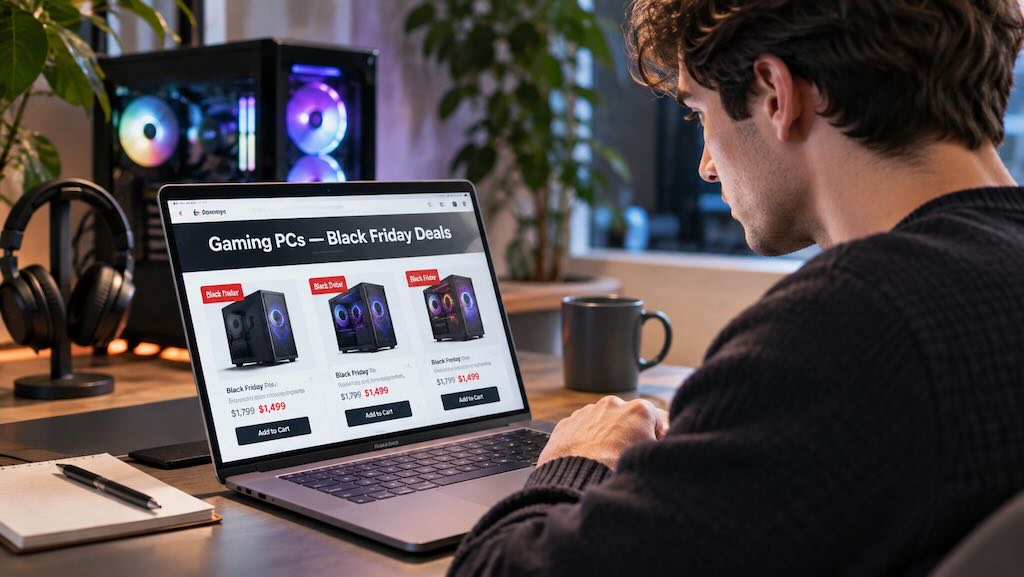
A gaming computer you have been saving for suddenly appears online at an extraordinary discount. The retailer looks familiar, the product photographs are professional, the reviews are reassuring and a countdown suggests you have only minutes to complete your purchase.
Everything appears to be in order. Except the store might not exist.
With Black Friday and Christmas shopping underway, fraudulent online retailers have an environment in which unusually low prices and pressure to buy quickly feel entirely normal. Expensive technology, from gaming computers to graphics cards and laptops, makes a particularly convincing lure.
The challenge is no longer simply recognizing a badly designed website. It is establishing whether the business behind a convincing storefront is genuine.

Why Black Friday makes fake bargains believable
During most of the year, a substantially discounted gaming computer from an unfamiliar retailer might raise suspicions. During Black Friday, the same offer can seem entirely plausible.
Ryan Merrett, director of Australian custom computer builder AFTERSHOCK PC, explained the problem in a November media statement.
“During end of year sales, people expect prices to drop. That can make them more willing to believe a deal they would question at another time.”
Ryan Merrett, Director of AFTERSHOCK PC
Australia’s National Anti-Scam Centre issued a warning in November 2026 about fraudulent online storefronts using substantial discounts and time-sensitive promotions ahead of the holiday shopping season.
Countdown timers and limited-stock notices are not necessarily evidence of fraud. Legitimate retailers use them, too. But neither should prevent you from checking whether an offer is genuine.
A professional website is not proof of legitimacy
Fraudulent retailers can reproduce established brands’ logos, photographs, product descriptions and entire storefront designs. Even convincing customer reviews and an encrypted checkout can create a false sense of security.
In a November 20, 2026, consumer alert, the US Federal Trade Commission (FTC) also warned that fraudulent retailers can appear in paid search advertisements alongside legitimate businesses.
Appearing prominently on Google does not establish that a retailer is trustworthy. Neither does the presence of HTTPS, which indicates that your connection is encrypted, not that the business itself is legitimate.
“Do not use the suspicious advertisement’s own contact details to verify the suspicious advertisement.”
Ryan Merrett
Five checks to make before buying
- Visit the retailer independently. Use a known official website address rather than following a promotional email or social media advertisement. Confirm that the advertised deal appears on the genuine website.
- Examine the domain name. Look for misspellings, unfamiliar domain endings and additional words intended to resemble an established retailer.
- Research the seller. Search its name and domain alongside terms such as “complaints” and “scam.” Read reviews across multiple independent platforms rather than trusting the store’s own testimonials.
- Compare equivalent products. Check several established retailers for the same model, condition, warranty and complete purchase price.
- Examine the returns and delivery terms. Establish who handles warranty claims, where returns must be sent and whether additional fees apply.
No individual check guarantees that a seller is genuine. The aim is to build enough independent evidence before committing your money.

Buying a gaming PC? Check what is actually inside
Even when a retailer is legitimate, vague descriptions can make a computer appear better value than it really is.
“‘High-performance gaming computer’ is a description, not a specification,” Merrett said.
Before comparing gaming computers, request a complete component list.
| Component | What to verify |
|---|---|
| Processor (CPU) | Exact model and generation. |
| Graphics card (GPU) | Exact model, manufacturer and graphics memory. |
| Memory (RAM) | Capacity, type and speed. |
| Storage | Capacity, drive type and model. |
| Power supply | Manufacturer, model and wattage. |
| Warranty | Coverage, duration and responsibility for repairs. |
Ask whether components are new or refurbished and whether the seller can substitute parts without your approval. Get important details in writing.
Less expensive components are not automatically inferior or fraudulent. The problem is paying for specifications, quality or performance that the seller cannot substantiate.
Choose a payment method that protects you
The FTC’s online shopping guidance recommends credit cards where possible. US consumers generally have stronger protections when disputing eligible credit card charges for undelivered or misrepresented purchases.
Payment services may also provide purchase protection, but eligibility, coverage and deadlines vary. Avoid retailers insisting on cryptocurrency, gift cards, wire transfers or person-to-person payments. On marketplaces, keep transactions within the platform’s approved payment system.
Buyer protection is a safety net, not a substitute for checking the seller.
Already paid a suspected scammer?
Do not wait for the promised delivery date if you have credible reasons to suspect fraud.
- Contact your bank or payment provider immediately. Request assistance disputing or recovering the payment and securing your account.
- Save receipts, screenshots, website addresses, order confirmations and correspondence.
- Change any compromised or reused passwords and enable multifactor authentication.
- Report the suspected fraud to the FTC in the United States or Scamwatch in Australia. Elsewhere, contact your national consumer protection or fraud reporting service.
Be wary of anyone subsequently offering to recover your money in exchange for an upfront fee. Recovery is not guaranteed, and people who have already experienced fraud can become targets again.
The best deal is one you can trust
A genuine Black Friday bargain can make an expensive technology purchase more affordable. But a discount only has value if the product arrives, matches its description and comes with the protections you expected.
Missing a sale is disappointing. Losing the money you had saved for it is considerably worse. Give yourself enough time to establish what you are buying, who you are buying it from and what happens if something goes wrong.