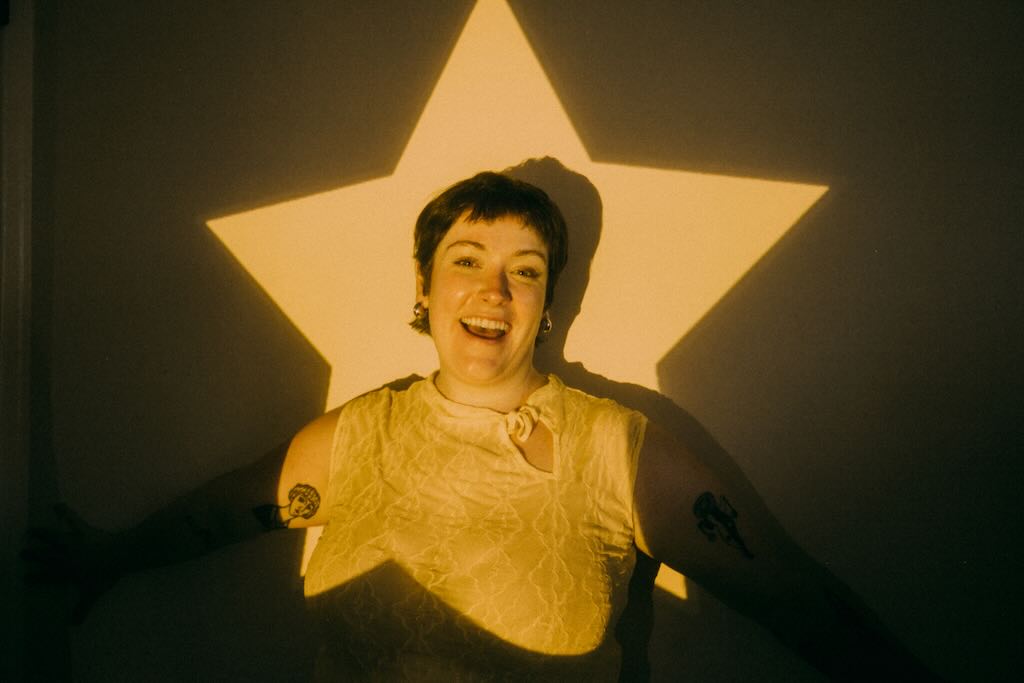
Melody Stolpp wasn’t sure she wanted to record “Two Steps Forward, One Step Back.” It was the newest song she had written, and she worried about how her family might receive it. She also wondered whether the words were too direct.
But during the final recording session for Punisher of Love, she played it for the musicians gathered at The Creamery. Some were hearing it for the first time. A hush settled over the room. Then everyone picked up their instruments, and they recorded the song in a single take around a room microphone.
The next day, Stolpp listened to the rough recording repeatedly on the train to work. She remembers thinking, “How lucky am I?”
For the New York City singer-songwriter, who makes music as Sweetbreads, that moment says something about the record as a whole. Punisher of Love grew out of private feelings about attachment, insecurity and the difficult things people do when closeness feels uncertain. Bringing those songs into a room with other musicians meant allowing them to become something she could not have made alone.
Produced by Quinn Devlin and recorded with friends at The Creamery, the album also marks a change in Stolpp’s musical life. As her earlier band began to disperse around family and work commitments, she decided to pursue a more twangy sound and take on the financial and creative responsibility of making a full album.
In conversation with Good Hours, Stolpp talks about the limits of writing from raw emotion, the friendships that shaped the recordings, the particular feeling of seeing New York from an elevated train and why a backyard screening of Young Frankenstein might be the ideal way to bring everyone together again.
Good Hours / Music
Artist File — 2026
Artist
Spotlight
Good
Hours
In Conversation
Sweetbreads
Melody Stolpp / Singer-Songwriter
“I took the train to work and listened to it on repeat the whole way over just thinking ‘How lucky am I?’”
Melody Stolpp / On Recording With Friends
Writing Beyond the First Feeling
Good Hours: You’ve described songwriting as a way of processing emotions that can feel very large and overwhelming, while also saying your songs often leave you with more questions than answers. When did you stop expecting a song to solve the feeling that created it?
Probably when I started going to therapy again in 2021! But it’s a life long practice. Haha.
Good Hours: The “Punisher of Love” turns anxious attachment into almost a character of its own. Once you gave that part of yourself a name and a personality, did it become any easier to recognise when it was speaking?
I know that’s a therapeutic technique, so in some ways it probably helped me. But the Punisher of Love still gets the best of me quite often.
Good Hours: Is there a difference between something being emotionally true enough to write in a notebook and being true enough to sing in front of other people? How do you know when a private thought is allowed to become a song?
I’m not the first to say this, but when you are writing it’s best practice to write about the thing you are most afraid of. I tend to change names in my songs so people’s identities aren’t exposed. That helps me a lot when I’m writing — I can tell myself the person I’m writing about won’t necessarily find out it’s about them. That is what usually permits me to move forward with writing something pretty personal.
I think knowing when an emotion is song-worthy is a whole other thing. I typically have to process something for a while to understand its nuances. That’s where writing about it in a song becomes interesting. Although I joke that songwriting is the one artistic medium where you can throw a pity party for yourself and get away with it, a feeling or circumstance is more interesting when I approach it from a lot of different angles and realize there’s more to the story than what I had initially thought or felt.
Honestly, if I were to write straight from my diary, I think my songs would come off kind of petty and immature. Maybe that’s too harsh, but I definitely take my time carving out a song so there is more to it than my first gut reaction.
Making Room for Other People
Good Hours: You collected these songs over several years before making the album with Quinn Devlin. What finally made you feel that this particular group of songs belonged together — and that it was time to stop collecting and actually make the record?
My band was slowly breaking down because many of my first bandmates were taking on greater responsibilities with their families and careers. I think I saw it as an opportunity to pivot and make my music lean into a more twangy sound. I had already released 2 EPs and felt like I was sitting on a couple songs that I was really proud of, so I decided to take the leap.
Planning for an album is a huge responsibility and is really expensive. I think at that point in my musical career, I knew it was time to grow and take the risk or throw in the towel. Writing “Open Mic” specifically gave me a sense of drive and confidence as a songwriter. That made me want to take up more space as an artist and put my work out there.
Good Hours: You met Quinn at a house show you were both playing, which feels wonderfully unplanned considering how important that collaboration became. What do you remember about meeting him, and what eventually made you trust him with songs this personal?
Quinn and I joked about the sort of unconventional bathroom in this loft space where the house show was taking place for a while, which made me feel comfortable and gave me the sense that we could be friends. I listened to his album on my way home from the party and his music really resonated with me. We decided to meet up and talk about music some more. In that meeting, I think we could both tell we had a lot of crossover in our musical tastes, which was something I was looking for in a producer.
At one point, I recorded backing vocals for our friend Couvo’s record. When I went over to Quinn’s studio for that, he was going on about a “Mixing with the Masters” YouTube video, which I saw as another green flag. I knew Quinn was ambitious and approached recording with a lot of curiosity and spontaneity because of that session. That helped me feel like he was the right person for the job.
Four Days at The Creamery
Good Hours: The initial recording happened over four days at The Creamery with a group of friends and musicians. Is there a small moment from those four days — something funny, mundane, accidental or especially tender — that you think you’ll still remember years from now?
We recorded “Two Steps Forward, One Step Back” in one full take around a room mic. It was the last song we recorded in the studio and the most recent song I had written. I wasn’t even sure I wanted to include it on the record because I was afraid of what my family might think of it. I was also a little worried the messaging was kind of on the nose and not poetic enough.
But when I played it for everyone in the studio — for some folks it was their first time ever hearing it — there was this very peaceful hush that came over the room. And then we all just picked up our instruments and started playing. It felt like magic. I literally will never forget it.
Quinn rarely sends me a raw bounce of a song, but since “Two Steps” was done in one take, he sent me the rough bounce the next day. I took the train to work and listened to it on repeat the whole way over just thinking “How lucky am I?” That marks a turning point for me as an artist for sure.
Good Hours: You’ve said that although the songs are deeply personal, making the record in community allowed it to become about something larger than your own struggles. Was there a moment in the studio when one of these songs stopped feeling entirely yours?
Recording “The Anvil” in the studio is a specific song on the album that comes to mind. Jordan started playing this really fresh new feel on the drums that completely shifted the vibe of the song. Suddenly it felt like it was infused with this tumbling energy, like a river flowing down a mountain.
And then when we brought it to the background singers (Molly Ganely, Hayley Rose Harrington, Sarah Trabue, and Kait Pelkey), their voices really helped build the choruses and bridge into something so much grander and expansive than I could have imagined. Kait literally wails “Sean got Marrrrried” in the track and every time I hear it, I well up with tears. Watching her sing that in the studio felt like watching a geyser erupt. It was incredible. I’m so proud of this album and it just couldn’t have been as beautiful without all the wonderful people who were involved.
Songs That Change When They’re Shared
Good Hours: There’s a lot of contemporary language around “healing,” particularly when people talk about heartbreak, anxiety and songwriting. Do you relate to the idea of making art as healing, or does that make the process sound tidier than it actually feels?
Hmmmm, good question! Yeah, maybe it does. I think playing the song out and feeling like others relate to it is another part of the process that helps me move toward healing. Sometimes a song can feel really scary to bring to an audience for the first time. Playing it more and more helps me see that we can all relate to these complicated, sometimes ugly, feelings that I try to write about. I think that helps me move past the pain more than simply writing them.
Good Hours: You make music in New York, a city where being surrounded by people and feeling completely alone can happen almost simultaneously. What places or routines in the city make you feel most connected to other people?
Seeing the skyline! Whenever I ride the subway and don’t wear headphones on an elevated train, I suddenly become so aware of how lucky I am to live here. All of us riding past the skyline together on the train makes me feel connected to other New Yorkers.
One time, my friend Sean Cahill said “Wow, can you believe it, we’re playing a gig in New York City tonight!” as we were driving on the Williamsburg Bridge on the way to a gig. It made me laugh because we’d been playing gigs as a group for a while, but also made me pause and realize we were literally living our dreams at that moment. Those are the kind of things that make me feel connected to this city and all the crazy dreamers who live here.
Good Hours: When you aren’t trying to understand yourself through a song, what reliably gets you out of your own head?
Oh gosh, usually getting feedback from a trusted collaborator. I’m extremely extroverted, so I rely on feedback a lot in order to feel like I’m heading in a strong direction with a song. I wish I was more self assured, but for better or for worse, that is how I start feeling comfortable enough to let go of control and get out of my own way.
A Backyard Movie Night
Good Hours: If you could spend an entirely ordinary day with the people who helped make Punisher of Love — with no recording, touring or music to accomplish — what would you want that day to look like?
I have been saying I want to get everyone together to watch “Young Frankenstein” sometime this month. I love feeding people I care about so the perfect day would consist of a potluck and a backyard movie watch on a crisp fall evening, I think.
After four days of recording, a one-take performance and the friendships that shaped the album, Stolpp imagines gathering those same people together again. This time, nobody needs to make anything.
Just a potluck, a film and a crisp New York evening.
Sweetbreads: Frequently Asked Questions
Who is Sweetbreads?
Sweetbreads is the musical project of Melody Stolpp, a New York City-based singer-songwriter. Her work explores relationships, attachment and the complicated emotions that can accompany closeness.
What is Punisher of Love about?
Punisher of Love explores anxious attachment, vulnerability and personal relationships. Stolpp describes the title character as a way of giving shape to a part of herself that can respond strongly to emotional uncertainty.
Who produced Sweetbreads’ Punisher of Love?
The album was produced by Quinn Devlin. Stolpp met Devlin at a house show where they were both performing, and their shared musical interests helped establish the collaboration.
Where was Punisher of Love recorded?
The album’s initial recording sessions took place over four days at The Creamery, where Stolpp worked with Devlin and a group of musician friends.
How was “Two Steps Forward, One Step Back” recorded?
According to Stolpp, the musicians recorded the song in a single take around a room microphone. It was the final song recorded during the sessions and one of the most personal songs she had brought to the studio.
How did the other musicians shape “The Anvil”?
Stolpp recalls drummer Jordan introducing a different rhythmic feel that changed the song’s energy. Background vocals from Molly Ganely, Hayley Rose Harrington, Sarah Trabue and Kait Pelkey further developed the arrangement.
Listen to Punisher of Love on all streaming platforms:
https://distrokid.com/hyperfollow/sweetbreads/punisher-of-love-3
https://www.instagram.com/sweetbreadsmusic