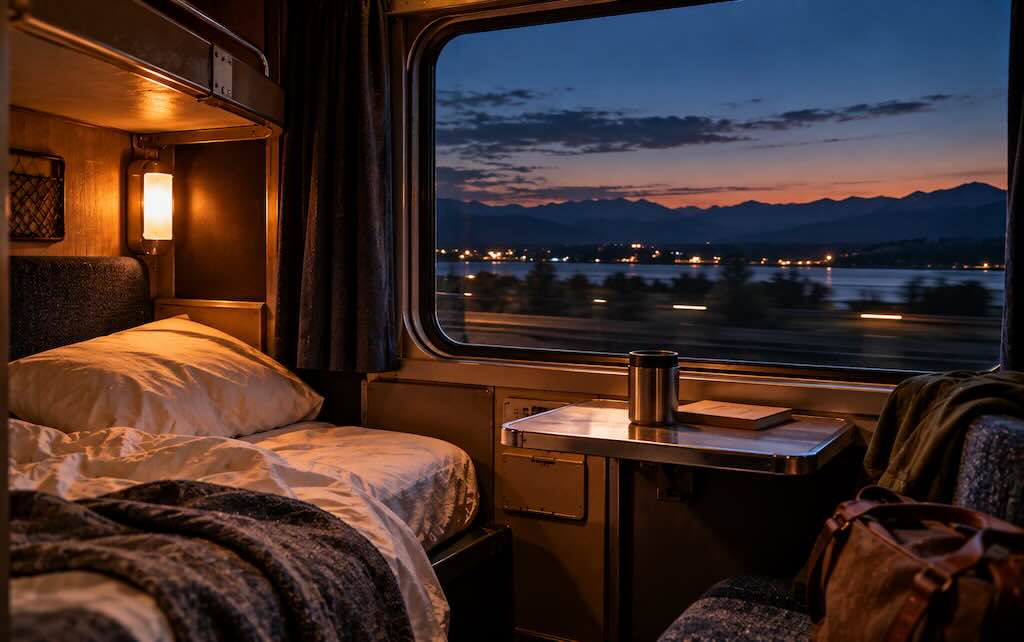
A night train gives you an unusual instruction at the beginning of a journey: go to bed.
You have found the platform, lifted your bag aboard and worked out where you will spend the night. Perhaps it is a private room. Perhaps it is a seat you are already beginning to suspect was an optimistic decision. There may be time for dinner or a drink before the lights outside thin and the train settles into the longer part of its journey.
Then there is very little left to do.
The train keeps moving without requiring much more from you.
For several hours, travelling and doing nothing become the same activity.
Distance feels like distance again
Flying is extraordinarily good at removing geography.
You enter one airport, spend some time inside a system of security lines, gates, departure boards and nearly identical shops, then emerge somewhere else. The distance has been crossed, but much of it has disappeared from experience.
Train travel leaves the connection intact.
This becomes particularly obvious in the United States, where an overnight train can cover a landscape large enough to change repeatedly outside the window. On Amtrak’s long-distance network, routes such as the California Zephyr, Southwest Chief and Coast Starlight are not simply ways of getting between cities while you sleep. The journey itself can occupy a substantial part of the trip.
The city thins into suburbs. Parking lots and warehouses give way to smaller towns, roads, rivers, farmland or open country. You eat dinner somewhere. It gets dark somewhere else.
Even after the landscape disappears into the night, its presence remains in crossings, station lights, changes of speed and brief stops in places you may never otherwise have reason to visit.
The destination is getting closer rather than simply appearing.
In America, the night can be only part of the journey
The American night train and the European sleeper do not always solve the same problem.
In Europe, an overnight service can function neatly as transport between major cities: board in the evening, sleep, arrive the following morning. Austria’s Nightjet network is built around many journeys of this kind.
Some Amtrak journeys fit that pattern too. Others are much longer. The California Zephyr between Chicago and the San Francisco Bay Area, for example, is scheduled as a journey of more than two days. The Coast Starlight between Seattle and Los Angeles involves a night aboard but also long stretches when being awake and looking outside is very much the point.
This changes the appeal.
The train is not merely a clever way to avoid losing daylight to transportation. It can become a temporary place to live: breakfast, book, window, lunch, conversation, another window, dinner, bed.
You stop asking when you will arrive quite so often.
Sleep is part of the ticket
It should be acknowledged that sleeping on a train can involve only a loose interpretation of the word.
The carriage moves. Doors open. The train brakes in the middle of the night. You wake briefly and have no idea whether you are in Ohio, Colorado or somewhere you had meant to look up before falling asleep.
There are people who sleep wonderfully on trains and people who arrive having experienced every mile.
Accommodation makes a considerable difference. On Amtrak’s long-distance trains, options vary by route and equipment, but sleeping-car accommodation can include Roomettes and Bedrooms, with meals included for sleeping-car passengers on many long-distance services. Coach is another proposition entirely: perfectly workable for some travellers, considerably less appealing to others once the journey involves an entire night.
European trains use their own categories. Depending on the operator and service, there may be seats, shared couchettes and sleeper cabins with different levels of privacy.
The names matter less than one basic question: how much do you need to sleep?
A sleeper train is a bedroom that happens to be crossing a country. It is worth deciding how much bedroom you require.
The strange hour in the middle
One of the pleasures of a night train happens when it fails at its main task.
You wake.
It is 3:17 a.m., perhaps. The carriage is quiet. Outside is a platform you have never seen before and probably never will again. A few lights remain on. Someone gets off. Someone else gets on.
Then the platform begins moving backwards.
On a long American route, the scale can be particularly strange. You went to sleep in one state and may wake in another, while your final destination is still hours away.
For a few minutes, the journey makes visible the enormous amount of ordinary life between the places large enough to appear prominently on the itinerary.
Morning does most of the work
The best argument for sleeping on a train arrives with daylight.
You wake somewhere else, but not necessarily there yet.
Pull back the curtain and the landscape has changed.
On some journeys, the change is subtle: different towns, different vegetation, a flatter horizon. On others, waking can reveal a completely different scale of landscape from the one outside when you went to bed.
People begin moving through the train again. Coffee appears. Bags are rearranged. In the dining car, breakfast can happen while the country continues passing beside the table.
If arrival is still several hours away, there is no particular urgency.
That may be the unfamiliar luxury.
Arriving by rail gives you the edges first
Eventually, open landscape starts becoming infrastructure.
There are freight yards, back fences, warehouses, apartment buildings, bridges, graffiti, parking lots and commuter platforms. The gaps between buildings disappear. Roads multiply.
These are rarely the views selected to introduce a visitor to a city.
That is part of their usefulness.
Arriving by air often means seeing the city from above and then joining a highway from the airport. Rail approaches from ground level, through the parts that connect the destination to everywhere around it.
By the time the train reaches the station, the city has already been introducing itself for half an hour.
Europe offers a different version of the same pleasure
For American travellers visiting Europe, the sleeper train can be useful in another way.
Distances between cities are often shorter, and the overnight journey can replace both a hotel night and part of a travel day. Networks operated by companies including ÖBB connect a changing selection of European cities overnight, while other national and private operators run additional sleeper services.
The experience is more compact. Compartments can be very compact too.
You might have dinner in one city, walk to its central station and wake the next morning approaching another country. Instead of driving to an airport on the edge of town, you step from the train with the city already around you.
It is worth checking current schedules directly with the operator. Sleeper routes, booking periods, accommodation types and operating days change, and an old map of Europe’s night trains can become inaccurate surprisingly quickly.
Choose the journey before romanticising the train
Night trains are easy to love in theory.
In practice, departure time matters. Arrival time matters. So does the difference between eight hours in a private room and thirty hours in coach.
Check the actual schedule. Look at the accommodation rather than assuming what the word “sleeper” means. Find out whether meals are included, whether there is a shower and how luggage works on that particular service.
And consider delays.
Amtrak’s long-distance trains share much of their route with freight traffic, and delays can occur. Building a tight onward flight or an immovable reservation around the scheduled arrival of a long-distance train removes some of the pleasure very quickly.
The journey works better when the first hours after arrival have some room in them.
Bring less into the room
There is a minor art to not unpacking your entire bag on a night train.
Keep what you need together: toothbrush, water, charger, medication, something comfortable to sleep in, earplugs and whatever you want first in the morning.
Everything else can remain where it is.
This matters in a European couchette shared with other passengers. It matters in an Amtrak Roomette where floor space becomes valuable the moment the beds are made up. It matters almost everywhere a railway company has attempted to fit sleeping humans into the dimensions of a train.
Compactness is part of the bargain.
Not every journey needs to disappear
Rail travel is often defended through comparisons: time, price, emissions, airport transfers, hotel nights.
All of those calculations can matter when choosing how to travel.
But they do not quite explain the affection people develop for sleeping on trains.
Part of it may simply be that the journey is allowed to remain visible.
Chicago does not instantly become Denver. Seattle does not become California between two airport terminals. Vienna and Paris have a night between them.
You leave somewhere. The landscape changes. Darkness arrives. You sleep badly or surprisingly well. Morning comes through the window.
Eventually the train slows.
By the time you step onto the platform, you have already spent some time arriving.