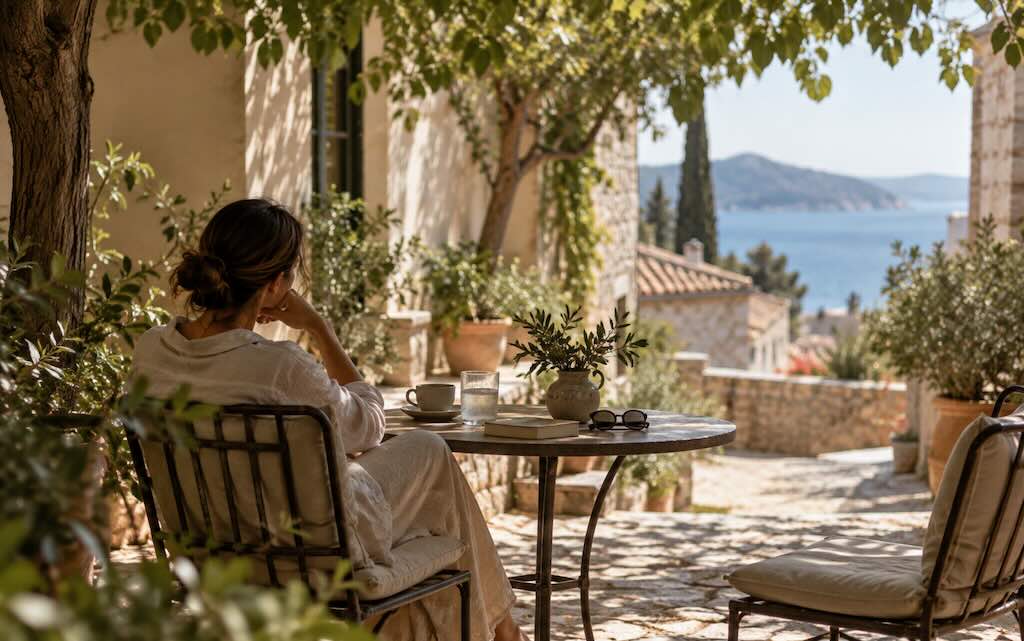
There is a particular kind of holiday morning when breakfast lasts longer than expected.
You order another coffee. Someone at the next table leaves and another person takes their place. The patch of sun moves across the floor. You could get up. There is a museum you meant to see, a market that closes at two and a neighbourhood somebody told you not to miss.
Instead, you stay where you are.
This can feel surprisingly difficult.
Travel comes with an unusual awareness of time. At home, losing an afternoon barely registers. On holiday, each hour seems to have been purchased in advance. There were flights or trains, accommodation, arrangements, perhaps months of looking forward to being here. Doing very little with that time can feel almost irresponsible.
So we fill it.
Breakfast at eight. Old town at nine. Lunch somewhere already saved on a map. Gallery after lunch. Drinks at the place from the list. Dinner reservation at eight-thirty.
It can be an excellent day. It can also leave surprisingly little room for being on holiday.
The itinerary is useful until you start working for it
Planning is part of travel. Nobody wants to arrive on the one day the museum is closed or discover too late that the restaurant they crossed town for requires a reservation.
The problem begins when the plan stops serving the trip and the trip starts serving the plan.
You notice it in small ways. Leaving somewhere pleasant because the next thing starts in twenty minutes. Eating when you are not hungry because lunch has a reservation attached to it. Crossing a city to see something you dutifully saved months ago, despite no longer being particularly interested in seeing it.
A full itinerary can also make ordinary moments feel like delays. The slow waiter. The wrong turn. The friend who wants to browse one more shop. The sudden rain that makes sitting under an awning with a drink more sensible than continuing across town.
These are often the parts of travel that become memorable precisely because nothing was supposed to happen in them.
Leave part of the day unclaimed
Doing almost nothing does not require spending a week beside a swimming pool.
It can mean protecting one part of the day from plans.
Go somewhere in the morning, then leave the afternoon alone. Make a dinner reservation but refuse to decide what happens before it. Pick one thing you genuinely want to see rather than six things you feel you should see.
This changes the texture of a trip. There is suddenly time to walk back instead of taking a taxi. To stop because a café looks good rather than because somebody recommended it. To return to the same beach tomorrow because you liked it today, even though another one is apparently better.
You begin making decisions according to the day you are actually having.
Recovery seems to depend on more than simply being away
There is research behind the feeling that a holiday can work differently when you genuinely disengage from ordinary demands.
A 2025 meta-analysis published in the Journal of Applied Psychology brought together 32 studies on vacations and employee wellbeing. It found a larger positive effect from holidays than earlier research had suggested, with the benefits also fading less quickly than previously thought.
When the researchers looked at experiences during holidays, psychological detachment from work emerged as particularly important. Physical activity was also associated with improved wellbeing.
Earlier vacation research has found something useful for the less ambitious traveller, too. In studies of summer holidays, passive activities such as relaxing and doing nothing have sometimes been positively associated with improvements in health and wellbeing. Researchers have suggested that part of the benefit may come from autonomy: being able to decide for yourself how to spend your time.
That does not make lying under a tree medically superior to visiting an archaeological site. Nor does it mean an active holiday is somehow less restorative.
It suggests something simpler. A holiday may work partly because, for a while, you have more say over what happens next.
Stay after you have finished
One way to practise doing almost nothing is to stop treating the end of an activity as a signal to leave.
Stay at the beach after the swim. Sit outside the museum after you have seen the exhibition. Finish lunch and remain at the table. When you reach the viewpoint, resist immediately opening the map to find the next place.
Travel creates many natural pauses. Efficiency tends to remove them.
Keeping a few changes what you notice. The restaurant staff eating together after service. Swallows above the roofs at dusk. Someone watering plants on a balcony. The sound a square makes after the shops close. How quickly a beach empties when a cloud passes over the sun.
None of these needed to be found.
You do not have to deserve the afternoon
Perhaps the hardest version of doing nothing on holiday is staying in.
You are in Lisbon, Rome, Copenhagen, Kyoto. Outside is an entire city you could be experiencing. Inside is a hotel bed at three in the afternoon.
Have the nap.
Not because rest is productive. Not because sleeping now will make you a more efficient tourist at dinner. You may simply be tired.
The same applies to reading on the balcony, spending two hours by the pool or going back to the room because it is hot. These choices can feel wasteful only because travel encourages us to measure a day by how much of the destination we consumed.
A place does not disappear because you spent an afternoon doing very little in it.
In some ways, that afternoon may be when you finally notice where you are.
Come home having missed something
There will always be another restaurant, another street, another beach, another room in the museum.
This is easier to accept once you stop treating completeness as a reasonable goal for travel.
You can leave without seeing the famous church. You can discover afterwards that the bakery around the corner was supposedly the one to visit. You can spend your last morning returning to the same café instead of making a final sweep through the city.
Missing something is not evidence that the holiday was poorly used.
Sometimes the clearest sign that you had enough time is that you stopped trying to use all of it.