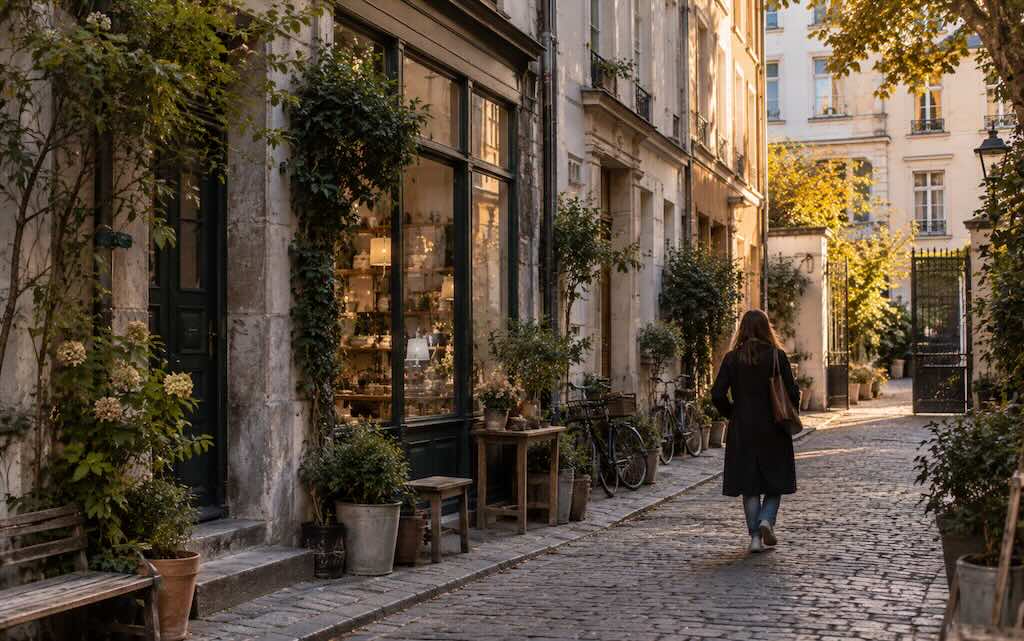
There is a small repair shop between the station and the centre of town.
You might pass it for years in a car without knowing what it repairs. From the pavement, you notice the old machines in the window. A handwritten card propped against one of them. A man working at a bench in the back.
Farther along there is a courtyard behind an open gate, then a bakery you can smell before you can see, then a narrow street that appears to lead nowhere useful.
None of these places would necessarily survive the question we increasingly ask a city: what is there to do here?
But walking has never been very good at respecting that question.
It keeps showing you things that were not part of the plan.
At walking speed, the city gets smaller
From a train window, a neighbourhood arrives as blocks. From a car, it becomes junctions, traffic lights and places to park. On foot, the unit of attention changes again.
A building is no longer only a façade. There is the recessed doorway where someone has put two chairs. The basement window with plants leaning toward the light. The worn patch of stone where generations of people have stepped over the same threshold.
Walking gives ordinary details enough time to become visible.
This is partly a matter of speed, but also proximity. Research into pedestrian experience and urban design has long considered what happens at the scale of the person moving through a street. The Danish architect and urbanist Jan Gehl has made the human scale central to his work on public space: what people can see, hear and experience when moving through cities at relatively slow speeds.
You do not need to know the theory to feel the difference. Walk a street you normally cross by bus and it often seems unexpectedly long, then unexpectedly full.
Useful places rarely announce themselves very loudly
The places that become familiar through walking are not always the places you would travel across a city to visit.
The tiny hardware shop. A laundrette. The florist that puts one bucket outside. A café with four tables and no particular reason to photograph your coffee. The bench that catches the last sun. A doorway where people wait when it rains.
They matter partly because they are there when you need them.
Walking teaches you this layer of a place almost accidentally. You begin to know where to buy batteries, which shortcut stays bright after dark, where there is a public toilet, which corner is sheltered from the wind and which café still has an empty table at four.
These are poor attractions and excellent pieces of local knowledge.
A wrong turn has different consequences on foot
Navigation has made getting around unfamiliar places remarkably easy. That is useful. It has also made it possible to move through a city as a sequence of instructions.
Turn left in 200 metres. Cross the road. Continue straight. Arrive.
Walking somewhere you roughly understand is different. You can choose the street with trees because it looks quieter. Cut through a square. Follow a road for another block simply because you want to know where it goes.
The cost of a small mistake is often a few extra minutes.
Those minutes are where an unfamiliar neighbourhood can begin to acquire shape. You find that two streets you thought were far apart nearly touch. The river is closer than you imagined. A church tower you have been seeing all afternoon finally reveals which street it belongs to.
The map becomes something you have moved through rather than something you looked at.
You begin to notice what changes
Walking the same route repeatedly produces another kind of attention.
One morning the chairs appear outside the café again. A tree that seemed bare a week ago has become green without you noticing the exact day it happened. The fruit shop replaces peaches with apples. Someone moves out of the ground-floor flat. A construction fence comes down and you struggle to remember what the corner looked like before it went up.
The changes are small enough that nobody would tell you about them.
Yet they are part of how a place becomes familiar. You stop seeing the street as permanent scenery and start noticing that it is continually being adjusted by weather, commerce, maintenance and the people living there.
A route repeated on foot becomes a very slow form of before-and-after photography.
Walking gives strangers a little more definition
There are people you know only because your schedules overlap.
The person opening the newspaper kiosk when you pass in the morning. Someone who walks the same old dog. The delivery driver unloading crates outside the restaurant. A parent waiting at the same crossing with a child in a bright coat.
You may never speak.
Still, repeated encounters give a place a population rather than simply a crowd.
Research on neighbourhood life sometimes describes these weak, repeated encounters as part of the social texture of public space. They are not friendships, and it would be too much to turn every nod at a bus stop into a theory of community. But familiarity can accumulate without introduction.
A city feels slightly different once some of its strangers are familiar.
The places worth noticing are not always worth recommending
Travel encourages us to collect places that can be passed on.
A restaurant worth booking. A museum worth the queue. A viewpoint worth the climb. These recommendations are useful because time in an unfamiliar city is limited.
Walking produces a different collection.
The courtyard with the good light at nine in the morning. A flight of steps where somebody always seems to be sitting. The narrow lane behind the market. A corner where you suddenly smell the sea. The apartment building with enormous windows and terrible curtains.
Try recommending one of these to somebody and it can sound ridiculous.
Perhaps that is part of their value. They do not need to become destinations. They can remain things encountered because you happened to be moving slowly enough to see them.
Walk the last part
You do not have to cross an entire city on foot to experience it this way.
Get off one stop early. Walk back from dinner. Leave the hotel without deciding on the most efficient route. When the map says twelve minutes, occasionally treat that as good news rather than a problem to solve.
The reward will probably not be a hidden masterpiece that somehow escaped every guidebook.
It may just be a repair shop, a courtyard and a bakery you did not know were there.
That is enough.
FAQ
Why does walking make us notice more of a city?
Walking combines slower movement with close physical proximity to buildings, shops, people and public space. That gives smaller details more time to register than they often receive when travelling at higher speeds.
Is walking a good way to explore an unfamiliar city?
Where conditions are safe and practical, walking can help reveal how streets and neighbourhoods connect while exposing everyday places that may not appear in travel guides. Public transport can still be useful for covering longer distances before exploring a smaller area on foot.
How can you explore a city without constantly following a map?
It can help to use navigation for the broad direction rather than every turn: know where you are heading, then choose some of the streets between. In unfamiliar places, sensible attention to safety, distance and local conditions still matters.
What should you notice when walking through a city?
There is no checklist. Shopfronts, entrances, courtyards, trees, building materials, sounds, smells and the way people use public space can reveal as much about the everyday character of a neighbourhood as its recognised attractions.