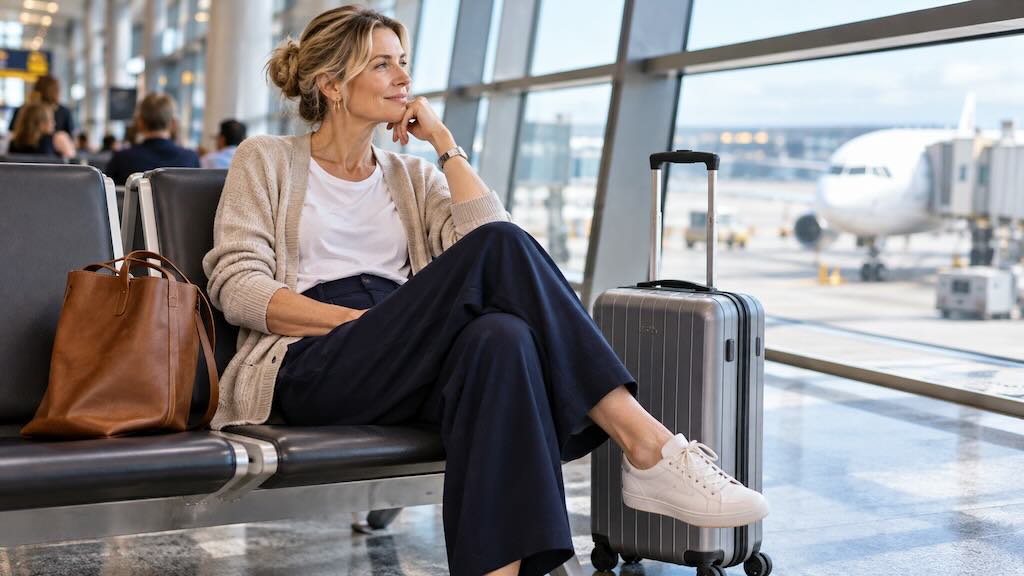
There comes a point on a long flight when the clothes you chose that morning begin to feel very different. The waistband that seemed perfectly comfortable at home starts digging in. Your sweater is too warm while you’re waiting to board, but somewhere over the Atlantic, you’re reaching for the airline blanket. And those shoes that looked so good with your outfit? You can’t wait to take them off.
Dressing for a long flight involves a particular kind of compromise. You want to feel comfortable sitting for eight or ten hours, but you also have an airport to navigate, possibly a connection to make, and a destination where you may not be able to change immediately.
The solution isn’t necessarily leggings, an oversized hoodie, or a special collection of travel clothes. A few thoughtful choices about fabric, fit, and layering can make the journey considerably more pleasant while still allowing you to look like yourself.
Start with pants you can sit in for hours
The most important part of a long-flight outfit is often the least glamorous: the waistband.
A pair of jeans may feel comfortable when you’re standing in front of a mirror, but sitting in the same position for several hours is a different test. Stiff denim, tight waistbands, and heavy seams can become irritating, particularly when you’re trying to sleep.
Look for pants with a little room through the hips and thighs, a flexible waistband, and fabric that moves with you. Relaxed tailored trousers, soft knit pants, or well-fitting joggers can all work. You don’t have to abandon personal style to be comfortable.
Wide-leg trousers in a soft, substantial fabric can look polished with a simple T-shirt and cardigan. Straight-leg knit pants offer a more relaxed alternative. Leggings may be comfortable for some travelers, although others prefer a looser fit during long periods of sitting.
The CDC recommends loose-fitting clothing during extended travel, alongside regular movement and leg exercises. Clothing alone cannot prevent travel-related blood clots, but avoiding unnecessarily restrictive garments is sensible.
Try this before packing: Sit in your intended travel pants for 20 minutes. Cross and uncross your legs, bend forward, and stand up again. If you’re already adjusting the waistband, choose something else.
Choose fabrics that feel good after several hours
Fabric matters more on a long flight than it does during a quick trip to the grocery store.
Soft cotton jersey is a familiar choice for T-shirts and relaxed separates. Merino wool can be useful for lightweight layers because it offers warmth without requiring a particularly bulky garment. Some synthetic performance fabrics are designed to manage moisture and dry quickly, although the feel varies considerably between products.
There’s no single fabric that suits everyone. Linen may feel lovely in warm weather but crease noticeably after hours in a seat. Thick fleece can be cozy in a cold cabin but uncomfortable during a warm connection. A silky blouse might look elegant, yet become irritating if it doesn’t breathe well or requires constant adjustment.
Rather than shopping according to a fabric label alone, think about how the garment behaves. Does it stretch when you move? Does it feel pleasant against your skin? Will you be comfortable wearing it for the entire journey?
Clothes you’ve already worn and washed several times can be a safer choice than something new. A long-haul flight is not the ideal occasion to discover that a beautiful sweater has an itchy neckline.
Layering is more useful than dressing for one temperature
Air travel rarely involves one consistent temperature. You might leave a warm house, spend an hour in an air-conditioned terminal, sit in a cool cabin overnight, and arrive somewhere considerably hotter.
That’s why a removable layer is often more useful than one heavy garment.
Start with a comfortable T-shirt or lightweight long-sleeved top. Add a cardigan, zip-front knit, or soft overshirt that can be removed without disturbing the person beside you. If you’re traveling in winter, keep your heavier coat accessible but don’t rely on it as your only source of warmth.
A cardigan is particularly practical because it can be worn open, buttoned up, or folded away. A large scarf can also provide extra warmth, although it’s worth choosing one that doesn’t shed fibers or take up too much room.
For overnight flights, think about what will happen when you try to sleep. A bulky hood, stiff collar, or heavy jacket may make it difficult to find a comfortable position against the headrest.
The best layer is one you’ll actually use, not simply something that completes the outfit.
Wear shoes you can walk in, not just sit in
It’s easy to underestimate how much walking an airport involves. Large terminals, distant gates, and tight connections can turn a travel day into several miles on your feet.
Comfortable sneakers are an obvious choice, but they aren’t the only option. Supportive loafers or other well-fitting flat shoes can work if you’re accustomed to walking in them.
What matters is that the shoes are already broken in, don’t rub, and leave your toes enough room. Some travelers notice that their feet swell during long flights, making a slightly more forgiving fit especially welcome.
Avoid shoes that are difficult to put back on while seated. If you remove your footwear during the flight, keep your socks on and put your shoes back on before walking around the cabin.
And don’t forget your socks. A soft, breathable pair without an uncomfortably tight cuff can make a noticeable difference, especially if you’re wearing shoes for most of the day.
Do you need compression socks for a long flight?
Compression socks are frequently included in long-haul travel packing lists, but they deserve a more careful explanation than a simple recommendation to buy a pair.
Long periods of limited movement can increase the risk of deep vein thrombosis, or DVT, particularly for travelers with additional risk factors. The CDC explains that the risk is generally small for most travelers, but can be higher for people with a history of blood clots, recent surgery, pregnancy, certain medical conditions, or other risk factors.
Graduated compression stockings may be recommended for some travelers at increased risk. They’re not a universal requirement, and fit and compression level matter. If you’re unsure whether they’re appropriate for you, ask a healthcare professional before traveling.
Regardless of what you wear, movement is important. The CDC advises getting up and walking periodically when possible, moving your legs frequently, and exercising your calf muscles while seated.
Comfortable clothing can make those movements easier, but it doesn’t replace them.
Three long-flight outfits that actually work
You don’t need an elaborate travel wardrobe. These combinations are starting points that can be adapted to your own style and the clothes you already own.
1. The relaxed, polished outfit
- Soft, relaxed tailored trousers with a flexible waistband
- A plain cotton T-shirt
- A lightweight cardigan or knit jacket
- Comfortable leather or fabric sneakers
- A roomy tote or crossbody bag for essentials
This combination works well if you prefer a more put-together appearance without wearing structured office clothes. Navy, charcoal, olive, and chocolate brown are practical alternatives to black, but color is entirely a matter of preference.
2. The overnight-flight outfit
- Soft knit pants or comfortable joggers
- A breathable long-sleeved top
- A zip-front sweatshirt or cardigan
- Supportive sneakers and comfortable socks
- A spare pair of socks in your personal item
For an overnight flight, prioritize garments without bulky seams, restrictive cuffs, or details that become uncomfortable when you lean against the seat. A soft waistband and an easily removable layer are more useful than a coordinated matching set.
3. The warm-weather arrival outfit
- Lightweight, relaxed trousers
- A breathable T-shirt or tank top
- A removable button-front shirt or cardigan
- Comfortable closed-toe shoes
- A lightweight outer layer packed within reach
This works for travelers leaving a cooler climate and arriving somewhere warm. You can remove the extra layer after landing without needing to change your entire outfit in an airport restroom.
What not to wear on a long flight
There aren’t many absolute rules about travel clothing, but some garments create avoidable discomfort.
- Very tight jeans or trousers: Stiff waistbands and restrictive seams can become uncomfortable during prolonged sitting.
- Brand-new shoes: A flight with a long airport connection isn’t the best time to break them in.
- Complicated outfits: Multiple belts, awkward fastenings, and garments that require constant adjusting add unnecessary inconvenience.
- One extremely heavy layer: A thick sweater may be comfortable in the cabin but difficult to manage in a warm terminal.
- Delicate fabrics that need attention: If you’re worried about creasing, staining, or snagging your clothes, you’ll spend more time thinking about them than enjoying the journey.
None of this means you must dress casually. If you enjoy wearing a dress, tailored pants, or a coordinated outfit, choose versions that allow movement and feel comfortable when seated.
Small details that make a surprising difference
Sometimes the most useful travel clothing decisions are the ones you barely notice until something goes wrong.
A shirt that rides up every time you reach for your bag. Pants with pockets too shallow to hold anything. A sweater that has to be pulled over your head in a cramped seat. None of these is a major problem, but small irritations accumulate during a long journey.
Consider keeping a clean T-shirt and spare underwear in your carry-on, particularly if you have a long connection or are checking a suitcase. A fresh top can make an enormous difference after an overnight flight.
Choose a bag that keeps your passport, phone, medications, and other essentials accessible without repeatedly opening the overhead bin. And avoid filling the space under your seat with more belongings than necessary; your legs will appreciate the room.
A quick checklist before you leave for the airport
| What to check | Why it matters |
|---|---|
| Waistband | Comfortable while sitting, bending, and standing |
| Fabric | Soft against the skin and suitable for hours of wear |
| Layers | Easy to add or remove as temperatures change |
| Shoes | Broken in, supportive, and comfortable for airport walking |
| Socks | Comfortable fit without irritating seams or cuffs |
| Carry-on clothing | A fresh top and essentials available if travel is delayed |
The best airport outfit is one you can forget about
There’s no need to buy an entirely new outfit for a long-haul flight. In fact, the most reliable travel clothes are often the pieces you already know well: trousers that don’t pinch, a top that feels good against your skin, a cardigan you’ve worn for years, and shoes you trust for a long day on your feet.
Looking good and feeling comfortable aren’t opposing goals. You can enjoy color, interesting proportions, and personal style without choosing clothes that make an eight-hour journey harder than it needs to be.
The real test comes somewhere around hour seven, when you’ve watched a movie, eaten dinner, tried to sleep, and stood up to stretch your legs. If you’re still comfortable and haven’t spent the journey adjusting your clothes, you probably made the right choices.
Frequently asked questions
Are jeans comfortable for a long flight?
They can be, especially if they’re soft, flexible, and not restrictive around the waist or legs. However, stiff or tight denim may become uncomfortable after several hours of sitting. Relaxed trousers or knit pants are often easier alternatives.
Should you wear leggings on a long flight?
Leggings can be comfortable if they fit well and don’t feel restrictive. Some travelers prefer looser pants for long journeys. Choose clothing that allows easy movement rather than assuming one style is best for everyone.
What shoes are best for a long-haul flight?
Well-fitting, broken-in sneakers are a practical choice because they support airport walking and are easy to wear throughout the journey. Comfortable loafers or other flat shoes can also work if they provide enough support and room for your feet.
Should you wear compression socks when flying?
Some travelers with increased blood clot risk may benefit from properly fitted graduated compression stockings. They aren’t necessary for everyone. Ask a healthcare professional if you have risk factors or are uncertain about the appropriate fit or compression level.