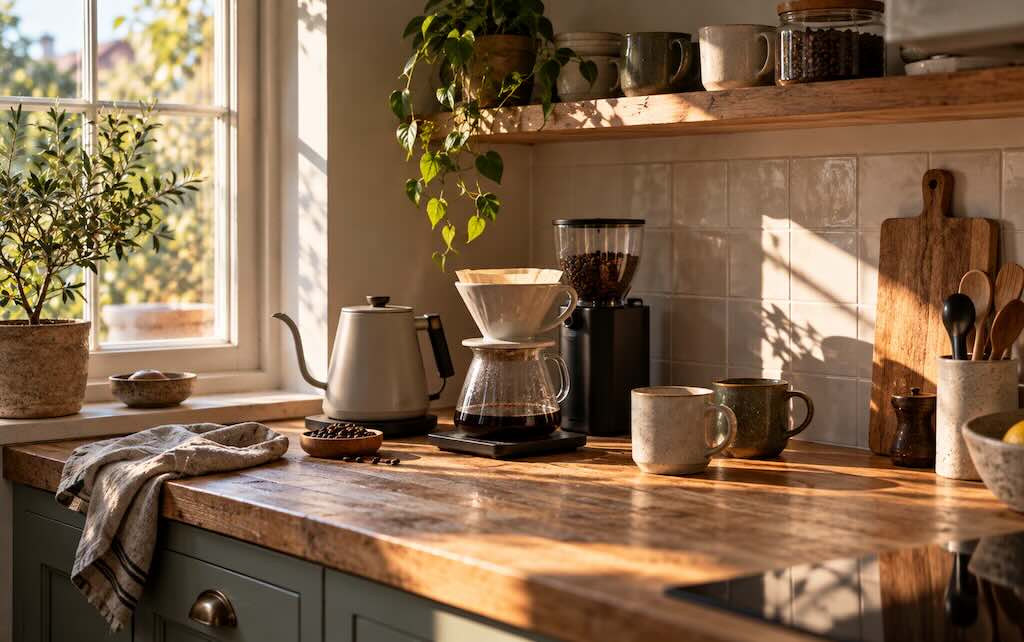
A surprising amount of making coffee is actually looking for things.
The beans are in one cupboard. Filters are somewhere else. The favourite mug is behind six others. The grinder has migrated because somebody needed the socket. Tea has accumulated in three different places, none particularly convenient.
A home café can be much simpler than the immaculate coffee stations that circulate online. You do not need a dedicated cabinet, matching canisters or a row of syrups. You need one small part of the kitchen where making the drink you have every morning becomes easy.
The point is less about recreating a café at home than giving a daily ritual somewhere to live.
Start with what you actually make
Designing the corner before thinking about your habits is how you end up with equipment you rarely touch occupying some of the most useful space in the kitchen.
Instead, watch what happens tomorrow morning.
If you make filter coffee, the useful group might be a brewer, filters, beans, grinder and a small measuring spoon. An espresso machine needs a different arrangement. Someone who usually drinks tea may need little more than a kettle, tea, a strainer and mugs within reach.
Put the things used every day closest to the hand. Occasional equipment can stay in a cupboard.
This sounds obvious until you look at how many kitchens are arranged around where objects fit rather than how frequently they are used.
A small corner is often enough
The end of a worktop can work. So can a narrow shelf above it, an unused section beside the fridge or a small freestanding trolley in a kitchen short on counter space.
Access to a socket matters if you use a kettle, grinder or coffee machine. So does proximity to water. Carrying a full kettle across the kitchen every morning soon makes an otherwise attractive location feel poorly chosen.
There should also be enough empty worktop to put something down.
That last part is easily missed. A coffee corner crowded with equipment, jars and cups may look complete but leave nowhere to actually make coffee. A little unused surface is part of the setup.
Keep the number of things visible surprisingly low
Once a corner has been designated for something, there is a strong temptation to decorate the designation.
A tray arrives. Then jars. A sign. Extra cups. A little rack. Perhaps several bottles of things that previously lived quite happily in a cupboard.
It is worth resisting most of this.
Keep out what you use often enough to justify seeing every day. If that is one kettle and a ceramic jar of tea, that can be the entire home café.
A tray can still be useful when it solves a practical problem. It catches coffee grounds, makes several small objects easier to move and gives them a defined boundary. But it does not need to announce that the corner has a theme.
The mug deserves more thought than the accessories
There are cups we own and cups we reach for.
The difference can be almost embarrassingly specific: the handle fits properly, the rim is thin, the coffee stays warm for the right amount of time, the weight feels good in one hand.
If two or three mugs are used constantly, let those live near the coffee rather than displaying an entire collection. This is where a small open shelf can be genuinely useful. It turns an object that normally disappears into a cupboard into part of the morning sequence: mug, coffee, water, wait.
Things acquire a different presence when they are used daily.
Make the reset part easy
The test of a useful kitchen arrangement is often what it looks like at 9.30 rather than 7.30.
Where do the wet spoon and used filter go? Where do you knock out coffee grounds? Can spilled water be wiped without moving five containers? Does the grinder scatter grounds into an awkward corner?
A cloth within reach is more useful than another decorative object. A nearby bin helps. So does choosing containers that can be opened with one hand and surfaces that are easy to wipe.
If resetting the corner takes less than a minute, it is far more likely to remain pleasant rather than gradually becoming another crowded section of worktop.
Then leave it alone for a while
Use the corner before improving it.
After a week, the unnecessary things become obvious. So do the missing ones. Perhaps the mugs should move down a shelf. Perhaps the beans need to be closer to the grinder. Perhaps you always carry the milk from the fridge and therefore nothing needs changing at all.
The best version will probably be less photogenic than the first one you imagined.
It may also become one of the most used few feet in the kitchen.
The ritual is the part worth keeping
There is something pleasant about a repeated sequence that does not require many decisions.
Fill the kettle. Grind the beans. Take the same mug from the shelf. Open the window while the water heats. Stand there for a moment instead of beginning the day somewhere else.
The objects help because they make the sequence easier, but they are not really the point.
A good home café is not a miniature commercial café. It does not need to look like one.
It is simply a small part of the kitchen that knows what happens there every morning.