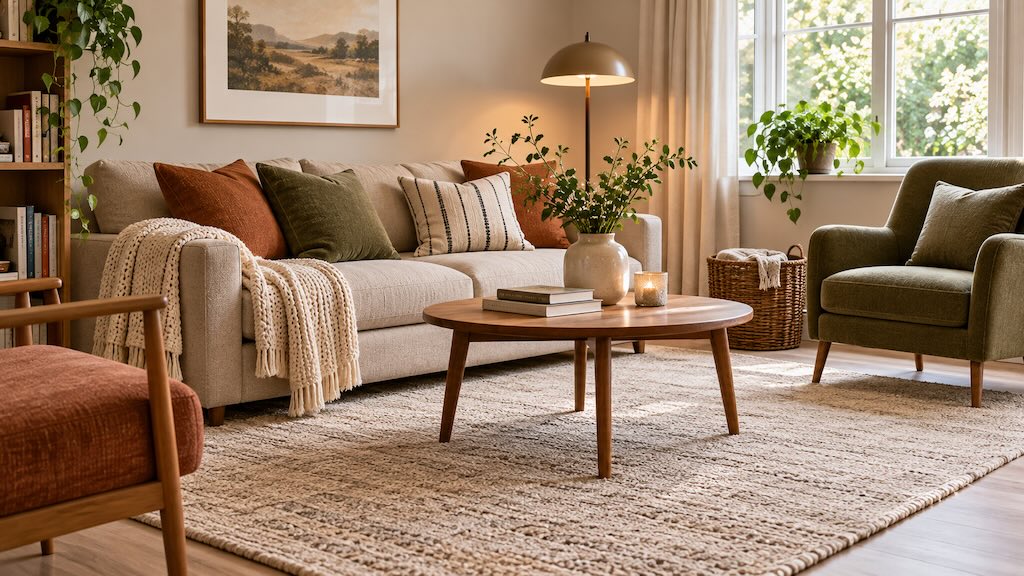
A rug can look enormous when it’s rolled up in a shop and surprisingly small once it’s lying in front of your sofa. Suddenly, the coffee table fits comfortably, but the armchairs are stranded on the bare floor. Or the rug disappears beneath the furniture, leaving almost none of its colour or pattern visible.
Choosing the right living room rug size is less about finding a measurement that suits the room and more about understanding how the furniture fits together. A compact living room may need a larger rug than expected, while a spacious room with one small seating area may not need a room-sized carpet at all.
Before choosing a colour or pattern, start with the sofa, chairs and the space you need to walk through. A few measurements can prevent an expensive mistake.
Start with your sofa, not the size of the room
If you know only one measurement before shopping for a rug, make it the width of your sofa.
As a useful starting point, choose a rug that extends beyond both ends of the sofa rather than stopping short of them. This helps the sofa and rug look like part of the same arrangement.
For example, if your sofa is 210 cm wide, a rug measuring 200 cm across may look undersized when centred beneath it. A 240 cm-wide rug would give you approximately 15 cm of additional width on either side. More generous margins may work better if the room allows.
This isn’t a universal design law. An unusually shaped room, an asymmetrical furniture layout or a small accent rug may call for something different. But it’s a sensible place to begin.
IKEA’s rug-sizing guide similarly recommends choosing a rug longer than the sofa and positioning the sofa partly or fully on it.
Three ways to position a living room rug
Most living rooms can use one of three basic arrangements. The best choice depends on the number of seats, the available floor space and how you want the room to feel.
1. All furniture legs on the rug
In this arrangement, the sofa, armchairs and coffee table sit entirely on the rug. It works particularly well in larger rooms or open-plan spaces where you want to establish a distinct seating area.
Because the rug sits beneath the whole furniture group, the arrangement can feel connected even when the furniture isn’t against the walls.
The trade-off is size and cost. You’ll need a rug large enough to accommodate the furniture without its edges finishing awkwardly beneath the legs. Measure the entire seating arrangement rather than choosing a size based on the sofa alone.
2. Front furniture legs on the rug
This is often the most practical arrangement for an average-sized living room. The front legs of the sofa and armchairs rest on the rug, while their back legs remain on the floor.
It visually connects the seating without requiring a rug large enough to sit beneath every piece of furniture.
Make sure the rug extends far enough beneath the furniture that the front legs sit securely on it. If a chair rocks because some legs are on a thick rug and others are on a hard floor, adjust the arrangement or choose a flatter rug.
Both West Elm and Lowe’s recommend front-leg placement as a useful guide for living room rugs.
3. Only the coffee table on the rug
A smaller rug can sit entirely in front of the sofa, with the coffee table resting on it. This is sometimes the only realistic arrangement in a very narrow room or when you already own a rug that isn’t large enough for the seating.
It can work as a deliberate accent, especially if the rug has a distinctive shape, texture or pattern. However, it won’t visually connect the sofa and chairs in quite the same way as a larger rug.
If you are buying a new rug specifically to bring the seating together, try the front-legs-on arrangement first. If you’re using a smaller rug you already own, there’s no need to replace it simply because it doesn’t follow a decorating rule.
What size rug works with a two- or three-seater sofa?
Standard rug sizes can help narrow the options, but the dimensions of sofas vary considerably. The table below is a starting point, not a substitute for measuring your furniture.
| Common rug size | Where it may work |
|---|---|
| 160 × 230 cm | A compact seating area or a smaller rug positioned in front of a sofa |
| 170 × 240 cm | A small sofa with a coffee table, depending on the layout |
| 200 × 300 cm | Many two- or three-seater sofas with front-leg placement |
| 240 × 340 cm | A larger sofa, sectional or seating group with armchairs |
| 300 × 400 cm | A generous seating arrangement where most or all furniture can sit on the rug |
These are approximate examples, and available sizes differ between retailers. A 200 × 300 cm rug may work beautifully beneath one three-seater sofa but feel too small when two armchairs and a large coffee table are added.
Also check which direction the rug will face. A rectangular rug can often be rotated to accommodate a wider sofa or a deeper seating arrangement, although the pattern and room shape may influence the result.
How to measure your living room before buying a rug
You don’t need an interior designer or specialist measuring equipment. A tape measure and some removable painter’s tape are enough.
- Measure your sofa. Record its full width, including the arms, and the depth of the furniture.
- Measure the seating arrangement. Include armchairs and the coffee table if you want them connected by the rug.
- Choose a placement. Decide whether all furniture legs or only the front legs should rest on the rug.
- Mark the rug’s outline. Use painter’s tape on a suitable floor surface to show the proposed dimensions.
- Check the room in use. Open doors, pull out chairs and walk along the usual routes through the room.
Leave the tape in place for a day if possible. A rug that looks correctly proportioned from the doorway may feel too large when you walk around the furniture or need to open a cabinet.
Check the retailer’s actual measurements before ordering. Rugs sold under familiar size labels can vary, and handmade rugs may not match their nominal dimensions exactly.
What if your living room is small or narrow?
A small room doesn’t automatically need a small rug. In fact, a rug that barely accommodates the coffee table can make the furniture appear disconnected.
In a narrow room, try placing a rectangular rug lengthways with the main seating arrangement. This may help define the seating area without spreading into the walkway.
Consider how much floor you want visible around the rug. Some exposed flooring can help distinguish the rug from fitted carpet, but there’s no single border measurement that suits every room.
If your sofa sits against a wall, you may not need the rug to extend all the way beneath it. Front-leg placement often provides a practical compromise.
For a particularly awkward layout, experiment with the tape outline before committing to a purchase. A rug that fits the furniture but blocks a doorway isn’t the right size for the room.
How big should a rug be under a sectional sofa?
Sectional sofas need a little more consideration because their shape creates an additional seating direction.
For an L-shaped sofa, think about the space inside the corner where the coffee table sits. A rug that extends beneath the front sections of both sides can help connect the arrangement.
For a sofa with a chaise longue, check whether the rug reaches far enough beneath the chaise to avoid an awkward edge in the middle of the seating area.
You don’t necessarily need to place the entire sectional on the rug. A well-positioned rectangular rug beneath the front portion of the sofa and coffee table may be enough, particularly in a smaller room.
If you’re choosing between two sizes and both fit comfortably, the larger option may provide a more unified arrangement. But don’t size up at the expense of necessary walking space.
The mistakes worth avoiding
The most common problem is choosing a rug by appearance alone. A beautiful pattern won’t compensate for a size that doesn’t work with the furniture.
- Buying before measuring: A rug that looks large in a product photograph may be too small for your sofa.
- Ignoring armchairs: A rug that suits the sofa alone may leave the rest of the seating disconnected.
- Forgetting door clearance: A thick rug can interfere with a door that opens across it.
- Choosing an unstable arrangement: Furniture should sit securely rather than wobble across different floor levels.
- Overlooking maintenance: A very large rug can be difficult to move, clean or rotate in a compact home.
Finally, consider whether the rug needs a suitable underlay. On smooth flooring, a rug that shifts or bunches can become a trip hazard. Choose a rug pad compatible with both the rug and your floor, and follow the manufacturer’s care advice.
Frequently asked questions
Should a living room rug be bigger than the sofa?
For a rug intended to anchor the seating area, extending beyond both ends of the sofa is generally a good starting point. The exact amount depends on the sofa, chairs and available floor space.
Does a 200 × 300 cm rug fit a living room?
It can work for many seating arrangements, particularly with a two- or three-seater sofa and front-leg placement. Measure your actual furniture before deciding.
Can a living room rug be too big?
Yes. A rug may be too large if it interferes with doors, extends awkwardly into walkways or covers more floor than you want. The goal is to suit the seating area while keeping the room comfortable to use.
Do all sofa legs need to be on the rug?
No. Placing only the front legs of the sofa and chairs on the rug is a widely used arrangement. All-legs-on placement can work especially well for larger rooms and furniture groups positioned away from the walls.
When you’re choosing a living room rug, it’s worth spending more time on the measurements than the product photographs. A rug should make the furniture feel connected, provide a comfortable surface underfoot and leave the room easy to use. Once those things are right, you can enjoy choosing the colour, texture and pattern.