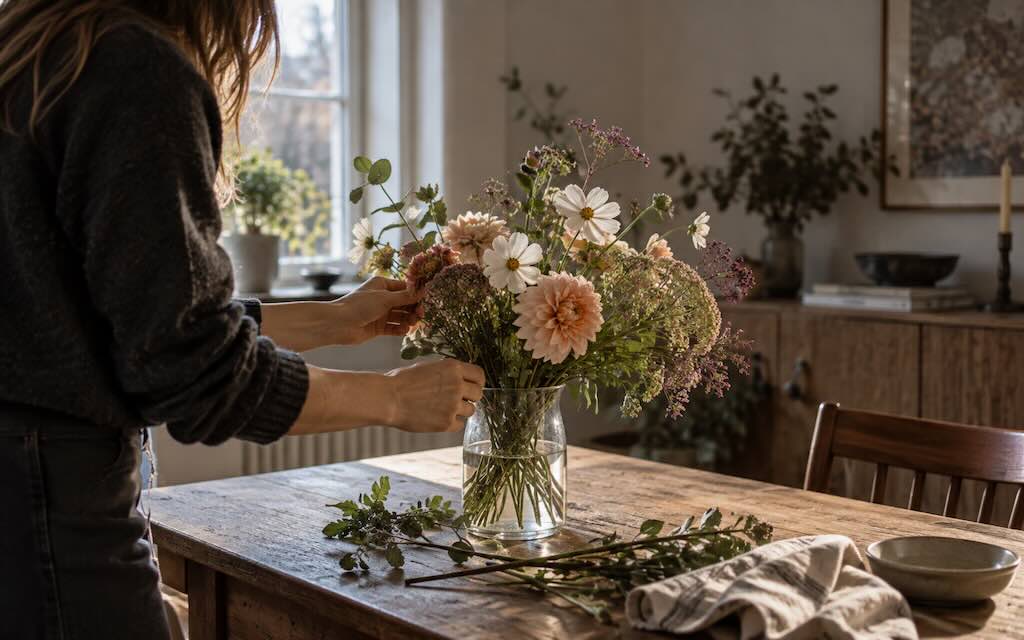
Sometimes the flowers are fine. It is the vase that is making them look wrong.
A bunch comes home from the supermarket looking loose and generous in its paper sleeve. Then it goes into the vase and suddenly seems too tall, too stiff or strangely small. You move it to the other end of the table. Turn it around. Pull one stem forward. Nothing quite fixes it.
Before blaming the flowers, look at the proportion.
The 1/3 vase rule is a useful starting point: let the vase account for roughly one-third of the finished arrangement’s visual height, with the flowers occupying the other two-thirds. It is not a floristry law, and some arrangements are better when they ignore it completely. But for an ordinary bunch of flowers in an ordinary vase, it can explain why something feels slightly off.
Start with one stem
Do not cut the whole bouquet at once.
Take one stem and hold it beside the vase. Imagine the finished arrangement as three loose sections: about one section of vase below, then two sections of flowers and visible stem above.
There is no need for a ruler. You are looking for proportion rather than an exact measurement.
If the vase is 20 centimetres high, for example, an arrangement somewhere around 60 centimetres from the base of the vase to its highest point gives you the basic one-third/two-thirds relationship. From there, individual stems can sit higher or lower.
Cut the first stem conservatively. You can always shorten it again.
If the bouquet looks awkward, it may simply be too tall
Supermarket flowers are sold with enough stem to work in different homes and different vases. That is useful until the entire bunch goes straight from its wrapping into a medium-height vase.
The flowers can end up hovering above the vessel rather than belonging to it.
Shortening the stems brings the weight of the blooms closer to the rim. Roses begin to gather rather than stand in a row. Tulips can bend outward instead of appearing to escape from the vase. A mixed bunch starts to read as one arrangement.
This is the part of the 1/3 rule that is most useful: it gives you somewhere to begin cutting when your eye knows something is wrong but cannot quite identify what.
The opening of the vase matters as much as its height
Proportion will not rescue the wrong opening.
Put six stems into a very wide vase and they may fall against the sides, leaving an empty centre. Force a large mixed bouquet into a narrow neck and the stems can become so compressed that every flower points upward.
A narrower opening is useful when you have relatively few stems because the vase does some of the arranging for you. It gathers them together and provides support. A wider vessel gives a larger bunch room to spread, but usually asks for more attention to how the stems cross and where the flowers sit.
This is also why owning one vase that works beautifully for every flower is unlikely. Tulips, a few garden stems and a dense bunch of chrysanthemums are asking different things from the vessel holding them.
Remove more leaves than feels necessary
Before arranging, remove leaves that would sit below the waterline. It keeps the submerged part of the arrangement cleaner and makes changing the water easier.
Then look at the leaves above the water too.
A supermarket bunch can carry a surprising amount of greenery around the lower part of each stem. Removing some of it creates space between the flowers and makes individual shapes easier to see. You do not need to strip everything bare. A few leaves can give the arrangement softness and volume.
The aim is to stop every centimetre from being occupied.
Do not cut every stem to the same height
The 1/3 rule is most useful as a proportion for the arrangement as a whole. It should not turn the top of the bouquet into a straight line.
Let one or two stems rise above the main shape. Bring heavier blooms slightly lower. Allow a stem that naturally bends to bend. Turn the vase as you work and look at the spaces between flowers rather than trying to fill every one.
A little unevenness creates movement. Flowers rarely improve when they are persuaded to behave like identical objects.
Arrange for the place where the flowers will live
A bouquet on a dining table has to work differently from one on a shelf.
If people will sit opposite each other, height matters for the practical reason that they should still be able to see one another. A vase on a console against the wall can have a clear front and back. Flowers on a kitchen island may be seen from every direction.
Decide where the vase is going before spending ten minutes making every angle equally beautiful.
Against a wall, turn fuller flowers toward the room and let taller stems create shape behind them. For a table or island, rotate the vase while arranging so one side does not quietly receive all the good flowers.
Sometimes the better vase is three smaller ones
Not every bouquet wants to stay together.
If the bunch feels crowded, take out a few stems rather than searching for a larger vase. Put three flowers beside the bed. One stem can go into a narrow bottle-sized vase in the bathroom. A small cluster can sit on the kitchen counter.
This is particularly useful toward the end of a bouquet’s life. Flowers rarely fade at exactly the same speed. Removing the stems that are finished and cutting the remaining ones shorter can turn a declining arrangement into several small ones for another few days.
The vase changes as the flowers do.
Know when to ignore the rule
Some flowers look better when the proportions become exaggerated.
A few long branches can rise far beyond the one-third/two-thirds balance. A low bowl of heavy flowers may spread sideways rather than upward. Tulips continue to grow after cutting and naturally bend toward light, so an arrangement that begins neatly proportioned can look quite different a few days later.
That is not a problem to correct.
The useful part of a styling rule is knowing what to try first. If a bunch looks awkward, check the relationship between flowers and vase. Shorten one stem. Move another. Step back.
Once it looks right on the table, the fraction has finished its job.
FAQ
What is the 1/3 vase rule?
The 1/3 vase rule is a simple proportion guideline for arranging flowers. Think of the vase as roughly one-third of the finished arrangement’s total height and the visible flowers and stems above it as roughly two-thirds. It is a starting point rather than a strict measurement.
How tall should flowers be compared with a vase?
For many everyday arrangements, flowers extending roughly twice the vase height above the vessel creates a useful starting proportion. Flower type, vase shape and the width of the arrangement can all change what looks balanced.
How do you make supermarket flowers look better in a vase?
Remove the packaging, trim the stems to suit the vase, remove foliage below the waterline and vary the height of individual flowers. Make sure the vase opening suits the number of stems and leave some space rather than packing every flower tightly together.
Should every flower in a bouquet be the same height?
No. Small variations in height and angle usually create a more natural arrangement. Use the 1/3 rule for the general proportion, then let individual stems sit above or below the main shape.
What vase is best for supermarket flowers?
It depends on the bunch. A moderately narrow opening can help support a smaller number of stems, while a fuller bouquet may need more room. Height matters too: choose a vessel that allows you to trim the stems without leaving the flowers either towering above it or disappearing inside it.