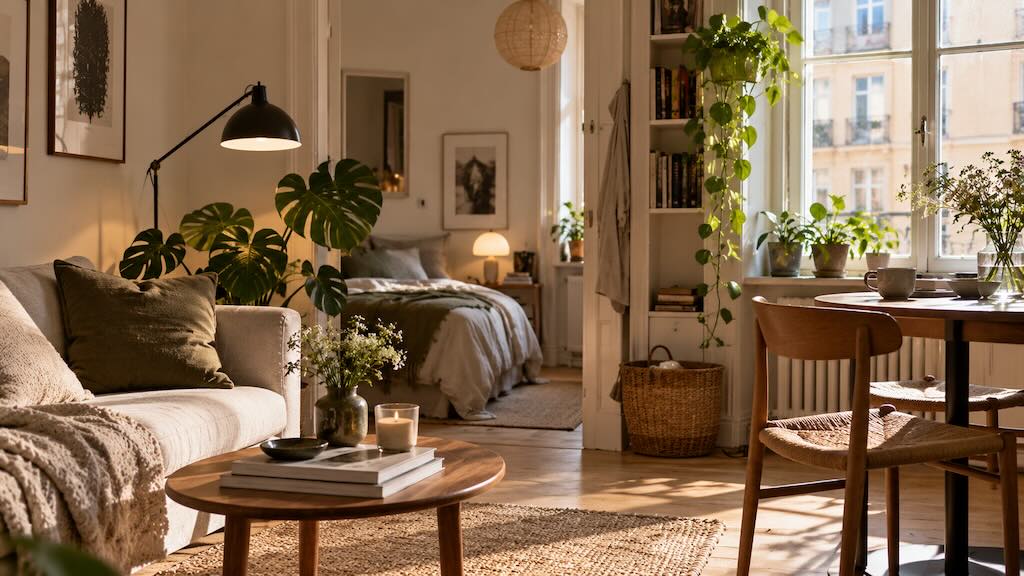
The sofa fits, but only if you move the dining table. The wardrobe has nowhere sensible to go. There’s one ceiling light in the living room, the kitchen cupboards are already full, and the landlord would prefer you didn’t change anything.
Furnishing a small rented flat involves a particular kind of compromise. You need somewhere to sleep, eat, work and keep your belongings, but you may have little control over the walls, floors, lighting or built-in storage. Even a perfectly ordinary piece of furniture can become an obstacle when every centimetre matters.
The answer isn’t necessarily to buy miniature furniture or fill every available corner with clever storage products. A more useful approach is to work out how you actually live, choose pieces that earn their space and make changes you can take with you when you move.
Start with the room you have, not the room you wish you had
It’s tempting to begin furnishing a flat by looking at photographs of beautifully arranged small apartments. But a room that works in a photograph may be awkward to live in, particularly when the furniture has been chosen for appearance rather than everyday use.
Before buying anything substantial, measure the floor space, wall lengths, windows, radiators, doors and existing fittings. Note where electrical sockets are located and which doors need room to open fully.
Measure the route into the flat, too. A sofa that fits the living room may not fit through the stairwell or around a narrow hallway corner. Check the packaged dimensions and whether the furniture can be dismantled for delivery and future moves.
Then make a simple floor plan. Graph paper works perfectly well, although a digital room planner can be useful. Cut out paper rectangles representing the furniture you’re considering and move them around until the arrangement makes sense.
Pay attention to what happens between pieces of furniture. Can you walk from the entrance to the kitchen without turning sideways? Can you pull out a dining chair? Can wardrobe doors open without hitting the bed?
If you’re uncertain about the size of a proposed sofa or table, mark its footprint on the floor with removable painter’s tape, after checking that the tape is suitable for the surface. Living with the outline for a day can reveal problems that measurements alone don’t show.
Decide what the flat needs to do every day
A small home cannot always accommodate a separate piece of furniture for every activity. That doesn’t mean you have to give up the activities themselves.
Start by identifying what matters most in your daily routine. Do you work from home? Cook regularly? Have friends over for dinner? Need somewhere comfortable to read? Own a bicycle, musical instrument or collection of books that requires proper storage?
Someone who works remotely five days a week may need a genuinely comfortable desk arrangement more than an occasional dining table for six. Someone who loves cooking may prefer to devote space to kitchen storage rather than a large television unit.
Make a distinction between things you do daily, things you do occasionally and things you imagine you might do. Furnish for the first two. Be cautious about spending money and space on the third.
Choose fewer pieces, but get their proportions right
Small flats often become difficult to furnish because they’re filled with too many separate pieces: a sofa, an armchair, two side tables, a coffee table, a television stand and several storage units, each requiring its own patch of floor.
Removing one unnecessary piece can sometimes improve a room more than replacing everything with smaller furniture.
Look for a sofa that offers comfortable seating without oversized arms or excessive depth. A compact two-seater may be more practical than a large sectional, but don’t assume that the smallest model will be comfortable enough for everyday use.
A round dining table can be useful in an awkward corner because it has no sharp corners to navigate, while a narrow rectangular table may work better against a wall. A drop-leaf table offers flexibility when you need additional surface space only occasionally.
Furniture with visible legs can make the floor beneath it easier to see, which may help a room feel less crowded. But visual lightness isn’t the only consideration. A low, solid storage unit may be more useful than an elegant piece that holds almost nothing.
Don’t be afraid of one substantial piece if it solves several problems. A well-proportioned wardrobe or sideboard can be more effective than a collection of small cupboards scattered around the room.
Make furniture work harder without asking it to do everything
Multifunctional furniture is often recommended for small homes, but not every clever design is pleasant to use.
A sofa bed sounds efficient until you discover that converting it requires moving the coffee table every night. A storage ottoman is useful only if you can reach its contents without dismantling the room around it.
Look for pieces that combine functions naturally:
- A bed with accessible storage underneath: useful for spare bedding, seasonal clothing or belongings you don’t need every day.
- A drop-leaf dining table: suitable for everyday meals, occasional guests or working on a laptop.
- A small desk with drawers: combines a work surface with storage for paperwork and everyday essentials.
- A bench with storage: can provide seating and somewhere to keep shoes or bags, provided it is designed for both purposes.
- Nesting tables: offer an extra surface when needed without permanently occupying the same amount of floor space.
Before buying a multifunctional piece, imagine using it on a tired Tuesday evening. If changing its function involves too much effort, you may eventually stop using half of what you paid for.
Storage without drilling: what actually works?
When wall-mounted shelves aren’t an option, it’s easy to assume that every storage solution must sit on the floor. But the goal shouldn’t be to fill the flat with cupboards. It should be to make your belongings accessible without allowing them to take over the living space.
Use the space you already have
Begin with wardrobes, kitchen cupboards and existing drawers. Adjustable organisers, drawer dividers and suitable shelf inserts may make them more useful without changing the fittings.
Under-bed storage can accommodate items you don’t need frequently. Choose containers that fit the available clearance and can be removed without shifting the entire bed.
Over-door organisers can help in some rooms, but check that they don’t interfere with the door, hinges or frame. Avoid placing heavy objects where they could fall or prevent a door from closing properly.
Choose storage based on what you own
Open shelves are useful for books and objects you enjoy seeing. Closed storage is often better for cables, cleaning supplies, paperwork and miscellaneous household items.
Before buying a shelving unit, measure the objects it needs to hold. A beautiful unit with shelves that are too shallow for your books or too short for your storage boxes won’t solve the problem.
Consider where the storage will be used. Keeping cleaning supplies near the area where you need them may be more practical than placing everything in the one cupboard that happens to have space.
Don’t confuse freestanding with safe
There’s an important limitation to the usual advice about renter-friendly storage: a piece of furniture does not become safe simply because it doesn’t attach to the wall.
Tall bookcases, wardrobes and chests of drawers can tip over, particularly when drawers are opened or children climb on them. The US Consumer Product Safety Commission recommends securing furniture according to the manufacturer’s instructions to reduce tip-over risks.
If furniture requires wall anchoring, don’t omit it because you’re renting. Ask the landlord about a safe, approved installation method, or choose a different piece that can be used safely within your restrictions.
Low, stable furniture may be an appropriate alternative in some situations, but it isn’t a substitute for following the safety instructions supplied with the product.
Use lighting to change how the flat feels
Lighting is one of the most useful things you can improve without redecorating.
Many rented flats rely on a single ceiling fixture in each room. It may illuminate the space adequately but offer little flexibility when you’re reading, cooking or relaxing in the evening.
Portable lighting allows you to create different conditions for different activities. A floor lamp beside the sofa provides a softer alternative to overhead lighting. A desk lamp gives you focused light where you work. A small table lamp can make a dark corner more inviting.
Choose bulbs according to the task and the fixture’s specifications. Warmer light can be comfortable in living areas, while brighter, well-directed lighting is useful for detailed activities.
Pay attention to cables and sockets. Avoid overloaded adapters, damaged cords and arrangements that create tripping hazards. Keep lamps clear of fabrics and other materials as required by their safety instructions.
Replacing a bulb in an existing suitable fixture is different from altering electrical wiring. Leave changes to fixed electrical installations to appropriately qualified professionals and obtain any required permission.
Divide a studio flat without building walls
In a studio, the challenge isn’t simply fitting furniture into one room. It’s creating enough distinction between sleeping, eating, working and relaxing that the space doesn’t feel like one continuous arrangement of belongings.
You can create that distinction without permanent partitions.
A rug can visually define a seating area. A table positioned near the kitchen can establish a place for meals. A floor lamp beside an armchair can make a reading corner feel separate from the rest of the room.
Furniture placement can help too. A sofa facing away from the bed may create a subtle boundary, while a low storage unit can provide separation without blocking as much light as a tall partition.
Be careful with freestanding screens and shelving used as room dividers. They need to be stable and suitable for their intended position. Don’t block exits, ventilation, heating equipment or access to windows that may be needed in an emergency.
There’s no need to conceal the bed completely. In a small studio, a neatly arranged sleeping area can simply be part of the room rather than something to disguise.
What to do about ugly floors, awkward walls and fittings you can’t change
Not every rental comes with beautiful flooring, well-placed sockets or kitchen cabinets you would have chosen yourself. Some details can be worked around. Others are better left alone.
A rug can soften an unattractive floor and make a seating area feel more intentional. Check that its backing or underlay is compatible with the existing surface and won’t cause staining or slipping.
Freestanding mirrors can reflect light and make a room feel more open, but large mirrors must be positioned and secured safely according to their design. Don’t assume that leaning a heavy mirror against a wall is a safe alternative to mounting it.
Art doesn’t always have to hang on a wall. Smaller framed pieces can sit on a stable shelf, sideboard or desk. Books, ceramics and textiles can add colour and personality without requiring permanent changes.
Be more cautious with peel-and-stick tiles, adhesive hooks, removable wallpaper and contact film. Products described as removable can still damage paint, finishes or underlying surfaces, particularly after prolonged use.
Test products where appropriate, follow the manufacturer’s instructions and check whether their use is permitted. Never assume that a surface can be restored perfectly simply because a product is marketed as renter-friendly.
Know which changes your tenancy actually allows
Rental rules differ between countries, properties and types of tenancy. A prohibition on major alterations doesn’t necessarily mean you’re forbidden from putting up a picture, and permission to decorate doesn’t mean you can modify fixed installations.
For example, in Sweden, the tenants’ organisation Hyresgästföreningen explains that tenants generally have rights to make certain decorative changes, including painting and wallpapering, provided the work meets appropriate standards. Significant alterations and changes to permanent fittings are treated differently.
That is a Swedish example, not a universal rule. Your rights may differ depending on where you live, the kind of tenancy you hold and any applicable building requirements.
If you’re unsure about drilling, painting, replacing fittings or installing anything attached to the property, check the relevant rules and seek written clarification before proceeding. Keep records of any permission granted.
Photographs of the flat’s condition when you move in can also help distinguish existing wear from later damage.
Where to spend money, and where to save it
A rented flat can make expensive furniture feel like a risky investment. You may not know how long you’ll stay, whether your next home will have the same layout or how much storage you’ll need in a few years.
That doesn’t mean everything should be temporary or cheap. It means thinking about which purchases will remain useful beyond the current address.
| Item | What to prioritise | Where you can be flexible |
|---|---|---|
| Bed and mattress | Comfort, support and suitable dimensions | Bedside tables and decorative headboards |
| Sofa | Comfort, size and ease of moving | Colour and decorative cushions |
| Dining table | Practical surface area and clearance | Second-hand finishes and styles |
| Storage | Capacity, stability and safe installation | Matching collections and decorative details |
| Lighting | Useful illumination and electrical safety | Decorative shades and finishes |
| Rugs and textiles | Suitable size, durability and easy care | Trends and seasonal colours |
Second-hand furniture can be particularly useful when you’re furnishing a small home. Solid tables, chairs and cabinets may be available at lower prices than new equivalents, and buying used can make it easier to experiment without committing a large budget.
Check dimensions and condition carefully. Look for structural damage, instability, unpleasant odours and signs of pests. Upholstered items deserve particular attention, while used electrical items should be assessed for safety before use.
It’s often worth waiting for the right piece rather than buying something simply to fill an empty corner.
The mistakes that make small rented flats harder to live in
Some furnishing decisions seem sensible at first but create problems once you begin living with them.
- Buying everything immediately: you may discover that you need a desk more than an armchair, or closed storage more than another shelf.
- Choosing furniture without checking delivery access: the room dimensions are only part of the problem.
- Filling every wall: leaving some space around furniture can make a room easier to use and less visually crowded.
- Buying storage before sorting belongings: you may end up paying to store things you no longer need.
- Ignoring the location of sockets and radiators: furniture that looks right on a floor plan may be impractical in the actual room.
- Choosing unsafe no-drill solutions: a rental restriction doesn’t justify ignoring anchoring instructions or load limits.
- Furnishing for photographs: an attractive arrangement isn’t successful if it makes ordinary activities difficult.
A practical plan for furnishing your flat in stages
If you’re starting with an empty flat or trying to improve a crowded one, work in stages rather than attempting a complete transformation over one weekend.
- Measure and photograph the rooms. Record dimensions, fittings and the location of sockets, radiators and doors.
- List your daily activities. Decide what the flat needs to accommodate before choosing furniture.
- Place the essentials first. Start with sleeping, seating, eating and the storage you genuinely need.
- Live with the arrangement. Notice where clutter collects, which corners remain unused and where you need better lighting.
- Add adaptable furniture gradually. Choose pieces that solve an observed problem rather than an imagined one.
- Finish with personal details. Bring in art, textiles, books and objects you enjoy, without making every surface decorative.
A small home often benefits from a little patience. The first arrangement doesn’t have to be the final one, and an empty corner isn’t necessarily a problem that needs solving.
Frequently asked questions
How can I decorate a rented flat without drilling?
Use rugs, textiles, portable lamps, freestanding furniture and smaller framed artwork displayed on stable surfaces. Some adhesive products may be suitable for certain finishes, but they can still cause damage. Check the product instructions and your tenancy rules before using them.
What furniture should I buy first for a small flat?
Start with the pieces needed for everyday living: a comfortable bed, suitable seating, somewhere to eat or work and essential storage. Your priorities will depend on your routine, so avoid buying a complete furniture set before understanding how you’ll use the space.
How do I make a small rented flat look bigger?
Choose furniture that fits the room, maintain clear walking routes, use well-positioned lighting and avoid overcrowding surfaces. Rugs can define areas, while carefully positioned mirrors may help distribute natural light. Function matters more than making the room appear large in photographs.
Can I use tall bookshelves if I’m not allowed to drill?
Many tall shelving units require anchoring to prevent tipping. Follow the manufacturer’s safety instructions. If your tenancy restricts drilling, ask about an approved anchoring method or choose furniture that can be used safely without prohibited installation.
Is it worth buying expensive furniture for a rented home?
It can be, particularly for comfortable, durable pieces you expect to use for years. Prioritise furniture that is adaptable, appropriately sized and practical to move. Be more cautious about expensive pieces chosen specifically for an awkward corner or unusual layout.
Make the flat work for the life you’re living now
A rented flat may come with restrictions, awkward proportions and decisions made by someone else years before you arrived. You might not be able to change the kitchen, replace the flooring or put a shelf exactly where you’d like one.
But you can decide where to sit with a book, how to arrange a table for dinner, which lamp to switch on in the evening and what deserves space in your home.
The most successful small flats aren’t necessarily the ones with the cleverest furniture or the fewest possessions. They’re the ones where everyday life feels comfortable, even when the room has limitations.
You don’t have to own the walls to make thoughtful decisions about what happens between them.