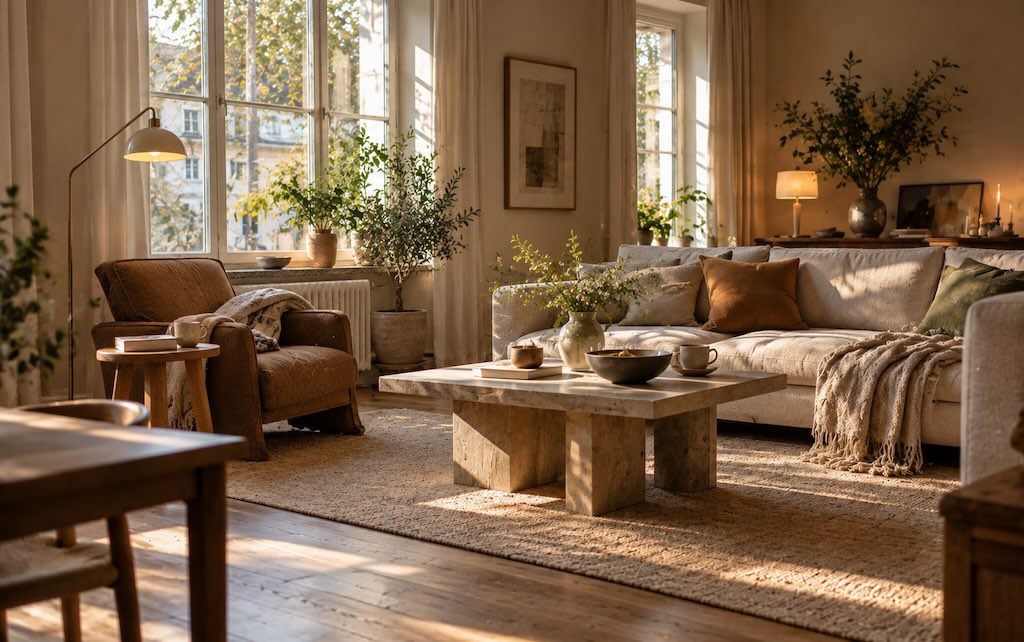
There is a familiar way to furnish a living room.
Put the sofa against the longest wall. Place a coffee table in front of it. Add another chair if there is room. Point everything towards the television.
It solves the furniture problem quickly.
What it does not always solve is the room.
A living room is usually asked to accommodate several kinds of life at once. Someone watches a film while somebody else reads. Two people talk. A child lies on the rug. Coffee is put down somewhere. A laptop appears for an hour. Friends come over and the chair that normally holds a pile of clothes suddenly becomes important.
The furniture that works best tends to acknowledge this before worrying too much about whether everything belongs to the same collection.
Start with what happens in the room
Before choosing another piece of furniture, it is worth noticing where people already go.
Perhaps everyone gravitates towards one end of the sofa because that is where the lamp is. Maybe a chair beside the window is used constantly during the day but almost never after dark. The coffee table may look perfectly proportioned and still be too far from the seat where you actually drink coffee.
These details reveal more about what a room needs than a photograph of an empty interior.
The original Divine article behind this piece made a useful point about choosing furniture according to how a household lives rather than simply following a style. That idea becomes more interesting when taken seriously.
If people regularly stretch out, a sofa with enough depth matters. If conversation is common, seating needs to allow people to face one another without turning awkwardly. If the room is small, a piece that can move easily may be more useful than something visually substantial.
Style comes into the decision. It just does not have to make the decision first.
Not every seat should do the same job
A sofa and two matching armchairs can create a beautifully coherent room. They can also give you three versions of essentially the same place to sit.
Different seats allow different postures and different degrees of participation.
There is the deep chair for reading. The upright one that is comfortable when somebody comes for coffee. The end of the sofa where you can lie down. A small stool that normally holds a book but becomes a seat when the room fills up.
These differences make a room more adaptable without requiring furniture marketed as multifunctional.
They can also make it feel less arranged. When every chair has the same height, fabric and relationship to the coffee table, the room can begin to resemble a furniture display. A mixture of seating gives the eye different levels and the people in the room actual choices.
Scale matters more than the number on the tape measure
A sofa can technically fit and still be too large for the room.
This is one of the more useful distinctions when buying furniture. Dimensions tell you whether an object will pass through the door and occupy the available wall. They do not tell you how much visual and physical space it will take once it arrives.
Arm width matters. So does back height. A sofa raised on visible legs often feels lighter than one whose base reaches the floor, even when their measurements are similar. An armchair with a broad back can interrupt a view across the room in a way a lower chair does not.
The empty space around furniture matters too.
A room needs places to walk without turning sideways. A drawer should open without hitting a table. People should be able to reach a chair without navigating an obstacle course around the coffee table.
This is why marking a prospective sofa or table on the floor before buying it remains useful. Painter’s tape or sheets of newspaper can show its footprint. Then add the space needed to walk around it.
The second measurement is often the revealing one.
The coffee table is not compulsory
Some pieces of furniture survive because they are useful. Others survive partly because a room seems unfinished without them.
The coffee table can be either.
In a large living room, a generous table can anchor the seating and give everyone somewhere to put a glass. In a narrow room, the same idea can occupy the most valuable stretch of open floor.
Two smaller tables may work better. So might a stool beside the sofa and another beside the chair. They can move when people arrive, disappear when floor space is needed and place a surface closer to the person actually using it.
This is a useful way to question other conventional pieces too.
You may not need a media console if very little media lives there. A large bookcase is unnecessary if your books fit comfortably on two shelves. An occasional chair that nobody chooses is taking up permanent space for an occasional problem.
A room does not need to contain every object associated with the idea of a living room.
Give conversation somewhere to happen
Televisions have an obvious gravitational pull. Arrange a sofa directly opposite one and the rest of the room tends to follow.
That may be exactly right if watching television is the room’s primary purpose. But even then, one chair at an angle can change how the room works when the screen is off.
People are generally more comfortable talking when they can see each other without holding an exaggerated position. Seating does not have to form a formal circle, but it helps when at least some of it acknowledges the other people in the room.
A chair turned thirty degrees can be enough.
This also prevents the television from becoming the visual conclusion of every seat. One chair can look towards the window. Another can face the sofa. A reading light can establish a small destination of its own.
The room gains more than one centre.
Small furniture earns its place by moving
Some of the most useful furniture in a living room is easy to pick up.
A stool becomes a side table. A small table moves beside whoever needs it. An ottoman takes a tray, then becomes a footrest, then an extra seat. A light chair can be pulled into a conversation and returned to the window afterwards.
This flexibility is particularly valuable in smaller rooms, where dedicating a large amount of floor space to something used twice a month rarely makes sense.
It is also a more ordinary form of adaptability than furniture that folds into walls or transforms through complicated mechanisms.
Sometimes multifunctional simply means you can move it with one hand.
A room can take time to furnish
There is a strong temptation to finish a room.
Once the sofa arrives, the empty corner asks for a chair. The bare wall asks for storage. The space beside the sofa seems to require a table.
Living with the gaps for a while can be more informative.
You may discover that the empty corner is where everyone likes to stand when the window is open. That you need a lamp there rather than another chair. That the coffee table should be smaller. That the sofa would work better twenty centimetres away from the wall.
Furniture becomes easier to choose once the room has had a chance to tell you what is missing.
That may be the most useful way to think about a modern living room. Not as a collection of current pieces, but as a space capable of accommodating different versions of an ordinary evening.