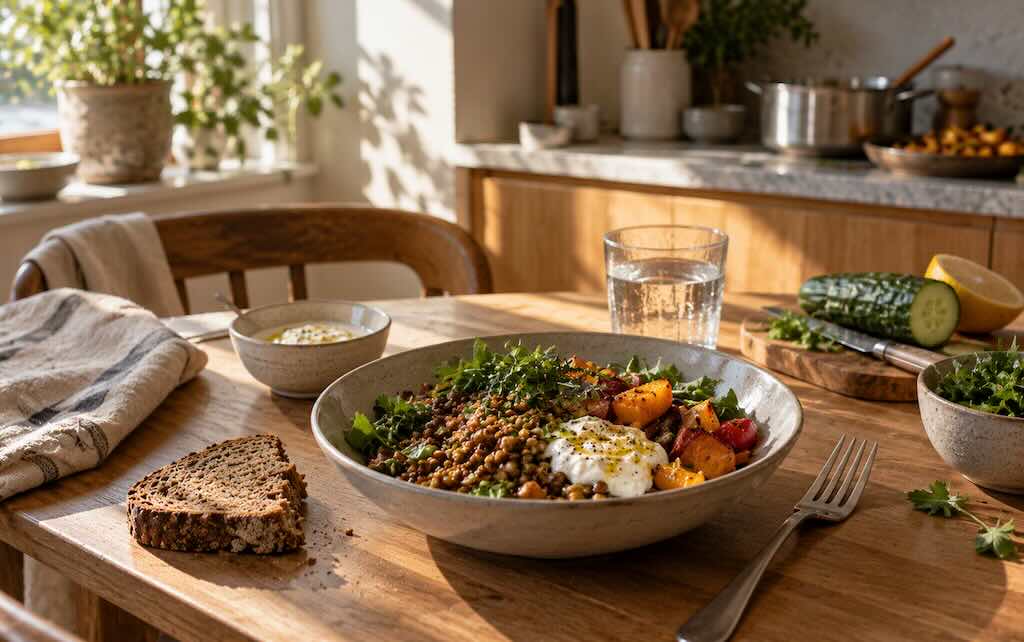
Lunch has an awkward place in the day.
Breakfast can be repetitive without attracting much comment. Dinner gets recipes, invitations, restaurants and the occasional hour spent chopping onions. Lunch often arrives while something else is happening.
A meeting finishes late. You have twenty minutes before the next thing. There is half a cucumber in the fridge, some bread and a container whose contents you can no longer confidently identify.
This is where a default lunch becomes useful.
Not the lunch you intend to eat every day for the rest of your life. Not a carefully portioned meal-prep system covering five identical containers. Just a meal, or a loose family of meals, that you can make without beginning the decision from zero.
The best ones are nutritionally sensible, certainly. They are also realistic enough to survive a Wednesday.
It should be made from food you normally have
A default lunch becomes much less useful when it depends on six ingredients bought specifically for it.
Think instead about what already moves through your kitchen. Eggs. Bread. Potatoes. Tinned beans. Yoghurt. Oats. Frozen peas. Tomatoes. Leftover rice. A piece of cheese. Lentils. Whatever vegetables tend to remain after dinner.
The precise list will be different in every home. That is the point.
A useful default emerges from the way you already shop rather than requiring a second, more virtuous version of your shopping habits.
This also makes improvisation easier. Eggs on toast can become eggs with yesterday’s potatoes. A bowl of lentils can take whatever vegetables are available. Soup becomes a more substantial lunch with bread and something alongside it. Leftover roasted vegetables can go into a sandwich, an omelette or a bowl of grains.
The meal has a shape, but not a strict recipe.
Give lunch enough substance to be lunch
There is no single composition that every lunch needs to follow, and nutrition is better understood across the broader diet than by trying to make each individual plate perfect.
Still, a useful default tends to draw from several kinds of food rather than relying on one thing alone.
The Nordic Nutrition Recommendations 2023, which provide the scientific basis for dietary guidance across the Nordic and Baltic countries, recommend a predominantly plant-based dietary pattern rich in vegetables, fruits and berries, pulses, potatoes and whole grains, alongside foods including fish, nuts and moderate amounts of dairy.
For an ordinary lunch, that leaves plenty of room.
A bean soup with rye bread works. So does an omelette with potatoes and vegetables. Leftover fish with grains and cucumber. Lentils dressed with olive oil and eaten with bread and yoghurt. A substantial sandwich with vegetables and fruit alongside it.
None requires turning lunch into a nutritional equation.
It is worth paying attention to what happens afterwards, too. If the lunch you habitually make leaves you looking for something else twenty minutes later, it may simply need to be more substantial. If it is so elaborate that you routinely decide not to make it, simplicity matters more.
A good default has several versions
The problem with deciding that your default lunch is, say, a lentil bowl is that eventually you will not want a lentil bowl.
It is more useful to have a structure that tolerates substitutions.
Consider soup, bread and something alongside it. The soup changes. The bread changes. The addition might be cheese, hummus, an egg or yesterday’s salad.
Or start with something on toast. Eggs one day. Beans another. Leftover vegetables with cheese on Friday.
A bowl can work the same way: potatoes, grains or lentils underneath; vegetables; something protein-rich; then a dressing, yoghurt, nuts, seeds or whatever gives it enough flavour that you actually want to eat it.
This is less meal planning than maintaining a few reliable arrangements.
Leftovers are more useful when you plan for their second life
Some of the easiest lunches begin the evening before.
Not through formal meal preparation, but by cooking slightly more of the ingredients that are annoying to make in small quantities anyway.
A tray of roasted vegetables does not care whether half is eaten tonight and half tomorrow. Nor does a pot of lentils, boiled potatoes, cooked grains or a soup that tastes better after a night in the fridge.
The useful shift is to stop seeing these solely as leftovers from dinner.
They are tomorrow’s starting point.
This makes lunch feel less like reheating yesterday’s meal. The potatoes from dinner become an omelette. Lentils go into a salad. Roasted vegetables move into a sandwich. A small amount of cooked grain gets bulked out with beans, cucumber and dressing.
You have already done the slow part.
Keep an emergency lunch
The default lunch and the emergency lunch are not necessarily the same thing.
The emergency version is for the day when there is almost nothing fresh in the house and no desire to improvise.
Its ingredients should last.
Tinned beans or fish. Crispbread. Frozen vegetables. Eggs, if you usually have them. Soup in the freezer. A jar of something sharp or savoury that can make plain ingredients more appealing. Nuts. Oats. Bread you froze before it went stale.
What belongs on that shelf depends entirely on what you like eating. There is little virtue in maintaining an emergency supply of chickpeas if every time you see them you decide to order lunch instead.
The test is not whether the ingredients look sensible together in the cupboard. It is whether you will turn them into food when you are hungry.
Repetition is allowed
Food culture gives novelty a great deal of attention. New recipes are pleasurable. So are unfamiliar ingredients and lunches worth crossing town for.
Weekday lunch does not always need that responsibility.
There is something useful about knowing exactly how long the eggs take, which bowl is the right size and how much mustard you like in the dressing. Repetition turns preparation into memory. You stop checking quantities. You notice when the pan is hot enough. You know which ingredients can disappear without ruining anything.
The meal becomes easy because you have made it before.
That does not mean eating the same thing indefinitely. Defaults are there to remove decisions when you do not particularly want to make one. On a day when you do, ignore them.
The best default lunch fits the day around it
A lunch can be nutritionally impressive and still be a poor default.
If it takes forty-five minutes to prepare during a working day, requires washing three pans or depends on an avocado reaching its ideal state at precisely 12:30, it may belong in a different category of meal.
The default version has to work under ordinary conditions.
It should survive a late meeting. It should tolerate substitutions. It should be possible when the fridge is not particularly inspiring. It should contain enough that you regard it as a meal, while remaining simple enough that making it feels easier than beginning another search for what to eat.
Once you find one that does all of that, make it again.
That is how it becomes useful.