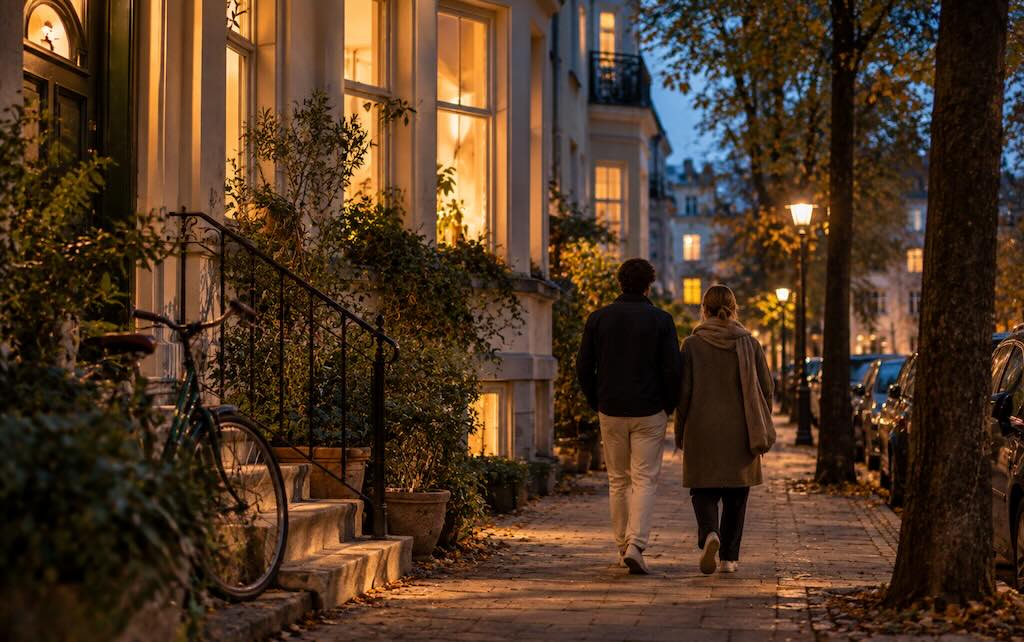
After dinner, the shortest distance is usually to the sofa.
The plates are still on the table. The kitchen needs dealing with. Outside it may already be dark. Going for a walk can seem like something that requires more enthusiasm than the evening has left.
But the after-dinner walk has one advantage over many things we are told to do for our health: it can be remarkably undramatic.
You do not need walking clothes. You do not need a route worth photographing. It does not have to count as exercise in any formal sense. Ten or fifteen minutes around the neighbourhood is still a walk.
And there is a surprisingly good physiological reason for taking it shortly after eating.
Your muscles have somewhere to put the glucose
After a meal containing carbohydrates, blood glucose rises as those carbohydrates are digested and absorbed. Insulin helps move glucose out of the bloodstream and into tissues where it can be used or stored.
Muscle activity gives glucose somewhere useful to go.
When muscles contract during walking, they increase their uptake of glucose. This is one reason researchers have become interested not only in how much physical activity people do, but in when they do it in relation to eating.
A 2023 systematic review and meta-analysis examined randomised crossover trials involving people with and without type 2 diabetes. Exercise after eating reduced the post-meal glucose rise compared with exercising before the meal and compared with remaining inactive.
Timing appeared to matter. In the studies included in the review, beginning activity sooner after eating was associated with a greater effect.
There are limits to how confidently we should interpret that result. The review contained only eight trials and 116 participants, and the researchers judged the included crossover studies to have a high risk of bias.
Still, the direction of the evidence is useful: moving after a meal can affect what happens metabolically in the hours immediately afterwards.
Ten minutes is not nothing
The walk does not necessarily need to be long.
In one randomised crossover study, 41 adults with type 2 diabetes were asked either to walk for 30 minutes once each day or for ten minutes after each of their three main meals. The same total amount of walking was prescribed in both conditions.
The post-meal walks produced a lower post-meal glucose response. The difference was particularly pronounced after dinner, which in this group tended to contain the most carbohydrate and was followed by the most sedentary time.
This does not establish ten minutes as a magic number. Studies use different populations, meals, walking intensities and timings, so there is no single scientifically perfect after-dinner route waiting to be followed.
What it does challenge is the idea that movement is only worthwhile once you have enough time for a proper workout.
It interrupts the evening sit
The other useful thing about walking after dinner has less to do with dinner.
For many people, evening begins with sitting down and largely continues that way until bed. Work may already have involved hours at a desk. Dinner adds another chair. Then comes the sofa.
The World Health Organization’s physical activity guidance emphasises two ideas that are easy to overlook when exercise is discussed primarily in terms of workouts: all physical activity counts, and any amount is better than none.
A walk after dinner therefore does not need to replace a longer walk, cycling, swimming, strength training or anything else you enjoy. It is simply another piece of movement in the day.
Its timing happens to make it convenient for breaking up a long stretch of sitting.
Make the route almost too easy
The mistake would be turning the after-dinner walk into another evening obligation with equipment, targets and a performance standard.
A useful route may be the boring one.
Out of the door, around two blocks and home. To the end of the road and back. Through the nearby park when there is enough light. Once around the neighbourhood while somebody else starts the washing-up.
The fewer decisions involved, the easier it is to repeat.
This is especially true when the weather is mediocre. A walk that depends on ideal conditions will happen less often than one that can accommodate drizzle, darkness and the fact that you would rather not go very far.
There is no requirement to walk briskly enough to look purposeful. The studies examining post-meal movement have used different intensities, and some have involved comfortable or self-selected walking speeds. The practical distinction is between moving and remaining seated, not between a leisurely walk and an athletic one.
It gives dinner an ending
There is also something a blood-glucose graph cannot show.
Walking creates a small border in the evening.
You leave the table and go outside. The temperature has changed. Shops are closing. Other windows are lit. A street you barely notice at eight in the morning looks different at eight in the evening.
If you live with someone, it can be one of the easier places to talk because neither person is looking directly at the other. If you walk alone, it is ten minutes in which very little is required of you.
None of this needs to be presented as a health intervention to be useful.
Sometimes it is simply pleasant to leave the house once more before the day closes.
Do not make dinner something you have to walk off
There is one framing worth avoiding.
A post-meal walk is not repayment for eating. Dinner has not created a debt that needs to be cancelled with exercise.
The evidence on post-meal glucose describes one physiological response to movement. It does not mean every meal requires intervention, nor that someone without diabetes needs to monitor ordinary fluctuations in blood glucose.
For people managing diabetes, medication or another condition affecting blood glucose, exercise can also interact with treatment. Individual advice from the clinician managing that condition matters more than a general article about walking.
For everyone else, the case can remain modest.
You have eaten. You are probably about to sit down.
Take the long way to the sofa.