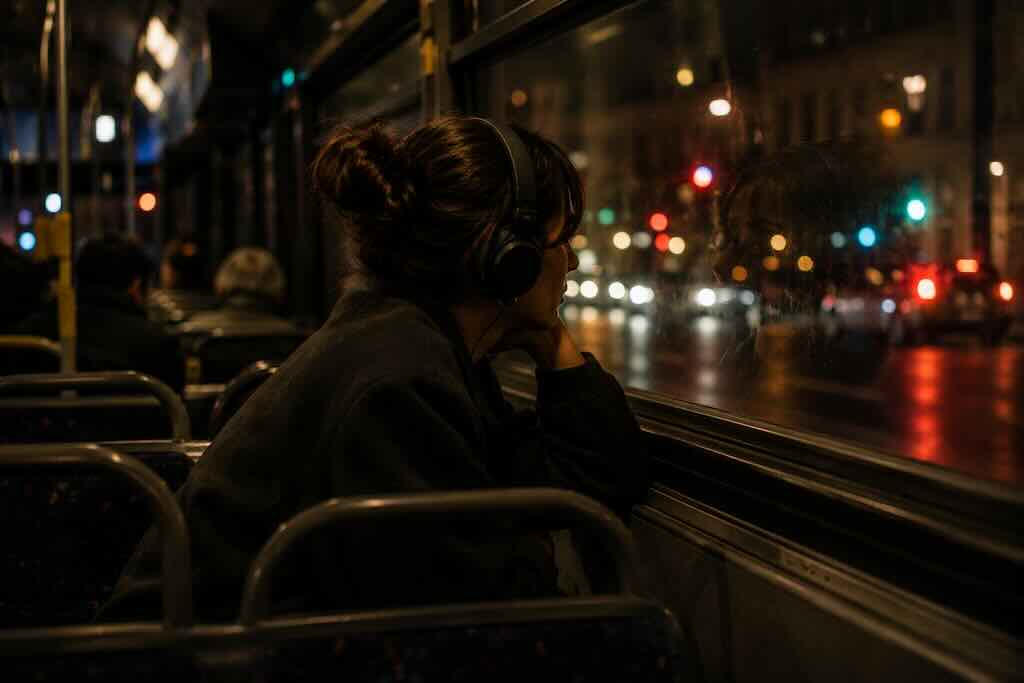
Some songs seem to wait for the room to get darker.
Play them at ten in the morning and nothing is technically wrong. The melody is the same. The recording has not changed. Yet something feels misplaced. Hours later, on a quiet train, through headphones on an empty street or alone in a room with one lamp on, the same track suddenly settles into focus.
We often talk about music as though our response belongs entirely to the song. But listening happens somewhere, while we are doing something, in a particular mood and at a particular hour. Night changes that context. And sometimes it changes what we are ready to hear.
We really do listen differently across the day
The idea of “night music” is not purely romantic.
A large study of more than two billion Spotify streaming events found clear daily patterns in the kinds of music people choose. Researchers identified five recurring listening periods corresponding broadly to morning, afternoon, evening, night and late night or early morning.
The musical characteristics shifted with them. In the data, night listening tended toward lower loudness and tempo, while late-night listening became more varied. Weekends changed the timing too: the higher-energy evening period stretched later into Friday and Saturday nights.
That does not mean there is a scientific formula for a midnight song. In fact, the researchers found that individual tracks did not consistently belong to one time of day. The stronger pattern emerged across listening behavior and playlists.
That distinction feels important. A song does not contain midnight. We bring midnight to it.
At night, the competition gets quieter
Daytime listening often shares space with something else.
Music plays while emails arrive, traffic moves, dishes are washed, conversations happen and notifications interrupt. It accompanies work, exercise, shopping and commuting. Sometimes that is exactly what we want from it: rhythm, momentum, familiarity, something occupying the air.
Late at night, the surroundings can thin out.
The street outside becomes quieter. Fewer messages arrive. Rooms become pools of artificial light surrounded by shadow. Through headphones, small elements in a recording can become unusually present: a breath before a vocal, fingers moving on strings, a distant layer of reverb, the space left between two notes.
The recording has not gained detail. The listener may simply have more room for it.
The same song can have a different job at 1 a.m.
Context affects not only what we choose but what we want music to do.
Research into everyday music selection has found that situational factors such as activity, attention and the function listeners want music to serve are important to understanding their choices. Time of day contributes to that context, but it does not act alone.
This helps explain why night music is not necessarily slow music.
At midnight, one person is trying to come down from a long day. Someone else is driving home. Someone is working. Someone is leaving a club. Someone has fallen in love. Someone cannot sleep.
The late hours contain unusually different kinds of listening because they contain unusually different kinds of wakefulness. The large-scale streaming research found greater diversity in musical characteristics late at night, mirroring greater diversity in what awake people were doing during those hours.
So the music that makes sense at night might be ambient and almost weightless. It might also have a bass line built for a dark room at 2 a.m.
Darkness changes the frame
There is also something less measurable happening.
Music is unusually good at attaching itself to settings. A song heard repeatedly on evening walks begins to carry those streets with it. An album played during a particular winter can seem to retain the temperature of that season years later.
Night gives music a strong visual frame: reflections in windows, passing headlights, apartment lights across the street, an almost empty highway, the blue-white glow of a kitchen after everyone else has gone to bed.
Certain recordings fit easily inside that frame. Spacious production has somewhere to expand. Quiet vocals feel closer. Repetition can become hypnotic rather than monotonous. A long instrumental passage that asks too much attention during a busy afternoon may feel entirely reasonable when there is nowhere else to be.
None of those qualities makes a song objectively better at night. They help explain why the setting can feel inseparable from the listening.
Night has always had its own music
The relationship between music and particular hours predates streaming playlists by centuries.
The nocturne became associated in Western classical music with the atmosphere of night. Serenades have their own evening history. In Hindustani classical music, traditions surrounding raga have long connected particular musical material with specific periods of the day.
Contemporary listening has made those associations more personal. We no longer need to wait for a concert, radio program or record collection. Almost any song is available at almost any hour.
Curiously, unlimited access has not made time irrelevant. Listening patterns suggest we still sort music through the rhythms of a day, even when technology no longer requires us to.
Then there are the songs that become ours after dark
Sometimes there is no acoustic explanation worth searching for.
A song makes sense at night because that is when you first heard it properly. Because it belonged to a drive home one summer. Because someone sent it to you after midnight. Because you listened to the album repeatedly during a period when sleep came late.
After enough repetitions, the hour itself becomes part of the association.
This may be why moving a favorite night song into daylight can feel almost like taking a painting out of its usual room. You can see it more clearly, perhaps, but something about the surroundings is missing.
Not every nighttime playlist is relaxing
There is an easy assumption that listening at night should help us wind down. For some people and in some circumstances, music may feel calming. But bedtime listening and sleep are not interchangeable.
One series of studies on music, nighttime earworms and sleep found that frequent music listening was associated with persistent involuntary musical imagery at night, and laboratory participants who developed these “earworms” experienced poorer sleep measures. The research is a useful reminder that a song can feel perfect for midnight without necessarily being useful for falling asleep.
Night listening does not need a wellness purpose anyway.
Sometimes we put music on because we want less stimulation. Sometimes we want more. Sometimes we want to concentrate on a record in a way the afternoon did not allow.
And sometimes a song simply meets the hour.
The city has gone quieter. The room looks different. There is less competing for your attention. A detail you had missed arrives through the headphones, followed by another.
It was there all along. Night just gave you somewhere to hear it.