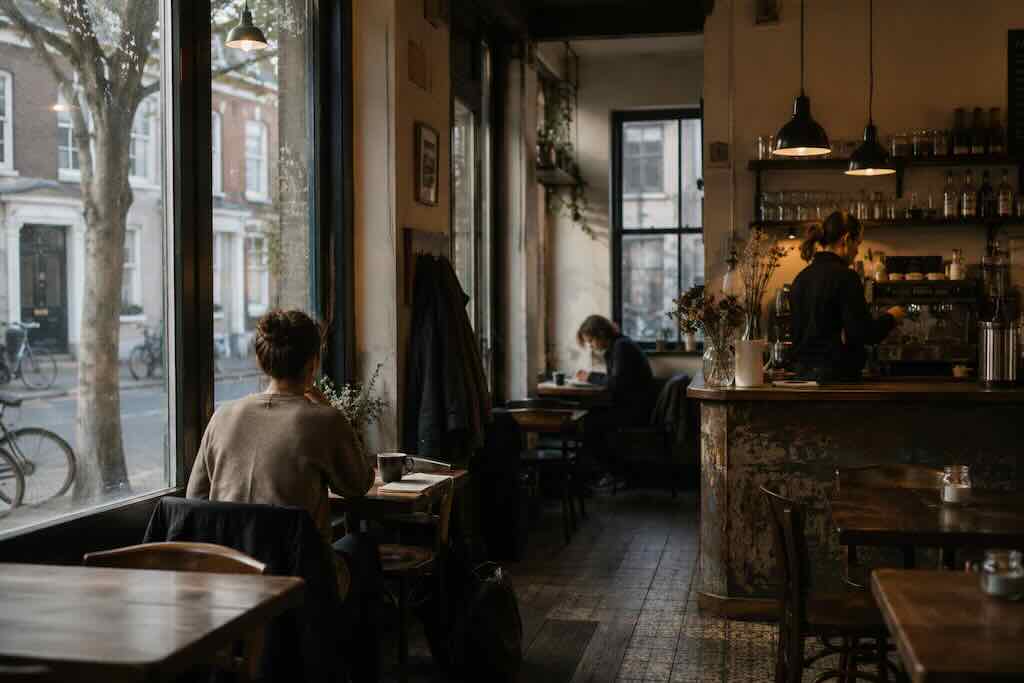
Somewhere in your week, there may be a place where nobody needs to ask what you are doing there.
It could be the coffee shop you visit on Saturday mornings, the library where you work for an hour after lunch, a neighborhood bar, a swimming pool, a park bench or the same small grocery store on the walk home. You may know the people there well. More likely, you know them only slightly: the person behind the counter, the man who always reads by the window, the dog you see on the same path.
Nothing particularly important has to happen. That may be part of the value.
In lives increasingly organized between private homes, workplaces and digital spaces, regularly returning somewhere physical can provide a quieter kind of connection: familiarity without obligation, company without necessarily having plans, and a small sense of belonging to the place where you live.
There is a name for places like this
Sociologist Ray Oldenburg popularized the idea of the “third place”: somewhere outside the home and workplace where people can gather informally. Cafés are the obvious example, but libraries, parks, bars, bookstores, salons, community centers and other ordinary gathering places can serve similar roles.
The concept has since become part of a wider conversation about social infrastructure and public health: the physical places and institutions that create opportunities for people to encounter one another.
What makes the idea interesting is not simply that these places exist. It is what can happen through repetition.
Go somewhere once and you are a visitor. Go every Thursday and you begin to recognize its rhythm.
Familiarity is a small form of belonging
Regular places accumulate details.
You learn which table catches the afternoon sun. You know when the pool is crowded and when it becomes quiet. You notice that the park smells different after rain. The person working the morning shift begins to recognize you before you order.
None of these relationships needs to become a friendship to matter.
Research into social infrastructure distinguishes between close relationships and the weaker connections that develop through everyday public life. Libraries, parks, cafés and similar spaces can create opportunities for repeated casual encounters; over time, researchers have linked such encounters with familiarity, neighborliness and trust. Recent research on social cohesion also points to the role shared neighborhood spaces can play in bringing residents into contact with one another.
There is something reassuring about being recognized without needing to perform intimacy. Someone remembers your order. You nod to the same person at the gym. The librarian has seen you enough times that your face is no longer entirely anonymous.
You are not among friends, exactly. You are simply no longer among complete strangers.
Being around people is different from making plans with them
Much of adult social life requires coordination. Dinner means finding a night everyone is free. Seeing a friend may require messages sent days in advance. Even casual plans can acquire calendar invitations and logistical negotiations.
A regular place asks for less.
You can sit in a café alone and still hear conversation around you. You can walk through a park without speaking to anyone. You can spend an hour at a library surrounded by people occupied with entirely separate lives.
That distinction matters because social connection is not produced simply by placing people in the same room. A recent study of working-age adults in rural America found that the relationship between certain gathering places and lower odds of loneliness was associated specifically with actually talking with other people there. Passive presence did not show the same pattern across the places studied.
It is an important correction to an appealing idea. A coffee shop is not a treatment for loneliness, and sitting among strangers does not automatically create community.
What these places can offer is opportunity: the conditions in which small interactions are allowed to happen repeatedly.
Regular places make a neighborhood more legible
There is another change that happens when you stop treating the area around your home as somewhere you simply pass through.
You begin to know it.
Not in the way a visitor knows a neighborhood after reading a guide, but through repetition. You know where the evening light reaches the sidewalk. You notice when a storefront changes hands. You recognize which streets become noisy after school and which become almost empty on Sunday mornings.
A regular destination gives those observations an anchor. The walk there becomes familiar too. So do the people and businesses around it.
This is easy to underestimate because nothing about it feels significant while it is happening. There is no moment when a neighborhood formally becomes yours. Familiarity builds through dozens of uneventful returns.
The best regular place may not be the best place
Finding somewhere to return to is different from searching for the highest-rated version of it.
The best coffee in the city may require a 35-minute journey. The most beautiful park might be across town. Neither is necessarily as useful to everyday life as the unremarkable place around the corner that you can reach without planning.
Convenience helps repetition happen.
So does comfort. A useful regular place is somewhere you can reasonably afford to visit, where staying for an appropriate amount of time feels natural and where you do not need a special reason to arrive. For some people that will be a commercial space. For others, free public spaces such as libraries and parks matter much more.
Access is not evenly distributed. Research into third places in the United States has found geographic and socioeconomic differences in their availability, which is one reason the conversation should extend beyond romanticizing neighborhood cafés. A welcoming library, park or community center can be just as important to the social texture of a place.
You do not need to turn it into another habit to optimize
There is a temptation to take any potentially useful part of life and turn it into a prescription: visit your third place three times a week, speak to two strangers, leave your phone at home.
That misses the point.
A regular place becomes meaningful precisely because it can remain ordinary. You go because the coffee is good enough, because you like the walk there, because the pool is quiet at seven, because you need a book, because sitting under the same tree for half an hour feels better than staying inside.
Conversation may follow. Recognition may follow. Neither has to be forced.
The U.S. Surgeon General’s work on social connection has drawn attention to the importance of environments that support human connection. At the scale of an ordinary week, that can begin with something much less ambitious than building a social network.
It can begin with going back.
Eventually, the person behind the counter looks up when you walk in. The path through the park becomes automatic. You have a preferred chair at the library, even though it does not belong to you.
The place has not become home. But it has become part of where your life happens.
Frequently asked questions
What is a third place?
A third place is an informal gathering place outside the home and workplace. Depending on the community, it might be a café, library, park, bar, bookstore, salon, recreation center or another accessible place where people regularly spend time around others.
Does a third place have to be social?
The traditional concept emphasizes informal social interaction. You do not need to arrive with friends, however. Part of the value of these spaces is that repeated visits can create opportunities for casual recognition and interaction with other people.
Can a library or park be a third place?
Yes. Third places are not limited to cafés, restaurants or other businesses. Libraries, parks, community centers and other public spaces can provide important places for people to spend time and encounter others without requiring significant spending.
How do you find somewhere to go regularly?
Start close to home and prioritize somewhere that fits naturally into your existing life. Accessibility, comfort and the ability to return without much planning matter more than finding the most fashionable or highly rated place in the city.