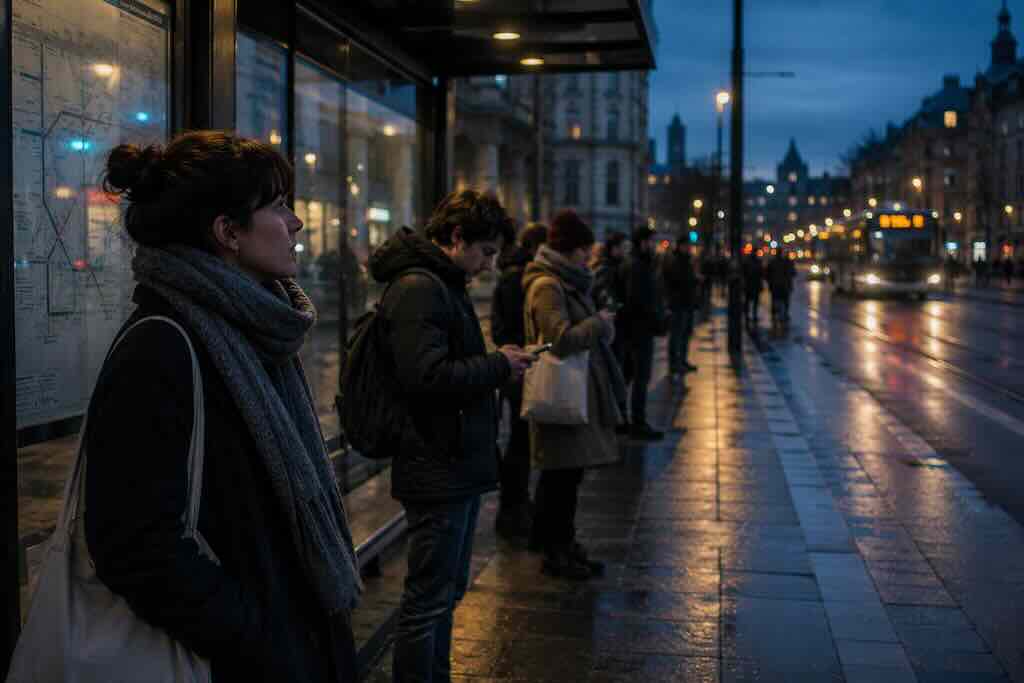
Waiting used to have a texture.
You stood at a bus stop and watched traffic. You arrived early and sat in a lobby with nothing particularly interesting to read. A friend was ten minutes late, so you looked around the room. The elevator took too long. The coffee was not ready yet. The train was somewhere down the line.
None of this was necessarily pleasant. Waiting could be boring, awkward and irritating. It still can be.
What has changed is how rarely those empty minutes are allowed to remain empty. A queue becomes three messages answered. An elevator ride becomes a notification checked. Thirty seconds before the light changes is enough time to reach for a screen.
We still wait. We have simply become remarkably good at making waiting disappear.
The empty minute has become usable
The smartphone did not invent distraction. People have always carried books onto trains, read newspapers over breakfast and picked up magazines in waiting rooms.
What changed was availability.
A book requires some intention. A newspaper eventually ends. A phone offers communication, news, games, music, video, shopping, maps, work and an effectively bottomless supply of small things to look at. It travels in a pocket and can fill almost any interval.
The result is subtle. Five minutes no longer has to feel like five minutes. It can become a handful of unrelated activities compressed into the space between one thing and the next.
Even very short waits now contain the possibility of stimulation.
Waiting really can feel uncomfortable
There is no need to romanticize boredom to understand why we avoid it.
In one experiment, researchers left participants alone in an empty room for seven and a half minutes as part of a study of boredom and perceived waiting time. Participants who experienced greater boredom felt that time passed more slowly and thought about time more frequently.
That familiar feeling has a psychological basis: when very little is happening, we can become unusually aware that time is passing.
Give attention somewhere to go and the experience changes. A later experiment comparing passive waiting with either smartphone use or a non-digital activity found that people left simply waiting felt more bored and experienced time as passing more slowly than participants given something to do.
Reaching for a phone while waiting therefore makes intuitive sense. It solves an immediate problem remarkably well: there is suddenly something happening.
But we are not always waiting for the phone to ask
It is easy to blame notifications for every glance at a screen. The behavior is more complicated.
A broad review of boredom in the digital age notes research in which most observed smartphone interactions were initiated by the user rather than triggered by the device. The same review describes a growing body of evidence connecting fragmented digital attention, habitual checking and boredom, while cautioning that the relationships between them can run in more than one direction.
That distinction changes the picture.
Sometimes nothing buzzes. Nobody has contacted us. There is no information we urgently need.
There is simply a gap.
The hand moves toward the pocket anyway.
A queue used to be a small public space
Waiting also once placed us in a peculiar relationship with strangers.
At a station, doctor’s office or checkout line, other people were part of the environment. You did not necessarily speak to them. Mostly you did not. But you saw them.
You noticed the person becoming impatient at the counter. Someone moved aside to let a parent with a stroller pass. Two strangers made the same expression when the train announcement changed again. Occasionally, a conversation began for no better reason than that two people were standing in the same place with nothing else to do.
Phones do not make those encounters impossible, and there is no reason every queue should become a community-building exercise. Still, an experiment examining phone access while strangers waited together found that participants with access to their phones socialized less than those without them and reported a worse experience across the waiting period.
The interesting part is not that strangers ought to talk more. It is that waiting once created conditions in which they sometimes did.
We have made waiting easier in genuinely useful ways
Not every disappearing wait deserves to be mourned.
Knowing exactly when a bus will arrive is better than wondering whether it has already gone. A message can explain that someone is running late. A restaurant can tell you when your table is ready instead of keeping you beside the host stand. A map can show traffic before you leave.
Uncertainty is one of the most frustrating parts of waiting, and technology can remove a great deal of it.
There is also nothing inherently superior about staring at a wall instead of reading something interesting on your phone. Empty time is not automatically profound simply because it is offline.
The more interesting question is whether every small interval needs to be occupied simply because it can be.
Boredom has not disappeared
If unlimited entertainment were a straightforward cure for boredom, the age of the smartphone should have made boredom considerably less interesting to psychologists.
Instead, a 2024 review published in Communications Psychology examined evidence that boredom may be increasing in the digital age. The authors argue that abundant digital stimulation can fragment attention, while rapidly switching between content may reduce engagement rather than satisfy it.
This creates a curious possibility. We can remove the immediate experience of having nothing to do without necessarily becoming less bored.
A spare minute becomes a scroll. The scroll provides stimulation. Yet the experience may be too fragmented to become particularly absorbing.
The empty space has been filled, but perhaps not occupied in any meaningful sense.
There used to be more edges between things
This may be the part of waiting worth noticing.
A day contains obvious activities: working, eating, traveling, meeting someone, exercising, watching something, going to bed. But it also contains the edges around them.
The walk from the office to the station. Three minutes before a friend arrives. Standing beside the oven. Sitting in the car before going inside. Waiting for the shower to warm up.
These moments do not have to be productive. They do not even have to be enjoyable.
They simply provide small transitions in which the previous thing has ended and the next one has not yet begun.
Once every edge contains a screen, the day can start to feel continuous. Information flows into entertainment, which flows into messages, which flows back into work. The bus arrives and the phone goes into a pocket. The meeting starts and the browser closes. There is barely a seam.
Perhaps waiting does not need to become a practice
It would be easy to turn this observation into another rule.
Do not check your phone in line. Spend ten minutes being bored each day. Practice intentional waiting.
That would give an ordinary part of life more importance than it needs.
You can answer the message. Check when the train is coming. Read the article. Put on a song. There are plenty of moments when a phone makes waiting easier, safer or simply less tedious.
But the next time there are two minutes with nothing in them, it may be worth noticing the impulse to immediately put something there.
Look out the window. Watch the room. Let the elevator arrive.
Not because waiting is secretly good for you. Because not every minute has to become something else.