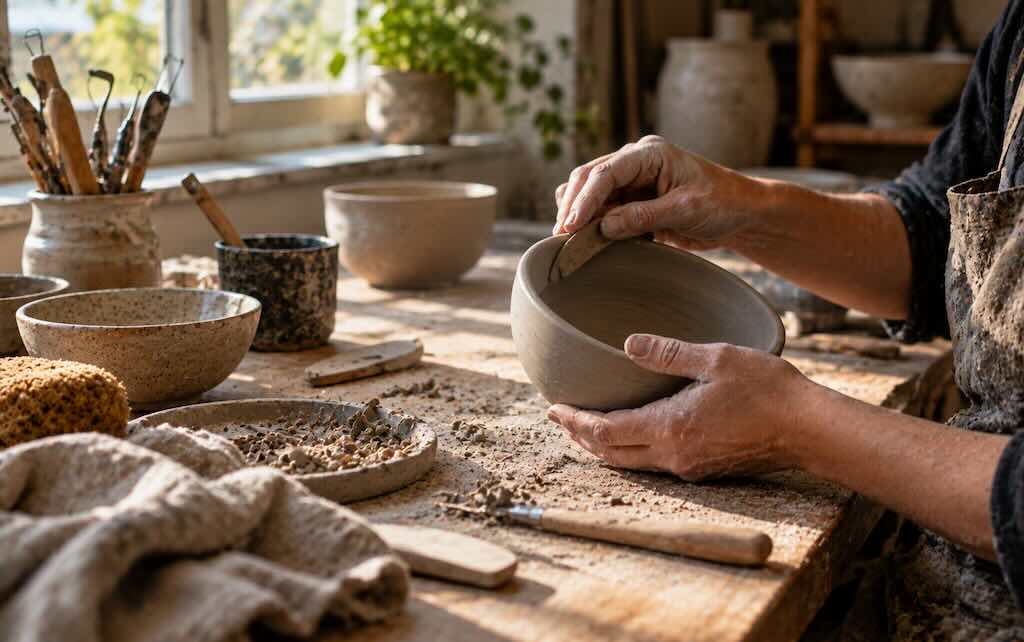
You can usually see where the hand has been.
The rim of a ceramic cup is not quite circular. Two knitted sleeves differ by a fraction. The marks left by a carving tool remain in a wooden spoon. A repaired shirt has a line of stitches that would never have appeared on the original.
For much of modern manufacturing, these were problems to solve. Industrial production became extraordinarily good at making one object exactly like the next.
Yet the evidence of making has acquired its own appeal.
Ceramics studios fill evening classes. Visible mending has turned repair into decoration. Small workshops sell brushes, baskets, knives, textiles and furniture with the name of the person who made them attached. Craft fairs sit alongside online shops, allowing a pot thrown in a small studio to find a buyer hundreds of kilometres away.
Calling this a return is slightly misleading. People never stopped making things by hand. What has changed is the attention we give them.
We notice variation because we are surrounded by sameness
Pick up six factory-made glasses from the same box and their similarity is reassuring. They stack properly. One can break and be replaced without disturbing the set.
Put six hand-thrown cups together and the differences become part of what you look at.
One glaze has run further. One handle sits slightly higher. The clay has darkened differently in the kiln. The maker may have intended a family resemblance rather than exact copies.
This does not automatically make the handmade object better. Industrial production has given us affordable, safe and remarkably well-made things. A handmade plate can be beautiful and inconvenient. A factory-made chair can last for generations.
The distinction is elsewhere.
With a handmade object, variation can tell you something about how it came into existence. Material met a particular pair of hands, on a particular day, through a process that allowed some evidence of that encounter to remain.
Craft did not stay outside the internet
It would be tempting to position craft as an antidote to digital life: the potter leaving the screen for clay, the knitter rediscovering patience, the woodworker choosing something tangible over something virtual.
The reality is less tidy.
The internet has become one of the reasons small-scale making can reach such a large audience.
The UK’s Crafts Council found in its Market for Craft research that 10.3 million people in Britain were buying craft online by the time of its 2020 report, more than three times the number a decade earlier. The majority still preferred buying craft in person, but online platforms had substantially widened access to makers.
The same screen that delivers mass-produced furniture tomorrow can show a potter opening a kiln this afternoon.
That visibility matters. We can see objects being thrown, woven, forged, stitched and carved before seeing their finished forms. Processes once largely hidden inside studios have become part of how makers explain and sell their work.
It has made the making itself visible again.
Buying from a maker changes the object slightly
A mug remains a mug whether you know who made it or not.
But knowledge has a way of attaching itself to things.
You remember that the bowl came from the ceramicist at the end of the market. The blanket came from a mill you visited on holiday. The wooden spoon was carved from a tree that fell locally. The ring was made to order and took six weeks.
The object’s function has not changed. Its context has.
This helps explain why physical craft fairs continue to matter even when the work can be bought online. Material is difficult to understand completely through a screen. Weight, texture, balance and scale are unusually important when choosing something whose appeal lies partly in how it was made.
Meeting the maker adds another layer. You can ask what the glaze is, why the handle looks that way, what kind of wood was used or how long the cloth took to weave.
The object arrives with a little more information than a barcode.
Making something yourself changes what you see
There is another side to the renewed visibility of craft: people do not only want to buy it.
They want to try.
Pottery workshops, sewing classes, knitting groups, printmaking sessions and furniture courses offer the experience of being bad at something physical for a while.
Your first pot may be heavy. The seam wanders. The chair takes much longer than expected. The basket that looked simple when somebody else made it suddenly involves a sequence of decisions you had not noticed.
This is one of the useful consequences of learning even a little craft. It changes the way you look at other people’s work.
A clean joint in a piece of furniture becomes visible. So does the consistency of a row of stitches. You begin to understand why a handwoven textile costs what it does, or why making twenty apparently simple cups requires more than multiplying the effort of making one.
You may never become particularly good at the thing yourself.
You become better at seeing it.
Repair belongs in the same conversation
Making by hand is not limited to creating something new.
Darning a sock, replacing a chair seat, sharpening a knife, sewing on a button or repairing a broken piece of furniture all require a different relationship with an object from throwing it away.
Repair is receiving institutional attention as well as cultural interest. In 2026, EU member states began applying new right-to-repair rules intended to make repairing certain consumer goods easier and extend their useful lives.
The legislation concerns manufactured products rather than craft, but the underlying question is connected: what would change if an object were expected to remain with us long enough to need care?
Repair makes time visible in a way replacement does not.
A patch shows where fabric wore thin. A new handle records the moment an old one broke. A repaired chair carries both the work of the original maker and the person who kept it going.
Not every repair needs to disappear.
Handmade does not mean simple
The romance around craft can obscure the economics of it.
Someone still has to pay for the workshop, materials, tools, electricity, shipping and the hours spent making an object. Small-scale production does not become inexpensive simply because the studio photographs beautifully.
The Crafts Council’s 2025 Makers Survey, based on responses from more than 1,000 UK makers, described a lively sector facing substantial pressure from rising operating costs, limited funding and competition from low-cost mass-produced goods.
This is worth remembering when handmade objects appear expensive beside superficially similar things produced by the thousand.
It is also why buying handmade cannot sensibly become another moral requirement. Not everyone can spend considerably more on a bowl, jumper or table simply because a person rather than a production line made it.
There are other ways to have a longer relationship with things: buying secondhand, maintaining what you already own, repairing it when possible and resisting replacement when replacement solves no real problem.
The useful imperfection is the one that tells you something
We have become good at manufacturing the appearance of handmade things too.
Factory ceramics arrive with deliberately uneven glazes. Furniture is distressed before anyone has lived with it. Identical objects are given small variations so that they appear less identical.
That does not necessarily make them bad objects. It does reveal how desirable the visual language of making has become.
The more interesting handmade things do not need to perform imperfection. Their differences come from process.
A basket carries the rhythm of weaving. A pot records pressure from fingers and tools. A piece of furniture reveals how two pieces of wood meet. A mend tells you exactly where something failed.
Perhaps that is what we are looking for when we pick up an object and turn it over to see the bottom.
Not perfection, and not imperfection for its own sake.
Just some evidence that somebody was there.