
When Gail Morin was 12, a poem she wrote won an award. She remembers thinking that she wanted to become a writer, although she had no particular subject in mind. She certainly hadn’t imagined a golden retriever wearing a detective hat.
Decades later, after a career in education, that early ambition has found its place. Gail, who lives in Locust Grove, Virginia, is the creator of Detective Sam, a friendly golden retriever who investigates mysteries with children and invites young readers to help him along the way. Sam is also the family’s therapy dog in her Bible Time Travelers stories.
Her years in the classroom are present in the smallest decisions. Gail thinks about whether a child has enough room on an activity page to draw, whether an instruction makes sense without explanation and whether a quieter character gets the chance to contribute. Emma, a character who uses a wheelchair, is part of the mystery rather than watching from the sidelines. She asks questions, looks for clues and has something to offer.
Gail is interested in what happens when children are invited to notice things for themselves. A story about someone being left out might prompt a question about friendship. A colouring page might give a child time to talk about something that would be harder to explain face to face. She makes downloadable activities available for families and educators, including separate resources for public-school settings and Christian audiences.
She is also developing Detective Sam and the Bible Time Travelers as an animated project, extending the character beyond books and printable activities. Moving from the page to animation has meant thinking differently about how a scene unfolds, what children see and hear, and when they might want to join in.
Creating Detective Sam has brought plenty of unfamiliar work. Through Detective Sam Media LLC, Gail has been navigating book production, website downloads and the early stages of animation. Some days, preparing a print file takes more time than writing. Retirement has given her more freedom to choose how she spends her days, but the responsibility for keeping the project moving is hers.
There is still room for quieter hours. Gail enjoys staying in a cabin, walking outdoors and stopping to watch wildlife. She doesn’t always turn those moments into material. Sometimes she simply wants to be outside.
In conversation with Good Hours, Gail talks about the childhood memory that stayed with her, the classroom experiences behind Detective Sam, the practical work of becoming an author and why starting with one page can be enough.
Good Hours / Culture
Creator File — 2026
Creator
Spotlight
Good
Hours
Featured Creator / In Conversation
Gail Morin
Children’s Author / Retired Educator
“Sometimes the one who’s been quiet is the one who spots what everyone else missed.”
Gail Morin / On Writing for Children
The Writer She Wanted to Become at 12
Good Hours: After a career in education, you chose to begin a new chapter as a children’s author. What first inspired you to pursue storytelling, and was writing something you’d always imagined doing after retirement?
I was 12 when a poem I wrote won an award. I remember thinking, “I want to be a writer.” I couldn’t have told you then what I’d write or when I’d do it. I certainly hadn’t pictured a golden retriever with a detective hat.
Years later, working with children gave me something I wanted to write about. It can be hard for a child to say, “I felt left out today.” Sometimes it’s easier to start with what happened to someone in a story. I liked the idea of writing an adventure a child would want to finish and giving them a way into that conversation at the same time.
Good Hours: Retirement can mean very different things to different people. How did your everyday life change when you stepped away from teaching, and what has having a creative project brought to this stage of your life?
For years I planned my days around a classroom. Now a day might begin with a scene I want to finish and end with me figuring out a book file or revising an activity for younger children. I enjoy having more say in what I work on each day. I also have to be the one who sits down and gets it moving.
The project gives me a sense of purpose. I still get to ask the questions I cared about as a teacher. What will a child be curious about? Where might they need a little help? Now I get to answer those questions by making something and seeing how it comes together.
Good Hours: You’ve spent years working in education. Is there a particular experience, conversation with a student, or classroom moment that has stayed with you and continues to influence the stories you want to tell?
What has stayed with me from teaching is how much it matters to a child to feel like there’s a place for them in the group. I keep coming back to little moments, like whether someone makes room for a child to join in or gives them enough time to answer a question.
That comes up when I write Emma, who uses a wheelchair. I want her to be in the middle of the mystery, asking questions and finding clues. I think about what each child gets to do in a story. Sometimes the one who’s been quiet is the one who spots what everyone else missed.
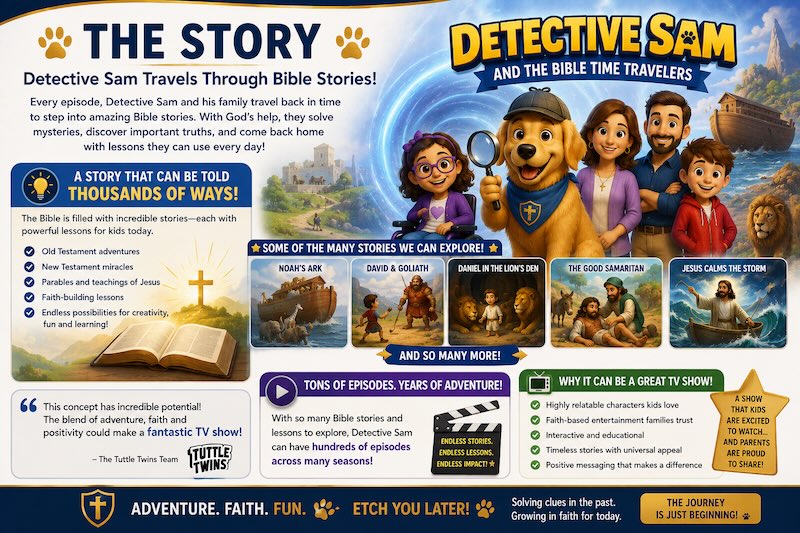
A Golden Retriever With a Detective Hat
Good Hours: Detective Sam is at the centre of your storytelling project. How did the character first come into your imagination, and what made you feel that Sam had the potential to connect with children and their families?
I’m a huge animal lover, so it felt natural to put a dog at the centre of the adventure. I imagined a friendly golden retriever who could make a child feel comfortable and still be funny enough to go around investigating with a magnifying glass. In the Bible Time Travelers stories, Sam is the family’s therapy dog as well as their fellow detective.
What made me want to keep writing him was the idea that children could help him. They can call out a clue, guess where he should look or notice something he walks right past. I like to picture the grown-up reading along and making a guess, too.
Good Hours: Your stories aim to encourage conversations about choices and kindness. How do you approach those subjects without making a story feel like a lesson, and what do you think children can teach adults about seeing the world differently?
I start with something the reader wants to find out. What happened? Who saw it? What’s Sam going to do now? If somebody gets left out, the choice another character makes about whether to go over and invite them in can change what happens next. The child gets to see what that choice means to somebody.
Children are good at asking the simple question adults can walk right past. “Why can’t she play with them?” is a perfectly good question. When a child asks it, I think the grown-up can learn a lot by asking what they noticed and giving them time to tell you.
The Conversations That Begin With a Crayon
Good Hours: Alongside your books, you offer free downloadable activities for families and educators. Why was it important to make those resources freely available, and how would you love to see parents and children using them together?
I wanted a teacher or parent to be able to print one page and use it that day. It helps if there’s something you can try straight away, whether you’re at the kitchen table or looking for a short group activity.
I’d love for a grown-up to sit down and colour alongside the child. You could ask, “What do you think Sam should do?” If the page is about getting help, you could each draw someone you’d go to. The drawing can give a child a little time to think. You might hear more while you’re both looking for the blue crayon than you would if you sat down just to ask questions.
Good Hours: You’ve created resources for different settings, including materials intended for public schools and separate Christian resources. How do you approach writing for families and educators with different backgrounds, beliefs and expectations?
I think about who will be using the page and what they came looking for. The public-school resources use situations children can recognise from school and everyday life, like being left out of a game, seeing someone get teased or deciding which trusted adult to go to for help. A class can talk about those choices together, and families can bring their own experiences to the conversation.
My Christian faith is important to me, and it has its own place in Detective Sam and the Bible Time Travelers. In those adventures, the children follow clues inside Bible stories and talk about what they’ve found. I label the Christian resources clearly so families and educators can choose what fits their setting.
From Classroom Questions to Finished Pages
Good Hours: How does a Detective Sam story or activity come together, and how does your teaching experience shape the finished result?
I start with an adventure or a situation I want a child to think about. Then I work out what Sam and the children will do and where the reader can join in. With an activity page, I pay attention to how much reading it asks of a child, whether the directions make sense and whether there’s room for a child to come up with an answer of their own.
Once I have a draft, I read it aloud. If a line feels too long to say in one breath, I’ll see where I can break it up. I look at an activity the same way I would have in the classroom. Can a child tell where to start? Is there enough space to draw? Those little things can make the difference between a child joining in and a grown-up having to explain the whole page.
Good Hours: Starting a creative project also means learning unfamiliar skills and making decisions outside your original profession. What has been the most challenging or unexpected part of becoming an author and developing Detective Sam Media LLC?
I knew I’d have to learn about publishing. I was surprised by how many separate jobs that meant. There are days when I spend more time getting a cover or a print file ready, or making sure someone can find a download on the website, than I do writing.
Animation has been another learning curve. I know how I want a scene to feel when a child watches it. Explaining that to someone else means thinking about what they’ll see, what they’ll hear and where there’s room for them to join in. I’ve had to get comfortable asking questions and revisiting things I thought I’d finished.
A Quiet Day in Virginia
Good Hours: When you’re not writing or working on Detective Sam, what does an ordinary good day look like for you in Virginia? Are there particular places, routines or simple pleasures that help you feel inspired or enjoy your time away from work?
A good day for me is pretty simple. I love spending time in a cabin, taking a walk outdoors and watching for wildlife. I’m happy to take my time and see what’s moving around me. If I spot an animal, I’ll stop and watch it for a while.
I live in Locust Grove, Virginia, and I enjoy having that quieter time away from the computer. My love of animals made its way into Detective Sam. On a walk, I’m just as happy to leave the story where it is and enjoy being outside.
Good Hours: For someone approaching retirement who has always wanted to write, make something or pursue an old interest but hasn’t yet found the confidence to begin, what would you tell them? And looking ahead, what are you personally most excited to explore in this new chapter?
Start with something you can do this afternoon. Write one page, sketch a character or get out the things you need for the hobby you’ve been putting off. You can keep that first attempt to yourself while you find out how it feels to do it. I’ve learned a lot simply by coming back to the work the next day.
I’m excited to keep developing Detective Sam and the Bible Time Travelers and to spend more time reading with children at schools, libraries and other community groups. I’d love to hear what clues they pick up and what questions they ask. When a child interrupts to tell you what they think is going to happen, that’s one of my favourite parts of reading a story together.
Gail’s advice to someone considering a creative project is modest: begin with something you can do this afternoon. A page, a sketch, an idea you don’t have to show anyone yet.
It’s a fitting approach for someone who now spends so much time thinking about how to help children take part. She knows that a small invitation can make a difference. In her stories, it might be a clue a child notices before the adults do. In her own life, it was a poem written at 12, and the possibility she eventually returned to.
Gail Morin and Detective Sam: Frequently Asked Questions
Who is Gail Morin?
Gail Morin is a retired educator and children’s author based in Locust Grove, Virginia. She created Detective Sam, a golden retriever character whose adventures invite children to solve mysteries and think about kindness, inclusion and everyday choices.
Who is Detective Sam?
Detective Sam is a friendly golden retriever who investigates mysteries alongside children. In the Bible Time Travelers stories, he is also the family’s therapy dog. Gail encourages young readers to look for clues and help the characters work out what happens next.
What inspired Gail Morin to become an author?
Gail remembers wanting to write after winning an award for a poem at age 12. Her later career in education gave her ideas for stories that could help children discuss experiences such as feeling excluded or needing support.
What is Detective Sam Media LLC?
Detective Sam Media LLC is Gail’s creative project for developing children’s stories, downloadable learning activities and animation connected to Detective Sam.
Is Detective Sam being developed as an animated series?
Gail is developing Detective Sam and the Bible Time Travelers as an animated project. The stories follow Sam and a family of young investigators through Bible-themed adventures. The project is in development.
Does Gail Morin offer free activities for children?
Yes. Gail offers printable activities intended for families and educators. They are designed to be easy to use at home or in a group, with opportunities for children to draw, answer questions and discuss choices.
Are Detective Sam resources suitable for public schools?
Gail creates separate materials for different settings. Her public-school resources focus on everyday situations such as inclusion, teasing and seeking help from a trusted adult. Her Christian resources are clearly identified and include stories connected to the Bible.
What advice does Gail Morin give to people starting something creative after retirement?
She recommends beginning with a small task that can be done immediately, such as writing one page or sketching a character. Her advice is to keep returning to the work and allow confidence to develop through doing it.