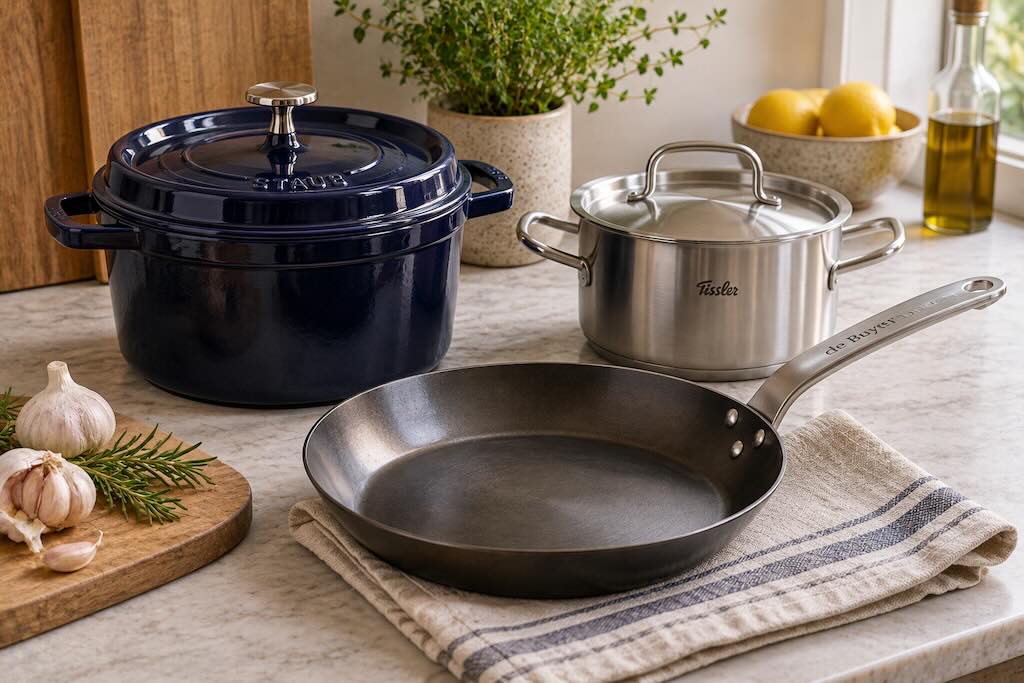
Some cookware is almost too beautiful to put away. A deep blue cast-iron pot sitting on the stove, a brushed-steel saucepan with perfectly balanced handles, a darkening carbon-steel frying pan that looks better after years of use. These are objects that can make a kitchen feel more personal, even when nothing is cooking.
But appearance is a poor reason to spend several hundred pounds or euros on a pan you rarely use. Good cookware should earn its storage space through the meals it helps you prepare, the way it feels to handle and the demands it places on your time.
We’ve selected three pieces that bring something different to the kitchen. Each has a distinct design, a practical purpose and a few compromises worth understanding before buying. None is essential for everyone, and none requires replacing cookware that already works.
The cast-iron pot that can go straight to the table
Staub La Cocotte, 24 cm
There is something particularly appealing about a pot that looks as appropriate on the dining table as it does on the stove. Staub’s La Cocotte has a restrained, substantial design: rounded handles, a fitted lid and richly coloured enamel that makes it feel more like a permanent kitchen object than another appliance to hide in a cupboard.
The 24 cm round model has a capacity of approximately 3.8 litres. Its enamelled cast-iron construction makes it suitable for braises, soups, stews and dishes that begin on the hob and finish in the oven. The enamelled interior also makes it useful for acidic preparations, such as tomato-based sauces, that are less suitable for seasoned carbon steel.
The appeal isn’t limited to slow cooking. A cocotte can be used for baking bread or bringing a shared dish directly to the table, reducing the need for separate serving cookware.
Who it’s for: Someone who regularly cooks one-pot meals, enjoys entertaining or wants a versatile oven-to-table casserole.
The limitations: Cast iron is heavy. Staub lists the standard 24 cm cocotte at approximately 4.6–4.75 kg before adding food, depending on the product specification. It also needs careful handling to protect the enamel. Although some models are labelled dishwasher-safe, the manufacturer recommends handwashing for long-term care.
Is it worth the price? Potentially, if you’ll use it every week for years. The premium is harder to justify if you mostly cook quick meals for one or already own a reliable casserole. A good secondhand enamelled pot, carefully checked for chips and damage, may be a more economical alternative.
Explore the Staub La Cocotte specifications at Zwilling.
The frying pan that improves as you learn to use it
de Buyer Mineral B Pro, 24 cm
Unlike colourful enamelled cookware, de Buyer’s Mineral B Pro frying pan has a distinctly utilitarian appeal. Its carbon-steel body and sculpted stainless-steel handle look as though they belong in a working restaurant kitchen.
It’s also a pan that changes with use. Carbon steel develops a dark seasoning layer as oil is heated on its surface. With proper care and practice, this can make cooking and releasing certain foods easier over time.
The Mineral B Pro is designed for high-heat cooking, including searing meat and browning vegetables. The 24 cm model works on induction and other common hob types, and its stainless-steel handle makes it suitable for oven cooking.
What makes this pan interesting is the relationship between the object and its owner. It won’t remain pristine. It will darken, develop marks and gradually become more familiar as you learn how much heat and fat different ingredients need.
Who it’s for: A keen home cook who enjoys frying, searing and learning traditional cooking techniques, and doesn’t mind looking after equipment.
The limitations: Carbon steel requires seasoning and thorough drying to help prevent rust. It cannot go in the dishwasher, and prolonged cooking with acidic ingredients can damage the seasoning. It is also heavier than many conventional non-stick pans.
Is it worth the price? The Pro model’s stainless-steel handle and oven compatibility make it attractive to someone who cooks frequently. But de Buyer’s less expensive carbon-steel ranges may offer better value if you don’t need those particular features. For someone who wants effortless cleaning and minimal maintenance, this isn’t the obvious choice.
Explore the de Buyer Mineral B Pro specifications.
The quiet appeal of well-designed stainless steel
Fissler Original-Profi Collection
Not all beautiful cookware needs colour or decorative details. Fissler’s Original-Profi Collection makes a case for brushed stainless steel, straightforward shapes and thoughtful engineering.
Made in Germany, the range includes saucepans, stockpots and frying pans. Its design is deliberately practical: wide pouring rims, integrated measuring scales on selected pots and sturdy handles. The stainless-steel surfaces have a restrained finish that suits both contemporary and traditional kitchens.
Stainless steel is particularly useful for everyday tasks involving liquids and sauces. Unlike seasoned carbon steel, it can handle acidic ingredients without damaging a seasoning layer. The Original-Profi cookware is also compatible with induction, and Fissler identifies the range as dishwasher-safe.
There is pleasure in small details that work properly. A saucepan that pours neatly, sits securely on the hob and can be cleaned without special rituals may prove more valuable than one that makes a stronger impression in photographs.
Who it’s for: Someone who cooks regularly, values easy maintenance and prefers a practical, understated design.
The limitations: Stainless steel isn’t naturally non-stick. Frying delicate foods requires attention to temperature, fat and technique. The premium price also deserves scrutiny, particularly when more affordable stainless-steel pans can perform many of the same everyday tasks.
Is it worth the price? For a heavily used saucepan, a robust construction and thoughtful details can justify paying more. But there’s little reason to buy a complete matching set if you only need to replace one pan. The most sensible purchase may be a single saucepan in the size you use most often.
Explore the Fissler Original-Profi Collection.
Which piece deserves a place in your kitchen?
These three choices serve different cooking habits. The right one depends less on which design you admire and more on what you find yourself reaching for during an ordinary week.
| Cookware | Best reason to consider it | Main compromise |
|---|---|---|
| Staub La Cocotte | Slow cooking, oven-to-table meals and versatile one-pot dishes | Weight and premium price |
| de Buyer Mineral B Pro | High-heat frying and a seasoned cooking surface | Maintenance and learning curve |
| Fissler Original-Profi | Everyday cooking with easy-care stainless steel | Price and the need for frying technique |
Before buying something new, look at what you already own
It’s easy to admire an expensive pan and imagine all the meals you’ll make with it. The better question is which meals you already cook and whether your current equipment makes them unnecessarily difficult.
If your saucepan heats reliably, pours without making a mess and is easy to clean, replacing it with a more attractive version may offer little practical benefit. If you regularly struggle to brown food in a worn frying pan, a suitable carbon-steel or stainless-steel replacement might make a noticeable difference.
Consider weight before buying cast iron. Check your hob compatibility, cupboard dimensions and whether you’ll actually follow the recommended care instructions. If possible, handle a pan in person: a beautiful object becomes less appealing when its handle is uncomfortable or its weight makes everyday cooking awkward.
Secondhand cookware is also worth considering. Stainless-steel pans can often remain useful long after their first owner has moved on. With enamelled cast iron, inspect the cooking surface carefully for chips, cracks or other damage before buying.
Beautiful cookware should be used
There’s nothing wrong with wanting cookware that looks good. Kitchens are living spaces, and the objects we handle every day contribute to how enjoyable they feel.
But the most convincing pieces combine appearance with a purpose. A cocotte that’s brought to the table every Sunday. A frying pan that gets better as you learn to cook with it. A saucepan you barely think about because it does its job so well.
The best cookware isn’t necessarily the most expensive or the most photographed. It’s the piece you keep reaching for, long after the pleasure of buying it has faded.