For a while, the spare corner of a room seemed destined to become something else.
A desk went there. Then perhaps a plant, a sculptural chair nobody particularly wanted to sit in, or another piece of storage. Living rooms became increasingly organised around screens, while smaller homes asked individual spaces to perform several jobs at once.
Now the reading corner is finding its way back in.
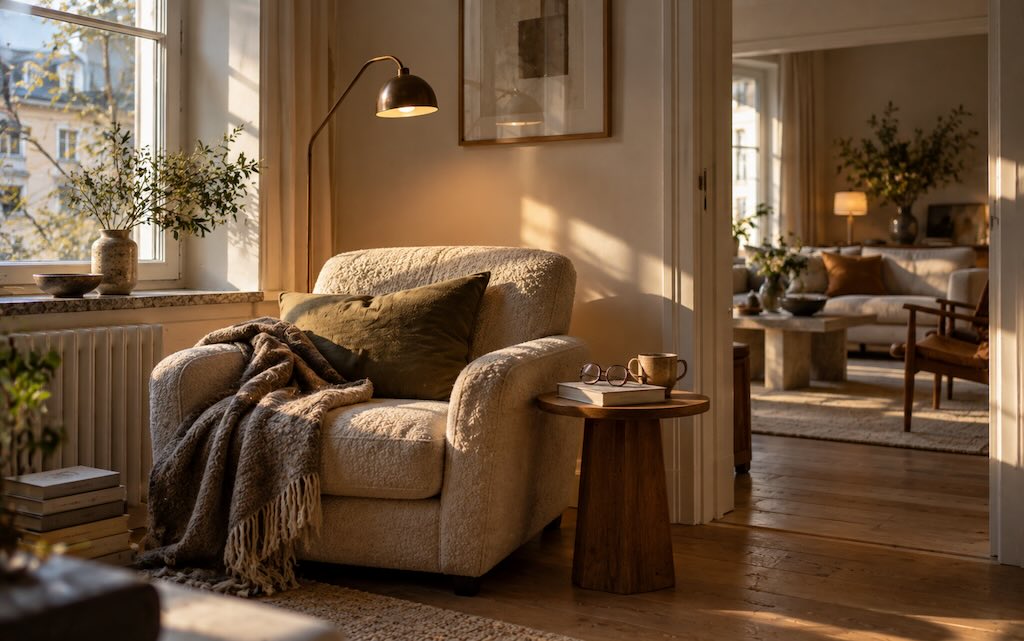
Not necessarily as the upholstered window seat with fitted shelves that the phrase “reading nook” tends to summon. The newer version can be much less architectural: one good chair, a lamp, somewhere to put a book and enough separation from the rest of the room to make sitting there feel intentional.
There are signs that people are actively looking for these spaces again. In its 2026 UK Emerging Trends Report, Houzz found searches for “reading nook” up 22%, while “small library” rose 317% and “cosy snug” 161%. Searches for alcove bookcases increased more than eightfold.
It is tempting to explain all of this as a reaction against phones. There is probably some of that in the appeal. But the more interesting change may be happening in the room itself.
We are giving the corner a job again.
A chair becomes different when it has a purpose
Most homes already contain somewhere you could read. A sofa. A bed. The kitchen table. The problem is rarely the physical impossibility of opening a book.
A reading corner does something slightly different. It assigns one small part of the room to an activity.
That affects how the space is arranged. The chair does not need to participate perfectly in the main seating group. It can turn towards a window rather than towards the television. A lamp can be positioned for the person sitting underneath it rather than for symmetry across the room. A small table only needs enough surface for a book, glasses and a cup.
The result often looks more personal because it has been arranged around behaviour rather than composition.
You can tell what is supposed to happen there.
You do not need a nook
The interiors version of a reading corner can become unnecessarily elaborate.
Built-in bookcases are lovely. So are bay windows, deep alcoves and benches made exactly to fit beneath them. None is a requirement.
Some of the best places to read are created by taking an ordinary chair and moving it somewhere slightly unexpected.
Try the end of a bedroom where a chest of drawers currently collects clothes. The awkward section beside a chimney breast. A wide landing. The part of the living room near a window that is too small for another sofa but too large to leave completely empty.
A corner begins to feel separate when its orientation changes. Turning a chair away from the main room by even a small amount can be enough. A rug, floor lamp or low table can strengthen the boundary without adding a wall.
This is useful in smaller homes because the idea does not depend on having a spare room. It depends on allowing part of an existing room to have a more specific purpose.
Start with the light
A beautiful chair in a dim corner is still a dim corner.
If the space will actually be used for reading, light deserves to be decided before almost everything decorative. Daylight makes a window an obvious starting point, but the corner should still work at nine in the evening in November.
A floor lamp beside or slightly behind the chair is often more useful than relying on the room’s central ceiling light. A wall-mounted reading lamp can work particularly well where floor space is tight. What matters is getting useful light onto the page without creating uncomfortable glare.
Then sit in the chair before deciding the rest.
Is there somewhere natural to put a drink? Can you reach the lamp without getting up? Does the chair remain comfortable after half an hour rather than thirty seconds in a furniture shop? Is there somewhere for the book when you stop reading halfway through a chapter?
These are small questions, but they are what separate a reading corner from a photograph of one.
Let the books accumulate normally
A reading corner does not need a library arranged behind it to establish its credentials.
In fact, a few books that are actually being read can make more sense than shelves assembled as a backdrop. Keep the current one beside the chair. Let the next one wait underneath it. If there is shelving nearby, use it, but there is no reason every book in the house has to migrate towards the corner.
The distinction is small but useful. Designing around reading is different from decorating with books.
Physical books still have a substantial place in how people read. Pew Research Center found that 64% of U.S. adults had read at least part of a print book during the previous 12 months in its October 2025 survey, compared with 31% who had read an e-book and 26% who had listened to an audiobook.
Those formats do not have to compete, of course. A reading chair works perfectly well with an e-reader. It can also be where you listen to an audiobook.
The useful thing about the corner is not what format you bring into it. It is that there is somewhere to go.
The room gets better even when nobody is reading
This may explain part of the reading corner’s return.
A room arranged entirely around its largest object can feel oddly settled before anyone enters it. Sofa faces television. Dining chairs face table. Bed faces whatever beds face. The plan is efficient, but there is not much ambiguity about where a person should be.
A chair turned towards a window changes that.
It creates another direction in the room. Someone can sit nearby without necessarily joining whatever is happening on the sofa. A person can read while somebody else watches television. The chair might occasionally be used for coffee, music or doing absolutely nothing.
That is not a failure of the reading corner. It is probably evidence that it works.
The nicest version is not a shrine to becoming the sort of person who reads fifty books a year. It is simply a comfortable place that makes picking up the book you are already reading a little easier.
Find the corner first. Give it a chair and enough light.
The books can come afterwards.