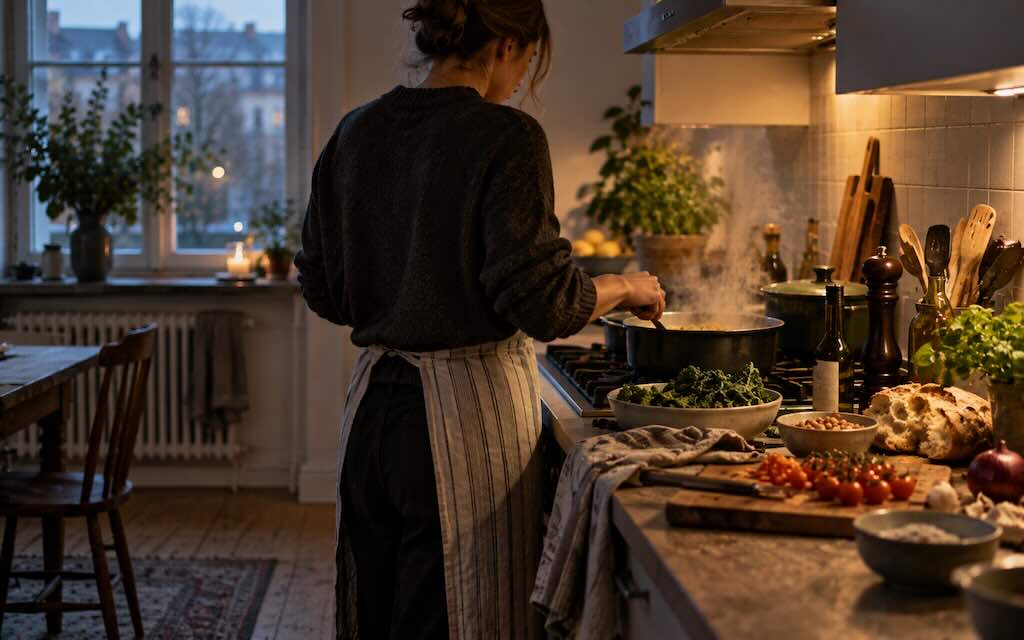
There are meals you cook and meals you know.
The second kind requires almost no negotiation. You know which pan to reach for, roughly how much rice to make, when the onions have had enough time and whether there is something in the freezer that can stand in for what is missing. You could probably make it while talking to someone.
These meals rarely look ambitious. Pasta with tomatoes and beans. Eggs, potatoes and something green. Rice with vegetables and tofu. Soup with bread. Yogurt, oats, fruit and nuts on a morning when breakfast needs to happen quickly.
Their value is repetition.
Eating reasonably well every day is easier when every meal does not begin with the question of what a reasonably well-balanced meal should be.
Dinner is harder at six than it was at ten
Morning plans tend to underestimate evening tiredness.
At ten, making dinner later can seem straightforward. By six, there may have been work, commuting, errands, messages and several smaller decisions that were not on the schedule. Opening the fridge becomes another problem requiring an answer.
This is where familiar meals earn their place. Not meal plans covering every day of the week, necessarily, but four or five things you can make without needing inspiration.
One might be pasta. Another could be a tray of roasted vegetables with chickpeas and a dressing. Perhaps there is an omelette that has slowly accumulated whatever combination of vegetables and cheese you usually have around. The point is less the recipe than the absence of uncertainty.
A meal you know by heart asks less of you at exactly the time of day when that can matter most.
Think in parts, not perfect plates
Nutrition advice can make an ordinary lunch feel strangely technical.
There is useful guidance beneath the terminology. The World Health Organization describes healthy diets through four broad principles: adequacy, balance, moderation and diversity. It recommends variety across foods including vegetables, fruit, whole grains, pulses, nuts and other sources of nutrients, while recognising that the exact diet will differ according to individual needs, culture and what foods are locally available.
In a kitchen, that can be translated more simply.
Start with something substantial. Add a source of protein. Get some vegetables or fruit into the meal. Include fats and carbohydrates rather than treating either as something that needs to be feared. Change the ingredients according to what you eat, what you can afford and what is in the cupboard.
A lentil curry with rice can do this. So can fish, potatoes and peas. So can beans folded into tomato sauce and spooned onto toast. There is no requirement that dinner resemble a carefully divided diagram.
Keep ingredients that can become several different dinners
A useful cupboard contains possibilities rather than one very specific recipe.
Tinned tomatoes can become pasta sauce, soup or the beginning of a stew. Beans can go into that sauce, onto toast or beside roasted vegetables. Eggs can become breakfast, dinner or the thing that turns leftover rice into another meal. Frozen peas require almost no planning at all.
Frozen and canned foods belong here without apology. WHO guidance notes that fresh, frozen and canned fruit and vegetables can all be useful choices, with attention to added sugars and excess sodium where relevant.
This matters because the ingredients that survive an imperfect week are often more useful than the ones bought for an ideal one.
Fresh spinach has plans for you. Frozen spinach is prepared to wait.
Cook once, leave yourself something
Batch cooking can sound like an entire Sunday disappearing beneath matching containers. It does not have to.
Make slightly too much.
Cook extra rice and use it the following day. Roast another tray of vegetables while the oven is already hot. Make enough soup for tomorrow’s lunch. Double the tomato sauce and freeze half before you become tired of eating it.
The useful unit is not necessarily a week of prepared meals. Sometimes it is simply one future meal that has already been partly dealt with.
Leftovers also become easier when they are thought of as ingredients rather than repetitions. Yesterday’s roasted potatoes can sit beside eggs. Cooked lentils can go into a salad or soup. Half a tray of vegetables can become the filling for a sandwich.
Tomorrow does not need the same dinner just because tonight produced extra food.
Make the easy option genuinely easy
A fruit bowl only helps if you like the fruit in it.
The same principle applies elsewhere. Nuts hidden behind baking supplies are less useful than the ones you can reach. Vegetables are easier to cook when washing and chopping them does not feel like the first act of a long production. Bread in the freezer can rescue breakfast when nobody remembered to buy any the day before.
Convenience is sometimes discussed as though it were incompatible with eating well. In practice, convenience can be part of what makes a varied diet possible on an ordinary Wednesday.
Pre-cut vegetables, canned pulses, frozen produce, cooked grains and other shortcuts can remove the part of cooking that is preventing dinner from happening. Which shortcuts are worthwhile will depend on price, availability and the way you actually cook.
The best shortcut is the one that gets used.
Not every meal has to correct the previous one
A large lunch does not require a punitive dinner. Cake in the afternoon does not create a nutritional debt that has to be settled before bed.
Healthy eating makes more sense as a pattern than as a sequence of individual tests. The joint WHO and Food and Agriculture Organization statement on healthy diets similarly frames diet around broad principles while recognising variation in preferences, cultural context and individual circumstances.
That longer view leaves room for meals chosen because they are convenient, celebratory, comforting or simply what somebody else wanted to cook.
It also makes repetition less suspicious. If you enjoy the same breakfast most mornings and it works for you, novelty is not automatically an improvement. Variety can happen across lunch, dinner, snacks and the week rather than being demanded from every plate.
Keep the emergency dinner
Every kitchen benefits from a meal for the night when cooking has lost the argument.
It might be eggs on toast with tomatoes. Pasta with frozen peas and olive oil. Soup from the freezer. A baked potato with beans. Hummus, bread, vegetables and whatever else can be put on the table without much preparation.
The emergency dinner does not have to be the most nutritionally impressive meal you eat that week. It has to exist before you need it.
There is a particular relief in opening a cupboard at the end of a long day and already knowing what happens next. Water boils. Something goes into the pan. Dinner appears without becoming another decision to carry.
Make enough that you know how to feed yourself. Leave the rest flexible.
FAQ
What does a balanced everyday meal look like?
There is no single ideal plate. A practical meal can combine foods that provide carbohydrates, protein and fats alongside vegetables or fruit, with variety across the wider diet. Individual needs and dietary patterns differ, so rigid proportions are not necessary for everyone.
Do healthy meals have to be cooked from scratch?
No. Frozen vegetables, canned beans and lentils, bread, tinned tomatoes and other convenient ingredients can make everyday cooking much easier. When choosing packaged foods, nutritional needs and factors such as added salt or sugar may be worth considering.
Is it fine to eat the same breakfast every day?
For many people, repeating a breakfast they enjoy can make mornings easier. Dietary variety can come from the foods eaten across the rest of the day and week rather than requiring every meal to be different.
How can I make weeknight cooking easier?
Keep a few familiar meals, stock versatile ingredients, use convenient frozen or canned foods where useful and make a little extra when you cook something that keeps well. The aim is to reduce the number of decisions required when you are hungry and tired.
What if I have specific nutritional or medical needs?
General healthy-eating guidance cannot account for every medical condition, allergy, deficiency, pregnancy, medication or individual nutritional requirement. Personal advice should come from an appropriately qualified healthcare professional or registered dietitian familiar with your circumstances.