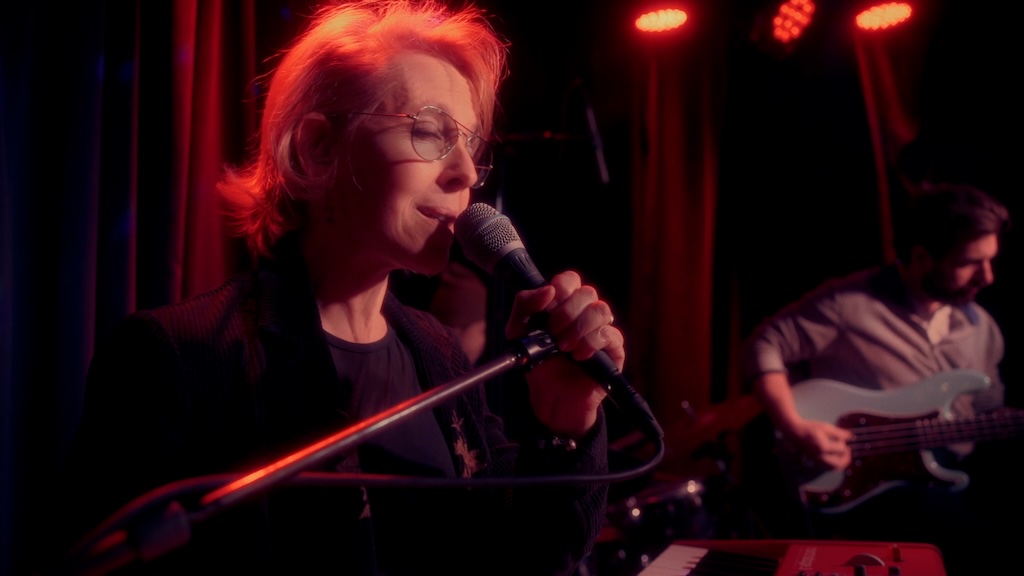
For Rallo Bennett, music and filmmaking offer different ways of exploring the same fascination: how stories are told, how emotions take shape and what happens when an idea becomes something other people can experience.
Film allows Bennett to build a scene through images, editing and carefully chosen details. Live music is less predictable. The energy of a room, the interaction between musicians and the small changes that happen during a performance can give a familiar song an entirely different character.
That contrast comes into focus on Live at Berlin, a six-track EP recorded at Berlin Under A in New York City. Bennett remembers a room filled with friends, film colleagues, musicians and strangers. During the performance, the audience began singing along to “Lonely with You,” an unexpected moment preserved in the recording.
Another song, “Pinch That Vein,” began with a conversation between friends about the patterns that can keep people attached to difficult relationships. Bennett heard a phrase that was too vivid to leave alone. The song became a way of approaching dependency and manipulation with frustration, recognition and a little humour.
There is a personal rhythm to moving between the two disciplines. A film can take a year or longer to move from script to screen. A song can begin at the piano, with one person trying to understand something that has happened. Both require patience, but music offers Bennett a more immediate form of connection.
In conversation with Good Hours, Bennett talks about finding light in difficult experiences, the intimacy of New York’s smaller venues, the collaborators who help bring the music to life and the pleasure of returning to a song without knowing exactly what will happen.
Good Hours / Music
Artist File — 2026
Artist
Spotlight
Good
Hours
Featured Artist / In Conversation
Rallo Bennett
Musician / Songwriter / Filmmaker / Educator
“When I write about something dark, difficult and full of conflict, I find the music allows me to find some light in the darkness and find joy in the reflection at the same time.”
Rallo Bennett / On Music and Difficult Emotions
Two Ways of Telling a Story
Good Hours: You’ve spent time telling stories through filmmaking as well as music. What can you express in a song that you find harder to communicate through images, dialogue or a film scene?
Songwriting presents me with some different options than film does as a visual medium. With a song I can be more direct with language, sounds and rhythm, as there aren’t visuals to help fill in the gaps – conversely I have to elicit words and sounds that might paint a picture, whereas in film I’m working visually and aurally be it with music, sound design and/ or words, but what’s not said is often more important in film as I have multiple characters to become different parts of the story which is akin to different instruments in an arrangement. But there is crossover in both – as storytelling is storytelling, characters and the perspective of the each are just represented differently be it symbolically, with one voice or character or multiple voices. I try to not ‘think’ too much when writing and composing, but trust my ear, inner voices, the desire to ‘see’ or understand something I have to get some clarity or do something positive with so it doesn’t consume me so to speak… I love combining both mediums through music videos, which allow me to explore visually what I already did with music and poetry.
Good Hours: Your work in both film and music seems drawn to the complicated parts of human relationships. Where does that fascination come from, and has your understanding of people changed as you’ve moved between the two disciplines?
When I write about something dark, difficult and full of conflict, I find the music allows me to find some light in the darkness and find joy in the reflection at the same time. The counterpoint music and lyrics can compliment each other in a very unique way. Both drama and songwriting allows me to put something potentially hurtful and negative and even destructive out there and turn it into recognition, clarity, humor, and sometimes something very healing. Music can add a lightness of being, and a level of acceptance that makes what was or is incredibly difficult, simultaneously empathic, understandable and even nourishing.
Being human is the one thing we all have in common – we have the relatively unique ability to step back and reflect – as well as be in the moment. It’s what connects us, and what we struggle with the most, be it at a global level or an individual relationship level. It’s really hard to make things work when there are deep needs, conflicts of interest, and still keep the love we naturally have as children or early on in a relationship alive and what keeps us connected in a way we deeply need to not only survive, but to reflect back the joys and the struggles we have.
There is so much to mine from even the smallest interactions; moments in relationships of all kinds that speak to the larger joys, fears, ambitions and anxieties we all face. If anything, both music and film have taught me just how much we all share many of the same experiences, and how with reflection and song we can support what is so very human about us, with compassion and without judgement.
The Story Behind “Pinch That Vein”
Good Hours: “Pinch That Vein” explores a relationship shaped by dependency and manipulation. What first drew you to this particular story, and how did you decide whose perspective the song should take?
Well it’s all very close to the bone — I have lived it, but whether I am drawing on something I see or hear that strikes a deep in me a chord in me, like “Closets” that I wrote based by a situation and relationship of a friend – it’s exactly what I recognized as something I’d felt and lived in some way. I write songs because I have to do something with what is happening to me and around me.
In this case I was talking with a close friend about when dysfunction in our relationships arises or reoccurs, and she said, ‘sometimes you just have to pinch that vein’… and it hit me that’s a song I have to write. It’s so visceral and was a way into a story I really wanted to sing about. After that, the music and the opening beat just came to me, which led me to the opening line – which called into play something I identified deeply with the woman who’s the voice of “A Thousand Shining Suns.” Bizarre as it might sound – I trust that that image came to be because it viscerally made me feel what I was writing about emotionally.
Good Hours: The song moves toward a moment of recognising that something cannot be repaired simply by trying harder. Why do you think that recognition can be so difficult, even when someone can see what’s happening?
I think when you want something badly, the reality that you might not get it can be difficult, sometimes almost impossible to reckon with. I like to think that approaching the idea in this song with a little bit of humor helps to reinstate that idea of shared humanity. The chorus was a grappling with the frustration that no matter what one sees and understands, if the other person in the relationship is not looking for connection through understanding and collaboration but through destructive means.
A Night at Berlin Under A
Good Hours: You’ve said the band gets to turn the attitude up considerably when performing “Pinch That Vein” live. Does the meaning of the song change for you when you’re singing it in front of an audience rather than recording it in a studio?
Part of the reason we released a live EP was because the songs really do take on a life of their own in-person. There’s a different energy, a freedom to let loose, be more dramatic and with the amazing energy the audience was bouncing back we love giving everything back to them tenfold. It doesn’t change the “meaning” of the song necessarily, but the experience of listening to it certainly does. A recorded song represents a different synergy, musicality and also the initial intention. Playing live allows us to find and play with new meaning and what it means in that moment in time. Live at Berlin – was a special performance and audience, we feel lucky it was also captured and recorded by the Berlin Under A and a filmmaker friend and DP, Mariano Flores and Jean-Luc McMurtry.
Good Hours: Live at Berlin captures a particular night at an intimate Lower East Side venue. What do you remember about the room, the audience or your bandmates that made that performance worth preserving?
It was such an exciting mix of friends, colleagues from both the film and music, friends of friends, and some people we didn’t know before which is always wonderful too! Getting to look out and see that melting pot was a reminder of how lucky I am to get to create art, and how many people I have had the honor of working with across my career. I’ve been collaborating and performing with guitarist Kevin Spencer Kendrick arranges and produces the music since at least 2011 and bassist Graham Orbe, for years. Mickey Santa Cruz is a longtime friend and colleague of Graham’s and has been recording and playing with us more recently but he brings so much inspiration with him and has such great vibe on what was our first live performance with him!
One thing that we couldn’t express on the EP is that we also premiered the music video for “Lonely with You,” which was shot on The Vessel in Hudson Yards. So in that way, it was yet another instance where the worlds of film and music could combine, this time on the side of live music and studio tracks. You can hear on the live recording, the audience going nuts on the chorus and singing along which was unexpected and thrilling!
Good Hours: As a filmmaker, you’re familiar with shaping a story through framing, editing and the choices made behind the camera. When filming a live performance, how do you decide what to capture without losing the spontaneity that makes the moment interesting?
It’s a funny thing because as much as we plan certain angles and placements, I’m on stage performing during the actual filming, so I have to hope that what’s being filmed is workable. It’s a nice surprise to get to review the footage when all is said and done, even if it can be a little strange to watch yourself perform. But again, Mariano Flores, who has DP’d multiple films I’ve directed, and is both a musician and filmmaker himself, did an amazing job with the roving hand held camera covering as all and the room together and Jean-Luc captured the closer shot which was important to the edit as well!
Returning to the Piano
Good Hours: You’ve described returning to music as returning to where you started. What brought you back to songwriting, and did your years working in film change the kind of musician you wanted to become?
There is something so pure, unfettered, honest, and powerful about just being able to sit down at the piano, play and sing some deeper truth and see how it resonates each time. You can do it by yourself, with one person, or many in a great venue. It’s something that happens on the set when you actually get into production and rolling – or in the movie theater when the final product’s being screened. It takes months or usually at least a year or more to make a film from script to screen, so music is a wonderful balance and anecdote to the longer arduous process. Not that a new song can’t take a long time to evolve but once a song is done, it becomes part of a body of work you can go back to and sing and share, as it’s hopefully something potent and universal and thus never gets old. And singing with and for other people who need or want to reflect with you and others sharing an experience in the room or via a recording is something we probably all need.
I can’t quite describe the level of connectivity it offers, but I think we all have felt it and know it, or people wouldn’t be going out to concerts in such numbers these days or enjoy watching live recordings of live music. But, to answer your question, I came back because I needed to, love the process, and find it so complimentary to the world of filmmaking.
Good Hours: New York has a long history of intimate music venues where the distance between performers and audiences almost disappears. What does playing in a room like Berlin Under A give you that a larger stage might not?
In a space like Berlin, there’s no hiding, false identities or disconnect – something I find incredibly wonderful. The audience is right there with you and can see you play every note and every emotion, intention and thought go across your face. They can see you sweat, what transpires between you and the band and you and everyone in the audience. All this really feeds the band’s energy and lets us be hyperaware of the shared experience that’s happening.
Life Beyond the Stage and Screen
Good Hours: Away from filmmaking, recording and performing, what does an ordinary evening look like when you’re able to enjoy music or a film simply as an audience member, without thinking about how it was made?
I’m generally a curious person, and try to experience as many art forms as I can, even mediums that I don’t create in myself. I’m also an educator; my partner Gary O. Bennett and I have been running Stonestreet Studios for over 30 years, developing young multi-hyphenates in front of and behind the camera via a unique residency program through immersion in our independent film studio.
In what sometimes feels like a distracted, split-focused world, I find immense joy and freedom in focusing on the work I do during the creative process, which has taught me how to live more in the moment and enjoy other people’s stories. This can be seeing a new independent film, checking out a hidden gem of a TV show, hanging out with my kids or cats, or even getting back to nature and letting some ideas flow outside. Playing music at home is pretty much a daily thing, as is sharing stories and finding common ground, even if it’s just at the dinner table with my family.
For Bennett, the distance between making art and living with it is often small. A conversation with a friend can become a song. A concert can become a film. An evening at home can involve music without any expectation that it will turn into a project.
What stays with Bennett from the Berlin performance is not only the recording, but the people who were there: longtime collaborators, familiar faces and an audience willing to sing along. It is the part of storytelling that cannot be fully planned, whether the work begins at a piano or behind a camera.
Frequently Asked Questions About Rallo Bennett
Who is Rallo Bennett?
Rallo Bennett is a musician, songwriter, filmmaker and educator whose creative work spans music and independent film.
What is Live at Berlin?
Live at Berlin is a six-track live EP recorded at Berlin Under A, an intimate venue on New York City’s Lower East Side.
What is “Pinch That Vein” about?
The song examines dependency, manipulation and the difficulty of recognising when a relationship cannot be repaired through effort alone. Its title came from a conversation Bennett had with a close friend.
How does filmmaking influence Rallo Bennett’s music?
Bennett approaches both disciplines through storytelling, character and emotional perspective. Music offers a direct connection through language, sound and rhythm, while filmmaking allows stories to unfold through images, sound and multiple characters.
What happened during the Live at Berlin performance?
The audience sang along to “Lonely with You,” and Bennett also premiered the song’s music video, filmed at the Vessel in Hudson Yards.
Who filmed the live performance?
Bennett credits filmmakers Mariano Flores and Jean-Luc McMurtry with capturing footage of the performance, including handheld coverage of the band and room and closer shots used in the edit.
What is Rallo Bennett’s connection to Stonestreet Studios?
Bennett says that they and their partner, Gary O. Bennett, have run Stonestreet Studios for more than 30 years, working with emerging performers and filmmakers through an immersive residency programme.
WEBSITE | INSTAGRAM | FACEBOOK | TIKTOK