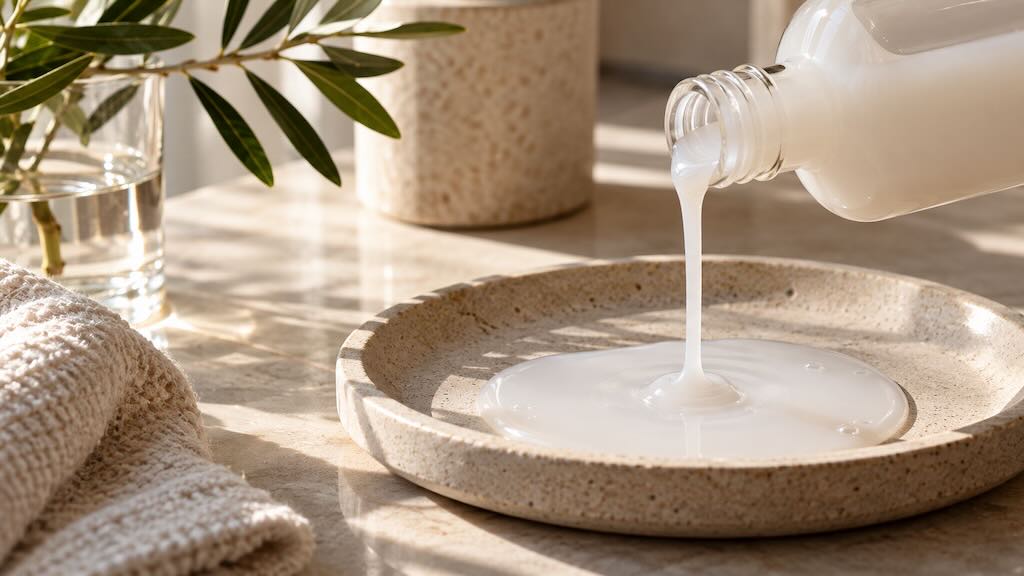
There is something particularly satisfying about a skincare product that pours like milk. It has more substance than water but none of the thickness of a conventional cream. Spread a little between your fingers and it seems to disappear almost immediately, leaving behind a softness that makes you want to use it again.
That feeling helps explain the appeal of milky skincare. From toners and essences to cleansers and lightweight moisturisers, these fluid, cloudy formulas occupy an interesting space between familiar product categories.
They also raise a reasonable question. If a milky toner feels like a very thin moisturiser, what exactly is it adding to your routine?
The answer depends less on the milky appearance than on what is inside the bottle.
Why milky textures feel different
Think about the products you already use. A watery toner tends to move quickly across the skin. A cream needs a little more effort to spread. A facial oil has its own distinctive slip and finish.
Milky skincare often sits somewhere between them.
A fluid milky formula can spread easily while leaving a softer, more cushioned sensation than water alone. Some leave a barely noticeable finish. Others feel closer to a lightweight lotion.
That combination can be appealing if you dislike heavy creams but find watery products unsatisfying. It can also make a skincare routine feel more comfortable without necessarily adding several steps.
There is a sensory pleasure here that shouldn’t be dismissed. The way a product feels influences whether we enjoy using it. A moisturiser can have a sensible ingredient list and still end up forgotten in a drawer because its texture is unpleasant.
But enjoying a texture and benefiting from a formula are two different things. A pleasant finish is a reason to like a product, not proof that it is better for your skin.
What makes skincare look milky?
Many milky skincare products are emulsions. These combine water-based and oil-based ingredients using emulsifiers that help keep the mixture stable.
The tiny droplets within an emulsion can scatter light, creating the cloudy or white appearance associated with milk. Other ingredients and formulation methods can also affect how a product looks.
What matters is that two equally milky products can behave quite differently.
One might contain relatively little oil and feel almost weightless. Another might include richer emollients and leave a more noticeable film on the skin. Both can look similar in the bottle.
The colour doesn’t tell you how much hydration a product provides, whether it will suit acne-prone skin or how well it will protect against moisture loss.
Those qualities depend on the complete formulation.
The difference between a milky toner, essence and moisturiser
One of the confusing things about milky skincare is how many different products can share the same appearance.
Milky toner
A milky toner is usually a fluid leave-on product applied after cleansing. Depending on the ingredients, it may help hydrate the skin, improve its feel or provide a light moisturising effect.
Modern toners are not necessarily the drying, alcohol-heavy products some people remember. As Cleveland Clinic explains, many contemporary formulas focus on hydration and comfort.
Milky essence
An essence can look and feel remarkably similar to a toner. The distinction isn’t tightly standardised across skincare brands, so an essence isn’t automatically more concentrated or effective.
Read the product description and ingredient list rather than assuming the name tells you what it does.
Milky moisturiser or emulsion
A milky moisturiser is generally intended to provide moisture and conditioning in a lighter format than a traditional cream. Depending on your skin’s needs, it may work as your main moisturiser.
Some people will find that enough. Others, particularly those with very dry skin, may prefer a richer cream.
Milky cleanser
Milky cleansers belong to a different category. They are designed to cleanse the skin and are generally removed according to the product’s instructions.
The creamy texture can make cleansing feel pleasant, but it doesn’t automatically establish that a cleanser is gentler or more effective than a gel or cream alternative.
Why a milky formula can feel so comfortable
The appeal of a good milky formula is often the balance between lightness and softness.
Humectants such as glycerin and hyaluronic acid help attract and retain water in the outer layers of the skin. Emollient ingredients help smooth the surface, while suitable occlusive ingredients can reduce water loss.
A milky product may combine some of these functions in a fluid texture that spreads easily.
But these ingredients aren’t exclusive to milky skincare. A clear serum can contain glycerin. A conventional cream can include hyaluronic acid and emollients. A gel moisturiser may provide sufficient hydration for someone who dislikes richer products.
The American Academy of Dermatology’s guidance on choosing moisturisers makes the distinction clear: the right texture depends on skin type and the degree of dryness.
Milky skincare offers another way to deliver familiar moisturising ingredients. It isn’t a separate category of skin benefit.
Who might enjoy milky skincare?
There isn’t one skin type that automatically benefits from every milky product. Still, certain preferences make these formulas worth considering.
If you dislike heavy creams
A fluid emulsion may be more enjoyable than a thick moisturiser, particularly if you prefer products that spread quickly and leave little noticeable residue.
The important test is whether your skin remains comfortable later, not simply how light the product feels when first applied.
If your skin is oily or combination
Some lightweight milky moisturisers may suit oily or combination skin, especially when richer creams feel uncomfortable.
But appearance alone is no guarantee. If you are prone to breakouts, consider formulas labelled non-comedogenic or suitable for acne-prone skin, and pay attention to how your skin responds.
If your skin feels dry
A milky toner may add a pleasant layer of hydration, but it may not replace a richer moisturiser.
For very dry skin, the American Academy of Dermatology generally recommends creams or ointments rather than lighter lotions. A thin emulsion might feel lovely initially while leaving the skin insufficiently protected against moisture loss.
Consider whether your skin needs more lasting moisture rather than another light layer.
If your skin is sensitive
A soft texture can make a product seem gentle, but sensitive skin requires a closer look at the ingredients.
Fragrance, exfoliating acids and other ingredients can cause irritation regardless of how creamy a formula feels.
Choosing a fragrance-free product and introducing it cautiously may be more useful than searching for a particular texture.
Does a milky toner replace moisturiser?
Sometimes, but not always.
If a milky toner contains enough moisturising ingredients for your skin’s needs, you may find that it works well without an additional cream. Another formula may provide only a brief feeling of hydration.
There’s no universal rule requiring a toner, serum and moisturiser to be used together.
Try judging the result over several ordinary days. Does your skin feel comfortable in the afternoon? Does it become tight after washing? Does the product leave an unwanted film or interfere with sunscreen?
Those observations tell you more about whether the product suits your routine than the number of steps you’re following.
How to add a milky product to your routine
The simplest approach is to identify what role the product is meant to play before deciding where it belongs.
- Milky cleanser: Use during cleansing and remove as directed.
- Milky toner or essence: Usually apply after cleansing, before a heavier moisturiser if one is needed.
- Milky moisturiser: Use as your moisturising step if the formula provides sufficient comfort.
- Morning routine: Finish with appropriate broad-spectrum sunscreen rather than treating a milky product as sun protection.
Applying moisturiser while the skin is still slightly damp can help retain water. This is consistent with the American Academy of Dermatology’s advice for dry skin.
There is little reason to introduce three milky products at once. Start with one, see how it behaves and decide whether it improves anything about your existing routine.
What to look for before buying
Milky skincare can be appealing on a shelf, particularly when the packaging makes the texture visible. But there are more useful questions to ask than whether the liquid looks luxurious.
- What does it replace? Is it a moisturiser, a hydrating step or simply another product alongside ones you already use?
- Which ingredients provide the benefit? Look beyond descriptions such as nourishing or comforting.
- Does the finish suit you? A product can be lightweight yet leave a film you dislike.
- Is it appropriate for your skin? Check for potential irritants and consider your skin’s response to similar formulas.
- Will you use it regularly? A product that fits easily into your routine may be a better purchase than one that makes the routine more complicated.
And if you already have a moisturiser you enjoy, you don’t need to replace it simply because milky textures are attracting attention.
The pleasure of a texture that feels right
Skincare is often discussed as a series of ingredients and results. Those things matter, particularly when a product makes specific claims. But the experience of using it matters too.
A formula that spreads comfortably, sits well beneath sunscreen and doesn’t leave your face feeling sticky can make an everyday routine easier to maintain.
That is perhaps the strongest case for milky skincare. Not that it performs some extraordinary function unavailable in other textures, but that it can deliver familiar benefits in a form people genuinely enjoy.
There is no need to turn that enjoyment into a complicated ritual. One well-chosen product may be enough.
The appeal is in the texture. The value is in whether the formula works for your skin.