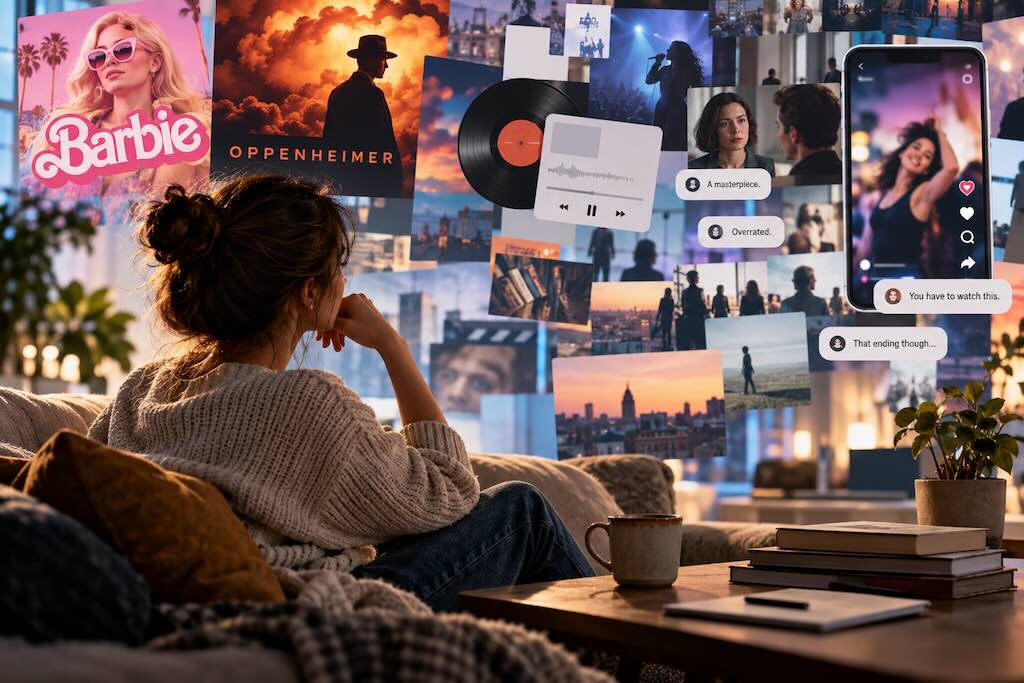
Before you’ve had a chance to watch the new film, someone has already explained why it’s a masterpiece. Someone else has called it a disaster. There are clips, arguments, rankings, memes and videos explaining the ending. You know which scene everyone is talking about, even if you haven’t seen it.
By the time you sit down to watch, it can feel as though you’re arriving late to a conversation that has already decided what the film means.
Something similar happens with music. A song finds an audience through a short video. A particular lyric becomes the soundtrack to thousands of unrelated moments. People who haven’t heard the album know the chorus. A television series becomes a collection of arguments about its characters before the final episode has aired.
None of this is necessarily bad. Culture has always been something people talk about, argue over and share. The difference is how quickly those conversations now take shape—and how easily they can become more familiar than the work that started them.
We have more opportunities to discover and discuss culture than ever before. But discovery, reaction and understanding are not quite the same thing.
The conversation sometimes arrives before the experience
Consider the summer of 2023, when Barbie and Oppenheimer opened in cinemas on the same day. The unlikely pairing became known as Barbenheimer, with audiences making double-feature plans, sharing outfits and treating two very different films as a shared cultural occasion.
It was an inventive, enjoyable example of how online enthusiasm can turn cinema-going into an event. People who might not otherwise have discussed either film found a reason to participate.
But the films also invited very different kinds of attention. Barbie could be approached as a comedy, a story about identity, a corporate entertainment product or a film about the contradictions of contemporary femininity. Oppenheimer raised questions about scientific responsibility, political power and how historical events are represented on screen.
The memes were part of the experience. They weren’t a substitute for everything the films had to say.
That’s the distinction worth keeping in mind. A cultural moment can be entertaining, commercially successful and widely shared while still deserving closer examination.
The trouble begins when participation in the conversation starts to feel like the same thing as engaging with the work.
We are becoming familiar with things we haven’t experienced
There is a particular kind of modern familiarity: knowing the reputation of a book without reading it, recognising a film’s most discussed scene without watching the film, or knowing exactly which song people associate with an artist while being unfamiliar with the rest of their music.
It’s not entirely new. People have always absorbed opinions from reviews, conversations, advertisements and headlines. The difference is that fragments now circulate so easily and so repeatedly.
A scene detached from its story can take on a different meaning. A lyric becomes a caption. A character becomes a symbol for an argument that the original work may not have been trying to make.
Sometimes those reinterpretations are imaginative and revealing. Audiences have always found meanings that artists didn’t consciously intend.
But there is also something limiting about encountering a work primarily through other people’s reactions. You inherit the expectations before you’ve had the chance to form your own.
Watch a film after hearing that its ending is disappointing, and you may spend the entire running time anticipating the disappointment. Listen to an album after being told which track is the only one worth hearing, and the remaining songs have already been assigned a lower place.
Those opinions might be reasonable. They are still someone else’s starting point.
The platforms have changed how culture reaches us
It would be too simple to blame this entirely on short attention spans. The way cultural information reaches us has changed.
The Reuters Institute’s 2025 Digital News Report documented the growing importance of social and video platforms in how people encounter news and commentary. Across the markets it studied, the proportion of respondents consuming social video news rose from 52% in 2020 to 65% in 2025.
That research concerns news consumption, not film criticism or music listening specifically. But it illustrates a wider change in the information environment: more people encounter ideas through feeds, video clips and individual creators rather than deliberately visiting a particular publication.
A separate Pew Research Center study of young American adults found that people aged 18 to 29 were especially likely to encounter news incidentally rather than actively seek it out.
Culture can reach us in a similar way. A film review appears between two unrelated videos. A song arrives through a stranger’s post. A television controversy becomes visible because enough people are arguing about it.
This can be an extraordinary discovery system. A small artist may reach listeners who would never have found them through traditional radio. An older film can acquire a new audience. A book that has been overlooked for years can suddenly become the subject of conversation.
What the feed cannot reliably tell us is whether something deserves our attention beyond the moment in which it appears.
A reaction tells us something. An interpretation tells us more.
There’s nothing wrong with having an immediate response to a film, album or book. Pleasure, boredom, irritation and surprise are part of experiencing art.
A quick review can also be genuinely useful. Sometimes you simply want to know whether a film is worth the ticket price or whether a series suits your taste.
But criticism can do something different.
Instead of asking only whether a work is good, it can ask what the work is attempting, how it achieves its effects, what assumptions it makes and why it might matter to the people encountering it.
Take a familiar example: a television character who makes a decision audiences dislike. The immediate conversation may revolve around whether the character is selfish, foolish or badly written.
A more considered reading might ask whether the decision fits the character’s established behaviour, what the writers want us to feel and whether our frustration is part of the intended experience.
That doesn’t mean the considered interpretation must be positive. It may conclude that the writing is unconvincing. But it gives us reasons to consider rather than a verdict to repeat.
Good criticism doesn’t need to be difficult or academic. It needs to notice something, support its argument and leave room for the reader to disagree.
Not every cultural argument deserves a winner
Online discussions often reward clarity of position. You loved it or hated it. The ending was brilliant or terrible. An artist is overrated or misunderstood.
These oppositions make for easy headlines and lively arguments. They can also flatten the experience of art, which is frequently more contradictory.
You can admire a film’s performances and find its story unconvincing. You can love a song while recognising that its lyrics are slight. You can find a book frustrating and still be grateful you read it.
Some of the most worthwhile cultural experiences resist a clean verdict. They leave questions that become more interesting after you’ve finished watching, listening or reading.
Criticism is useful precisely because it can accommodate those mixed responses.
It can also change its mind. A work dismissed on release may look different years later, when its influence becomes clearer or the circumstances around it have changed.
An opinion formed quickly isn’t necessarily wrong. It simply may not be the last thing worth saying.
Social media criticism deserves more credit than it gets
There is a temptation to imagine that serious cultural thought happens in essays and shallow reactions happen on social media. That distinction doesn’t hold up.
Thoughtful criticism can appear in a short video, a podcast, a newsletter or a carefully written social post. Some creators make complicated ideas approachable for people who would never seek out a traditional review.
Online communities also make room for perspectives that established cultural institutions have sometimes neglected. Fans can bring detailed knowledge, personal experience and alternative interpretations to works that professional critics have overlooked.
And a long essay isn’t automatically insightful because it is long. Length can disguise repetition just as easily as brevity can encourage oversimplification.
The useful distinction isn’t between old and new media, or between professional critics and ordinary audiences.
It’s between commentary that gives us something to think about and commentary that merely asks us to take a side.
The value of returning to something later
Some works make an immediate impression. Others reveal themselves slowly.
A film you found unremarkable at twenty may feel entirely different at forty. A song associated with a particular relationship can acquire another meaning years later. A novel you struggled with may become more accessible after you’ve lived through something its characters describe.
Culture doesn’t remain fixed simply because the work itself hasn’t changed. We bring different experiences to it each time.
This is one reason the pressure to deliver an immediate opinion can feel so unsatisfying. It encourages us to treat our first response as the finished response.
Sometimes the most interesting thing about a film isn’t what you thought as the credits rolled. It’s the scene you remember three days later, or the conversation it starts with someone who saw something entirely different.
Those later thoughts rarely arrive on a platform’s preferred schedule.
How to make room for your own interpretation
You don’t need to abandon social media or become a serious student of film, literature or music to have a more rewarding relationship with culture.
A few small choices can change how you experience the things that interest you.
- Experience the work before reading the verdict. When possible, watch the film or listen to the album before searching for other people’s opinions.
- Follow curiosity beyond the popular excerpt. If a song catches your attention, listen to the rest of the record. If a scene interests you, find out how it fits into the story.
- Read criticism that explains its reasoning. Look for writers who discuss specific choices and examples, even when you disagree with their conclusions.
- Allow yourself an unfinished opinion. You don’t need to decide immediately whether something was brilliant, disappointing or worth recommending.
- Talk to someone who saw it differently. A conversation can reveal details that neither person noticed alone.
These aren’t rules for becoming a better consumer of culture. They’re ways of keeping the experience open a little longer.
Culture needs conversation, not just attention
It would be strange to wish for a world in which fewer people talked about films, music, books or television. The excitement of sharing a discovery is one of the pleasures of culture.
A recommendation from a friend can change what we listen to for years. An enthusiastic online discussion can introduce an unfamiliar filmmaker to a new audience. A funny observation about a television series can make watching it feel communal.
Speed helps those connections happen. It allows a cultural moment to travel beyond the people who were already paying attention.
But attention is only the beginning of a relationship with a work. What follows—curiosity, disagreement, reflection, reconsideration—can be just as valuable.
There is room for the quick joke, the immediate review, the enthusiastic recommendation and the essay written after someone has had time to think. They don’t have to compete for the same purpose.
The question isn’t whether culture should slow down. New films will keep arriving, songs will keep finding audiences and conversations will continue moving at their own unpredictable pace.
We can enjoy that energy without allowing it to determine how quickly we must form an opinion.
The next time something becomes the subject of everyone’s attention, there is no obligation to join the argument immediately. You can watch, listen, think about it and decide what you make of it later.
Culture moves fast. Understanding it doesn’t always have to.