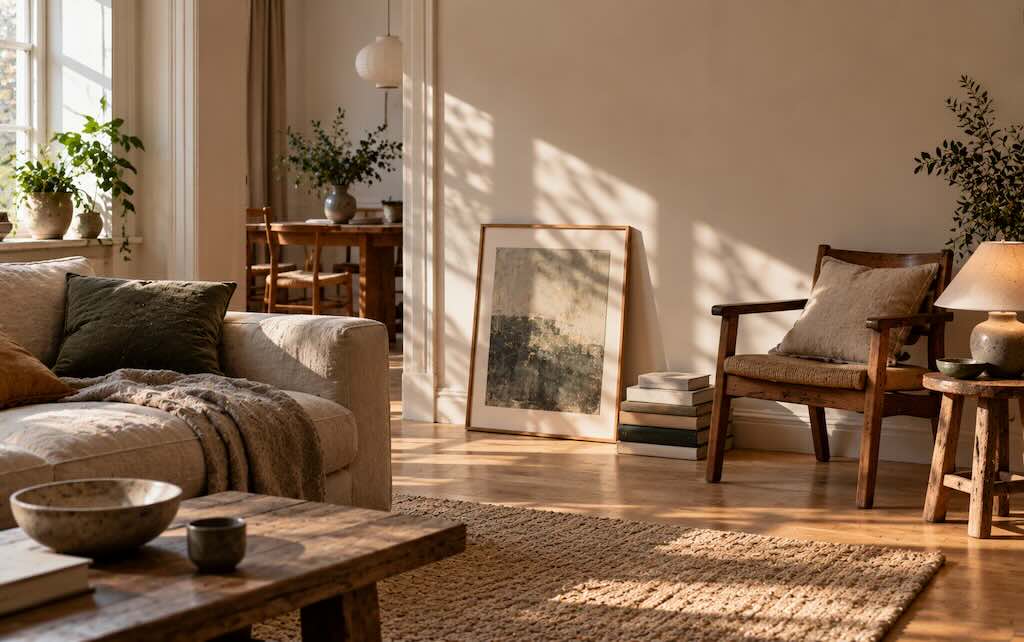
There is often a period after moving into a home when you can explain every unfinished part of it.
The pictures are still leaning against the wall because you have not decided where they belong. There is no lamp beside the chair yet. The books are stacked on the floor. One window has curtains and another does not. You are still looking for a table that fits the awkward space by the kitchen.
Then enough time passes that these things stop feeling temporary.
Sometimes that is when a home starts getting interesting.
Not every empty space is waiting to be filled
Rooms are easy to treat as lists of missing things.
The corner needs a plant. The wall needs art. The console needs something on top of it. The end of the sofa requires a side table because sofas in photographs nearly always seem to have one.
Some of those additions will make the room better. Others simply make it fuller.
An empty wall can remain an empty wall until you find something you actually want to see every day. A bare corner can give a small room breathing space. There is no obligation to place an object on every available surface.
Waiting is useful because it separates what the room needs from what convention says belongs there.
You may discover that nobody ever uses the chair you planned to buy a lamp for. Or that the supposedly empty corner is where you put a suitcase while packing. Or that the kitchen wall works better without shelves because it is the only visually quiet part of the room.
A little incompleteness gives you time to find out.
The best things often arrive out of order
A room designed all at once has one considerable advantage: everything can agree.
The woods match. The colours have been considered together. The rug is the correct size before the coffee table arrives.
A home assembled over years behaves differently.
A chair comes from a previous flat. A bowl appears after a holiday. Someone gives you a lamp. You inherit a small table you would never have chosen from a shop and eventually cannot imagine getting rid of. A print bought inexpensively at twenty-seven ends up beside something acquired much more carefully at forty.
These things do not necessarily share a style.
They share an address.
Given enough time, that can be a stronger connection.
Living in a room tells you things a floor plan cannot
You can measure a room before moving in. You cannot measure all the ways you will use it.
Perhaps the morning sun makes the place you intended for a desk impossible to work at. Perhaps everyone sits at the kitchen table despite the carefully arranged living room. The chair that looked stranded by the window becomes the best place to drink coffee. The expensive storage idea turns out to be less useful than a row of hooks by the door.
This information arrives slowly.
It is one reason furnishing a home immediately can sometimes produce rooms that look resolved before anyone knows how they need to work.
Live with the irritating gap beside the bed for a while and you may realise you need a narrow shelf rather than a conventional bedside table. Leave the dining area alone and you may notice that a bench would be more useful than two additional chairs.
The room can tell you what is missing if you give it long enough.
Temporary solutions have a habit of becoming good ones
Homes contain plenty of things that were never supposed to stay.
The stool being used as a bedside table. The old dining chair holding clothes in the bedroom. The basket that became the place for gloves because it happened to be near the door. The small lamp moved into the kitchen one evening and never moved back.
Sometimes these arrangements persist because nobody gets around to replacing them.
Sometimes they persist because they work.
There is a useful distinction between a compromise that annoys you every day and an unconventional solution that only looks temporary because it was not planned.
If the stool is the right height, holds the book and fits the space, it may already be a bedside table.
You can leave the difficult purchase until later
Some objects are easy to buy quickly. Others seem to punish haste.
Art is one. Rugs can be another. So can dining tables, armchairs and the lamp that has to sit in a very particular corner without looking as though it was bought merely to occupy it.
The pressure to finish a room makes these purchases harder. Suddenly the goal is not to find something good but to stop the space looking incomplete.
That is how the almost-right thing gets bought.
Almost the right colour. Almost the right size. Fine for now.
Then it remains for seven years because replacing a perfectly functional almost-right object feels wasteful.
An empty space is sometimes cheaper than the wrong thing.
Finished is not the same as settled
There are homes that have been decorated completely and still feel strangely untouched.
Nothing is out of place because nothing has yet had much opportunity to move.
A settled home is different.
The useful objects migrate towards where they are needed. The chair turns slightly because that is the better angle for conversation. Books gather near the place where they are read. A bowl ends up by the door because somebody always needs somewhere to put keys.
None of this prevents a home from being beautiful. It simply means beauty is not the only force arranging it.
Habit gets a vote too.
Some things should remain unresolved
A home changes because the people inside it do.
Someone starts working from home. A child arrives. A hobby occupies a table. A record collection grows. Knees become less enthusiastic about a very low sofa. People move in, move out, cook differently, sleep differently, acquire things and give others away.
A room that was once exactly right becomes slightly wrong and then useful again in another arrangement.
There is no final photograph after which nothing moves.
So hang the picture when you know where you want it.
Until then, it can lean against the wall.