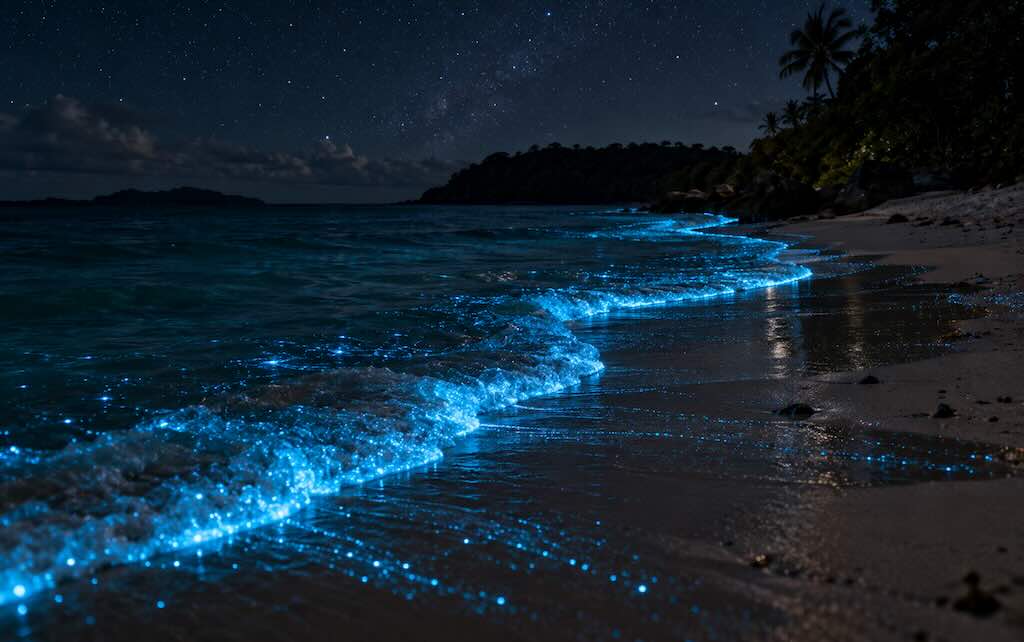
During the day, there may be nothing unusual about the water.
Then darkness comes, somebody drags a paddle through the surface, and a line of blue light appears behind it. A breaking wave flashes at its edge. Put a hand into the water and points of light scatter around your fingers.
Bioluminescence is one of those natural phenomena that photographs almost too well. Online, the sea can appear electrically blue, every wave outlined like neon.
Seeing it in person can be subtler. Your eyes need darkness. The brightness changes. Sometimes the light is a distinct blue-green flash; sometimes it looks more like sparks appearing briefly beneath black water.
And unlike a waterfall, monument or beach, it may not be there simply because you have arrived.
The light is alive
Bioluminescence is light produced by a living organism through a chemical reaction. It occurs widely in the ocean, from microorganisms near the surface to animals living far below it.
NOAA describes marine bioluminescence as surprisingly widespread. Different organisms use light for different purposes, including defence, communication and finding or attracting prey.
The coastal displays travellers tend to seek out are often associated with dinoflagellates, microscopic organisms capable of producing brief flashes of light when the water around them is disturbed.
This is why the effect becomes visible around a paddle, a hand or the edge of a wave. Movement turns dark water briefly bright.
But not every glowing patch of ocean is biologically identical, and not every bloom is benign. Some marine algal blooms can produce toxins. A glowing shoreline should not automatically be treated as an invitation to swim, particularly where local authorities have issued water-quality or harmful-algal-bloom warnings.
Puerto Rico: three places built around the phenomenon
If seeing bioluminescence is an important reason for making the journey, Puerto Rico is one of the more convincing places to start.
The island has three established bioluminescent sites: Mosquito Bay on Vieques, Laguna Grande near Fajardo and La Parguera at Lajas on the southwest coast.
These are not simply beaches where glowing plankton occasionally washes ashore. They are sheltered aquatic environments where dinoflagellates occur in concentrations capable of producing repeated displays. Narrow entrances, shallow water and local tidal conditions help maintain the ecosystems.
At Puerto Rico’s bio bays, the usual experience is therefore not standing on a beach waiting for a wave to glow. It is going onto the water after dark.
Mosquito Bay is reached on Vieques, an island off Puerto Rico’s east coast. Kayaks move through dark water and each paddle stroke disturbs the organisms beneath the surface. Laguna Grande, technically a lagoon, lies at Fajardo and can also be explored on organised night kayak trips.
La Parguera is different again. It is Puerto Rico’s bio bay where swimming is generally permitted, although conditions and restrictions should always be checked locally before visiting.
Even here, nature retains control. Brightness changes with conditions, and darker nights generally make the light easier to see.
In the Maldives, the beach is less predictable
The Maldives produces some of the most recognisable images of bioluminescent beaches: pale sand, black sky and blue points of light appearing where the Indian Ocean reaches the shore.
It is often presented online as though there is one particular beach where this happens reliably.
There isn’t.
Visit Maldives notes that bioluminescent plankton can occur around different islands and atolls. Its presence depends on conditions including tides, water temperature, salinity and nutrient levels.
That makes the Maldivian experience both more accidental and, perhaps, more interesting.
You might walk onto a beach after dinner and find nothing unusual. On another night, waves arrive with points of blue light in their edges and footprints disturb tiny flashes in wet sand.
The useful travel advice is therefore not to choose a Maldivian island solely because a photograph online calls it a “Sea of Stars” beach. If bioluminescence is present during your stay, local guides and accommodation staff are likely to know where it has recently been visible.
Jervis Bay: go for the coast, hope for the glow
On the south coast of New South Wales, Jervis Bay occasionally produces another version of the spectacle.
The bay is already worth visiting for its pale beaches, clear water, national parks and marine life. Bioluminescence sometimes appears in its waters as an additional after-dark event rather than something that can be promised for a particular night.
That distinction matters when planning a trip.
Puerto Rico’s bio bays are destinations specifically associated with persistent bioluminescent ecosystems. Places such as Jervis Bay are better approached as destinations where bioluminescence may occur.
Travel is less disappointing when the difference is understood before booking the flight.
Darkness matters more than your camera
Bioluminescence is an experience of darkness as much as light.
At Puerto Rico’s bio bays, darker nights around the new moon are generally recommended because less moonlight makes the flashes easier to perceive. Artificial light has the same problem. A bright phone screen can make something you travelled a considerable distance to see temporarily harder to see.
Give your eyes time to adjust.
It is also worth lowering expectations created by long-exposure photography and heavily processed travel images. Cameras can collect and amplify light differently from human eyes. What appears as an intensely luminous blue shoreline in a photograph may be a more delicate sequence of flashes in person.
The smaller version is not necessarily disappointing. Watching points of light appear around a paddle in otherwise dark water is strange enough without requiring the entire bay to resemble a special effect.
Treat a glowing bay as an ecosystem, not a backdrop
The conditions that allow large concentrations of microscopic organisms to persist can also be sensitive to what happens around them.
At Puerto Rico’s protected bio bays, visitors are asked to follow local rules, minimise artificial light and avoid putting unnecessary chemicals into the water. Swimming is prohibited at Mosquito Bay and Laguna Grande.
Those restrictions are part of visiting the place, not an inconvenience around the main attraction.
The same principle applies elsewhere. Follow local guidance about entering the water. Do not assume a glowing bloom is safe because it looks beautiful. Use established operators where access is controlled, and resist the temptation to disturb wildlife or shoreline habitat for a photograph.
Choose the place before the phenomenon
There are two ways to plan a journey around bioluminescence.
If seeing it is the point of the trip, choose somewhere with an established bio-bay ecosystem and organise the visit around a dark night. Puerto Rico makes sense for precisely this reason.
If you are travelling somewhere that experiences occasional coastal bioluminescence, do the opposite. Choose a place you would want to visit anyway.
Go to the Maldives for the islands and the Indian Ocean. Go to Jervis Bay for its beaches, national parks and marine life. Then ask what has been happening in the water after dark.
If nothing glows, the journey still works.
And if one night the edge of a wave suddenly lights up blue, go outside.