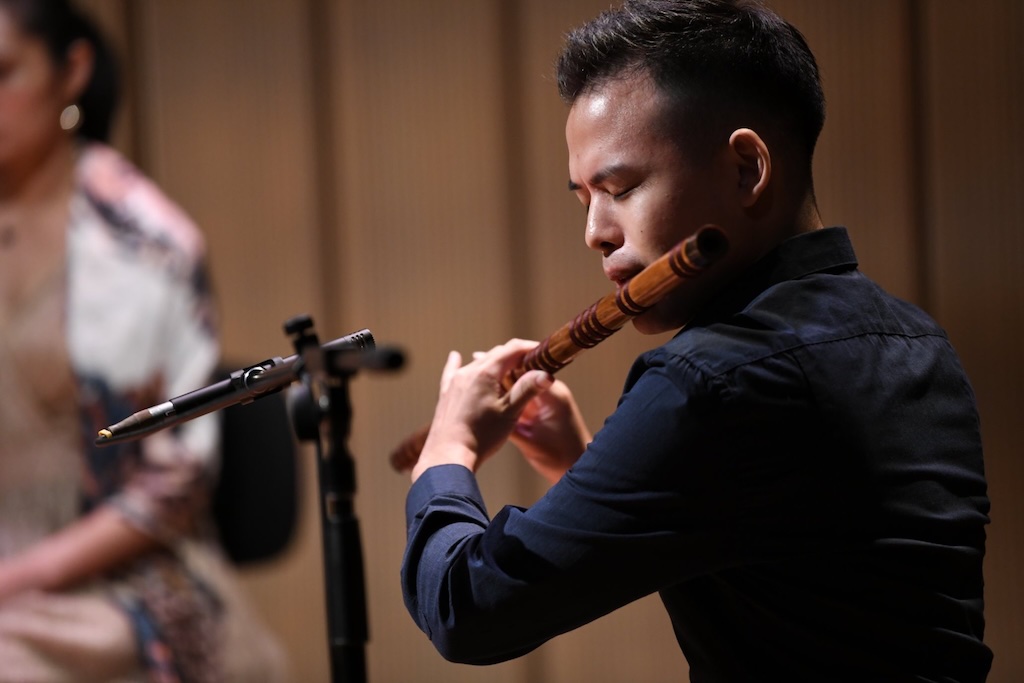
Taiwanese improvising flutist Lin Hsiao-Feng works in a space where tradition is neither fixed nor left behind. Moving between dizi, xiao, the Indigenous Paiwan nose flute and free improvisation, he explores what can happen when instruments carrying distinct histories are placed in unfamiliar musical conversations.
That idea traveled with him across the United States in 2026. Performing with pianist and harpsichordist Hsuan Chang Kitano as Cadenza Duo, Lin moved from experimental collaboration in Washington, D.C. to performances, talks and cultural exchange, before concluding the tour at the World Flute Society Annual Convention in Eau Claire, Wisconsin.
Along the way, traditional flute practices met electronics, piano, composed works and spontaneous performance. The tour also created space for a more complicated question: how can a musical tradition travel, change and encounter other cultures while remaining connected to the history and identity it carries?
Good Hours spoke with Lin about improvisation, the responsibility of presenting the Paiwan nose flute outside Taiwan, listening across musical languages and what happens when preservation and experimentation share the same breath.
Artist Spotlight
Lin Hsiao-Feng
Tradition is not really a boundary for my improvisation. It is already one of the languages in my body before I play the first note.
— Lin Hsiao-Feng, in conversation with Good Hours
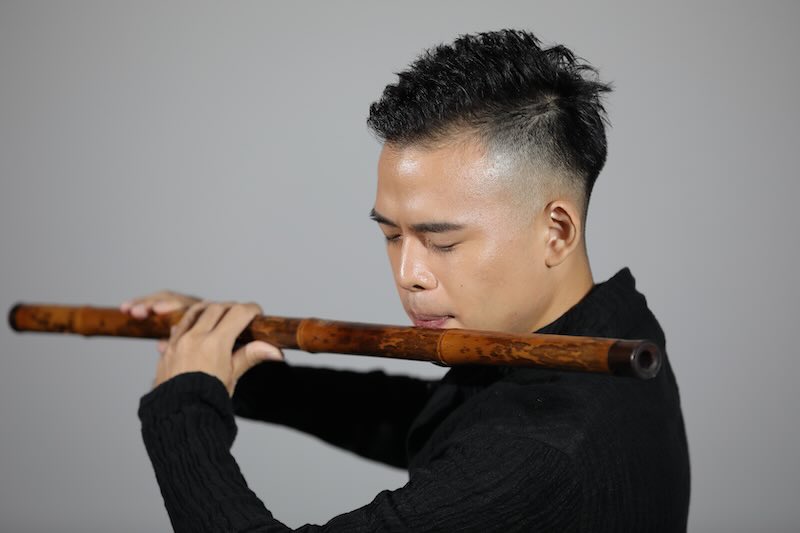
Your work brings Taiwanese flute traditions into contemporary free improvisation. When you begin improvising, how much are you consciously thinking about tradition, and how much do you allow yourself to move away from it?
When I start improvising, I don’t really think about how much of the music should be traditional and how much should move away from tradition. After playing the dizi and xiao for so many years, that tradition is already part of my physical memory: the way I breathe, articulate, shape a tone, use ornamentation, and even the way I listen.
Once the improvisation begins, I actually try not to think, “I need to sound traditional.” One of the things I value most about free improvisation is that a sound can leave its familiar function or context and become something else.
For me, that doesn’t mean abandoning tradition. I just don’t want tradition to become something that has to be preserved behind glass. Even when the music moves quite far from a traditional vocabulary, that physical memory is still there and often returns in unexpected ways.
So tradition is not really a boundary for my improvisation. It is already one of the languages in my body before I play the first note.
The Paiwan nose flute carries a specific Indigenous history and cultural identity. What responsibilities do you feel when presenting the instrument to audiences outside Taiwan?
I think my first responsibility is to make clear that the Paiwan nose flute comes from a very specific cultural tradition. It is not simply an unusual sound or an exotic instrument that can be separated from its history.
I am not Paiwan, and that distinction matters to me. I can introduce what I have learned about the instrument, acknowledge where that knowledge comes from, and share my own experience of playing it, but I cannot speak on behalf of Paiwan people or define what the nose flute means to their culture.
When I use the instrument in improvisation, I am not trying to remove it from its tradition or give it a new identity. I am asking what kind of relationship it can have with contemporary music while its origin and cultural memory remain visible.
For me, there is an important difference between introducing a tradition and representing it. Being honest about that difference is part of the responsibility.
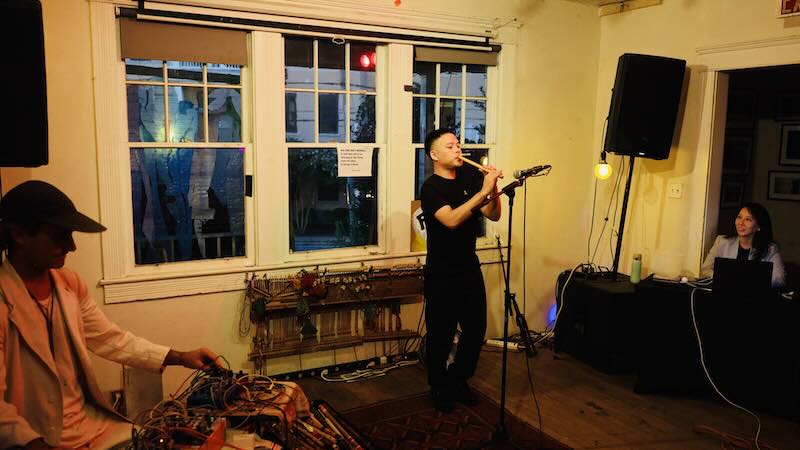
At Rhizome DC, Cadenza Duo performed with electronic musician Patrick Cain. What happens to your listening when an acoustic traditional instrument meets electronics in a completely improvised setting?
What I enjoy about playing with electronics is that sometimes I’m not immediately sure where a sound is coming from. At Rhizome, it might have been Patrick’s electronics, Hsuan’s piano or electronic sounds, my flute, or even something created by the resonance of the room.
Strangely, when I’m less certain about the source of a sound, I listen more carefully.
Instead of thinking, “What should I play next?” I start asking what the whole sound environment needs at that moment. I might respond to density, frequency, noise, resonance or silence rather than to a melody or chord.
I also don’t really think of it as a traditional instrument meeting modern technology. Once we are improvising, that distinction becomes much less important to me. They are simply different sources of sound with different possibilities, and we are trying to discover what kind of space they can create together.
Dizi, xiao and the Paiwan nose flute each have very different physical and tonal qualities. How does changing instruments change the way you think, breathe and respond during improvisation?
Changing instruments can almost feel like changing bodies.
The dizi is very immediate and responsive. It can be bright and penetrating, and I can change direction very quickly with it. The xiao has a more inward relationship with breath, and when I play it I often become more aware of space, resonance, decay and silence.
The nose flute changes the physical experience even more because the air comes through the nose rather than the mouth. That affects my sense of phrasing, pressure and time. I can’t simply transfer the same technique or musical logic from the dizi to the nose flute.
So I don’t really think of them as three different tone colors that I can choose from. Each instrument changes my physical state, and that changes the way I listen and respond. In improvisation, sometimes the instrument itself leads me somewhere I would not have chosen intellectually.
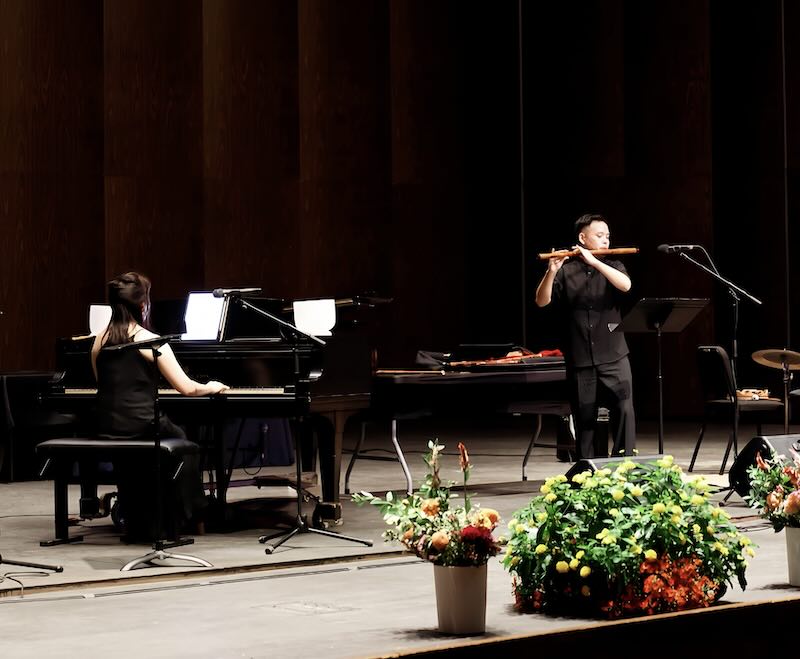
You perform with Hsuan Chang Kitano as Cadenza Duo. How has your musical relationship developed, and what have you learned about each other’s instincts through improvisation?
The longer we play together, the less I feel that good communication means knowing what Hsuan is going to do next.
We have become much more comfortable allowing each other to go in completely different directions. If one of us creates something very dense, the other doesn’t necessarily have to match it. If one person introduces an idea, the other may respond immediately, much later, or not at all. Sometimes silence is the most interesting response.
Hsuan works with piano, harpsichord and electronic music, so she brings several different ways of thinking about sound and structure into the duo. That often makes me reconsider what role the flute needs to play. It doesn’t always have to be the melodic voice.
I think what we have developed is less about predicting each other and more about trust. We know that we can take risks, leave things unresolved, or surprise each other, and the music can still find its own direction.
At the Chinese American Museum DC, “The Resonant Island” placed spontaneous improvisation alongside Wyatt Cannon’s composed work “Facing the Current.” What interests you about allowing composed and improvised music to coexist within the same program?
I have never felt that composition and improvisation have to be opposite worlds. There are many possibilities between something that is completely fixed and something that is created entirely in the moment.
Wyatt knew that I came from an improvisational background, so when he wrote “Facing the Current,” he left quite a lot of space for interpretation and freedom. The piece has a clear composed structure, but within it I can make decisions about sound, phrasing and how I respond in the moment. I like that because I don’t feel that I am simply reproducing a predetermined answer. I am still participating in the creative process.
That is why it felt very natural to place the piece alongside free improvisation in “The Resonant Island.” For me, the interesting difference was not “composition versus improvisation,” but different degrees of openness. In one situation, you find freedom inside an existing structure. In another, the musicians discover the structure together while the music is happening.
Part of the tour involved talks and music-sharing sessions rather than conventional concerts. Did explaining these instruments and traditions in words change the way you thought about performing them?
Yes, definitely. When I perform, I can allow a sound to remain ambiguous. But when I have to explain an instrument to people from a different cultural background, I suddenly have to examine many things that I normally take for granted.
When I talk about the dizi, xiao or nose flute outside Taiwan, I can’t assume that the audience shares the same cultural references. So I have to think about what information is actually important for understanding what they are hearing.
At the same time, I don’t want to explain so much that the audience has already been told what the sound is supposed to mean before they hear it. I still want them to have their own experience of the sound.
The tour made me think a lot about a simple question: How much context does a listener need before listening? I still don’t have a fixed answer, but moving between speaking and performing has made me much more aware of that balance.
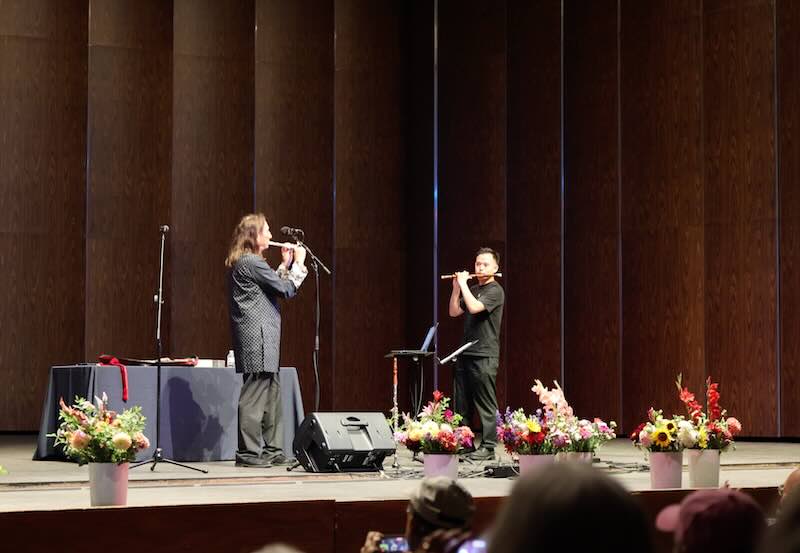
Your final convention performance included an improvised collaboration with Canadian flutist Ron Korb. When musicians with different backgrounds meet without a fixed score, what tells you that a musical connection is beginning to form?
My encounters with Ron actually reminded me that improvisation doesn’t always mean starting from nothing.
During Cadenza Duo’s performance, we invited him to join us for Teresa Teng’s “The Moon Represents My Heart,” a song that is very familiar to audiences in Taiwan and across much of Asia. The melody gave us a shared starting point, but we left space around it to improvise and respond to each other.
Ron also invited me to join him on one of his own pieces. That was almost the reverse situation: I was entering his musical world, listening to its melody, structure and atmosphere, and finding my own way to respond with the flute through improvisation.
For me, musical connection begins when you really start hearing what the other person is doing. It might mean responding to an idea, changing direction, or deciding not to play at all. You don’t have to come from the same musical background or speak exactly the same language. Sometimes a melody gives you the meeting point, and sometimes the meeting point is simply listening.
Traditional instruments are sometimes presented primarily through preservation and history. Your work places them inside new musical situations. Where do you personally draw the line between preserving an identity and allowing a tradition to change?
I’m not sure that I have the authority to draw that line for an entire tradition. I can only be responsible for the choices I make in my own work.
For me, one of the most important things is being honest about where something comes from. I don’t think using an instrument in a new way automatically threatens its identity. What concerns me more is when the cultural context disappears and we begin treating a sound as if it has no history.
At the same time, preservation doesn’t necessarily mean keeping everything exactly as it was at one particular moment. Traditions stay alive because people continue to practice them, make choices, and sometimes change them.
So I’m not trying to decide what a tradition should become. I’m making my own contemporary response to it. I want to explore new possibilities, but I also want the history and origin of the instruments I work with to remain visible.
Your recent work has taken you from the 2024 Paris Cultural Olympiad to a 2025 residency at Indiana University Bloomington and now this U.S. tour. What have these encounters with different musicians and audiences revealed to you about how Taiwanese musical traditions are heard outside Taiwan?
I’ve realized that there is no single way people outside Taiwan hear “Taiwanese music.”
Some people are immediately curious about the bamboo flute itself. Others become interested in the cultural background of the nose flute. And sometimes people don’t begin with nationality or history at all. They simply hear a sound and respond to it.
Those reactions have made the question of identity much more interesting to me. What makes a sound Taiwanese? Is it the instrument, the repertoire, the history, the performer, or the relationships we create through music?
The more I travel, the less interested I am in giving a single definition of what Taiwanese music should sound like. I think I am more interested now in creating situations where these traditions can enter new conversations without having to represent one fixed image of Taiwan.
After this tour, what musical question are you most interested in following next?
Recently I have been thinking a lot about the identity of the instrument itself.
When an instrument carries a long cultural memory but enters a completely immediate and unpredictable musical environment, how far can it travel while still remaining connected to its history?
If I play a bamboo flute without traditional repertoire, without a familiar melody, and without deliberately using a traditional musical vocabulary, what still makes it culturally recognizable? Is that identity in the sound, the material of the instrument, the physical technique, or the relationship between the performer and the history behind it?
I don’t expect to find one final answer, and I think that is exactly why I want to keep exploring it.
The question I’m following now is not simply how far tradition can travel, but what remains with us when it does.
FAQ
Who is Lin Hsiao-Feng?
Lin Hsiao-Feng is a Taiwanese improvising flutist whose work brings together Taiwanese flute traditions, the Indigenous Paiwan nose flute, free improvisation and cross-cultural collaboration.
What instruments does Lin Hsiao-Feng play?
His work includes the dizi, xiao and Paiwan nose flute, which he approaches as distinct instruments with their own physical, tonal and cultural characteristics.
What is Cadenza Duo?
Cadenza Duo brings Lin together with pianist, harpsichordist and electronic musician Hsuan Chang Kitano. Their work explores improvisation and the relationships between different instruments, musical traditions and approaches to sound.
Instagram:https://www.instagram.com/fongdizi/
Facebook:https://www.facebook.com/BambooFluteDIZI/
YouTube: https://www.youtube.com/@fong0915
Website: https://www.linhsiaofeng.com/