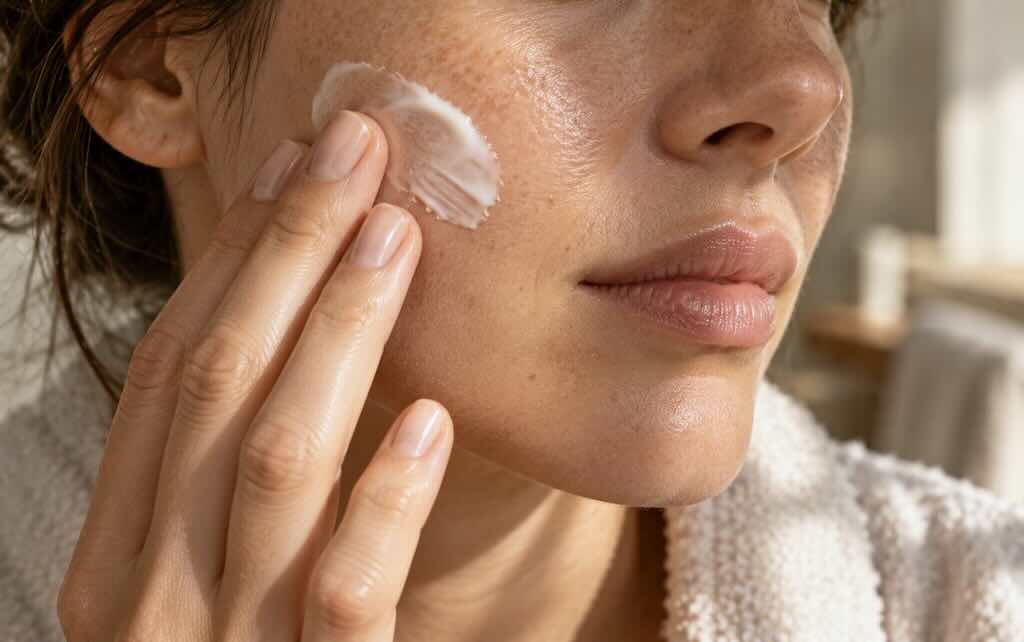
A skincare routine can become surprisingly complicated once your skin starts behaving badly.
A cleanser suddenly stings. Moisturiser disappears almost as soon as you apply it. Your face feels tight after washing, yet may still be oily in places. There is redness, flaking or an uncomfortable sensitivity to products that were previously uneventful.
Online, much of this now gets described as a damaged skin barrier.
Sometimes irritation and impaired barrier function really are part of the problem. But “skin barrier damage” has also become a loose explanation for almost any difficult period of skin, from acne to allergic reactions. Those things are not interchangeable, and persistent redness, itching, rashes or breakouts deserve more than an internet diagnosis.
For ordinary dryness and irritation, however, the useful part of barrier repair is much less complicated than the product category surrounding it suggests.
What the skin barrier actually is
When skincare companies talk about “the barrier,” they are usually referring primarily to the outermost part of the epidermis: the stratum corneum.
One familiar way of describing it is bricks and mortar. The bricks are corneocytes, flattened cells in the outer layer. Between them is an organised mixture of lipids that includes ceramides, cholesterol and free fatty acids. Together, this structure helps limit excessive water loss while providing protection from the outside environment. Reviews of skin-barrier biology describe ceramides as an important part of this intercellular lipid structure.
When that system is disrupted, water can escape more readily and irritants can become harder for skin to tolerate. The result may be dryness, roughness, tightness, stinging or increased sensitivity.
That does not mean every blemish is your barrier asking for help.
Sometimes the routine is the first thing to repair
There is a peculiar response to irritated skin that skincare makes very easy: adding more skincare.
A new serum for the redness. An exfoliant for the flakes. Another active for the spots that appeared after everything became irritated. Then a barrier cream to compensate for the rest of the routine.
It can be more useful to look at what the skin is being asked to tolerate.
Retinoids, exfoliating acids, benzoyl peroxide, harsh cleansing, scrubbing and combinations of irritating products can all contribute to irritation in susceptible skin. DermNet notes that irritant contact dermatitis can result from the cumulative effect of multiple irritants rather than one dramatic exposure, and includes topical treatments such as retinoids and benzoyl peroxide among possible irritants.
If a routine has gradually become an elaborate rotation of active ingredients, a period of simplification may be more sensible than finding another active ingredient marketed for recovery.
Cleanse without trying to feel exceptionally clean
That squeaky, stripped feeling after washing is not a useful target.
For dry or sensitive skin, the American Academy of Dermatology recommends gentle, fragrance-free cleansing, warm rather than hot water and avoiding unnecessarily long exposure to hot water. Someone with dry or sensitive facial skin may not need the same cleansing frequency as someone with much oilier skin.
The cleanser’s job is fairly ordinary: remove what needs removing without making the next ten minutes of your routine about recovering from the cleanser.
A moisturiser does more than add water
This is where barrier care becomes less about a single fashionable ingredient and more about formulation.
Moisturisers can contain humectants, which help increase water in the outer skin; emollients, which soften and smooth; and occlusive ingredients, which reduce water loss from the surface. One product may perform several of these jobs at once. Glycerin is a familiar humectant. Petrolatum is a particularly effective occlusive. Ceramides are lipids naturally important to the stratum corneum and can also be included in moisturising formulas.
Research supports the usefulness of ceramide-containing formulations in some forms of dry and barrier-impaired skin, including atopic dermatitis. But there is an important detail easily lost on the front of a jar: putting ceramides on an ingredient list does not tell you everything about how a product will perform. A 2024 review notes that their incorporation into a formulation matters to their barrier-repair potential.
So you do not necessarily need to hunt for the moisturiser with the longest list of barrier-associated ingredients.
You need one your skin tolerates and that provides enough moisturisation for how dry it currently is.
Cream can be enough
For noticeably dry skin, creams and ointments generally provide more substantial moisturisation than lighter lotions. The American Academy of Dermatology recommends applying moisturiser soon after washing, while the skin is still damp, which helps retain water that would otherwise evaporate.
If fragrance is making already sensitive skin unhappy, “fragrance-free” is the useful wording to look for. “Unscented” does not necessarily mean the same thing; a product may contain ingredients intended to disguise its smell.
And if an uncomplicated moisturiser already leaves your skin comfortable, there is no inherent advantage in replacing it because another jar says barrier repair.
The flakes do not necessarily need exfoliating
Flaking creates a strong temptation to remove what you can see.
But when skin is already dry and irritated, exfoliation can compound the problem. The AAD specifically advises against exfoliating dry, peeling skin and recommends moisturising instead.
This can feel counterintuitive if acids, scrubs or retinoids are normally part of your routine. Leaving them alone for a while may look like doing less precisely when your skin appears to need more attention.
Doing less is still doing something.
What about slugging?
Applying a thin layer of petrolatum as an occlusive final step can reduce water loss and can be useful for very dry areas. It is not, however, a universal requirement for repairing the skin barrier, nor does every face need to be covered in it each night.
Think of occlusion as one possible tool rather than the ritual that proves you are taking barrier repair seriously.
Give the routine a quiet period
A sensible temporary routine can be remarkably short: gentle cleansing when needed, a moisturiser that does not sting or irritate, and broad-spectrum sunscreen during the day. The AAD recommends SPF 30 or higher as part of daily sun protection.
Then resist the urge to conduct a new skincare experiment every second evening.
There is no universal timetable for “repairing” a barrier because the underlying problem matters. Mild irritation from overdoing a routine is not the same thing as eczema, allergic contact dermatitis, psoriasis, acne or another skin condition. Even skin that looks simply dry can have more than one cause.
If your skin remains persistently red, painful, intensely itchy, cracked, bleeding or rash-like, or keeps worsening despite a gentler routine, that is a reason to see a dermatologist rather than continuing to rotate barrier creams. The same applies when you are unsure whether the problem is irritation at all.
For ordinary overworked skin, though, the useful version of barrier repair is not especially glamorous.
Remove what is irritating it. Wash gently. Put moisture back. Help keep that moisture there.
Then give your skin a little time without asking it to do anything else.
Skin Barrier Repair: Frequently Asked Questions
What are signs that your skin barrier may be irritated?
Dryness, tightness, roughness, flaking, stinging and increased sensitivity can occur when skin is irritated or its barrier function is impaired. These symptoms are not specific to barrier damage, however, and can also occur with skin conditions that may need professional assessment.
Do you need ceramides to repair your skin barrier?
Ceramides are important lipids in the stratum corneum, and ceramide-containing moisturisers can be useful for dry and barrier-impaired skin. They are not the only useful moisturising ingredients, and the performance of the complete formulation matters more than simply seeing “ceramide” on the label.
Should you stop retinol while your skin is irritated?
Retinoids can cause irritation, particularly when skin is already sensitive. Temporarily simplifying an irritating routine may be appropriate, but anyone using a prescription retinoid should follow the advice of the clinician who prescribed it rather than changing treatment solely on the basis of general skincare guidance.
Is Vaseline good for the skin barrier?
Petrolatum is an occlusive ingredient that can help reduce water loss from the skin and is useful for many people with very dry areas. It does not treat every cause of irritated skin, and using it over the entire face is not necessary for everyone.