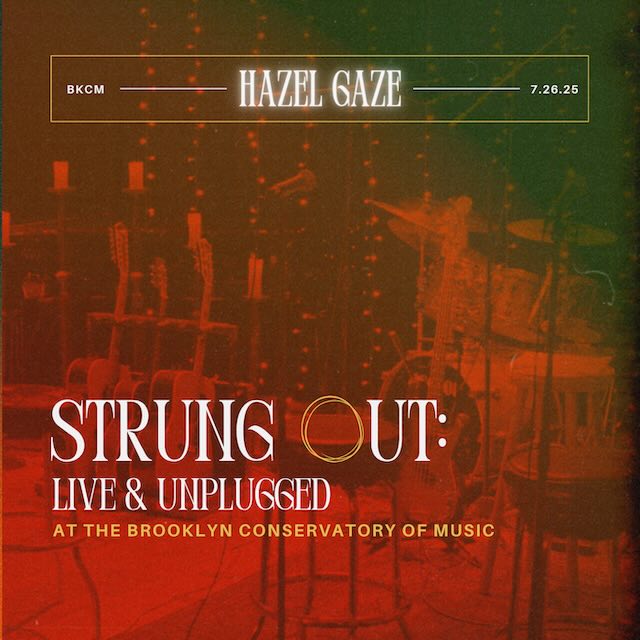
Hazel Gaze have never been a band particularly interested in keeping things contained. Their music draws its energy from the scale and immediacy of rock, but for Strung Out: Live & Unplugged at the Brooklyn Conservatory of Music, the New York band approached their songs from a different direction: stripping them back, bringing strings into the arrangements, and recording the performances live in a room where there was nowhere for the music to hide.
The resulting 15-track project places violin, viola and cello alongside the band, trading some of the force of their conventional live sound for space, texture and a different kind of intensity. Rather than simply translating electric songs into acoustic versions, the process gave Hazel Gaze an opportunity to discover what remained when familiar layers were removed — and what new details appeared when everyone had to listen to one another differently.
Recording live also meant accepting something increasingly unusual in a world where almost anything can be corrected after the fact: the performance happening in the room had to matter. The Brooklyn Conservatory itself became part of that equation, providing not simply a backdrop for the accompanying film but an environment that shaped how the musicians approached the songs.
For Good Hours, Hazel Gaze talks about turning down the volume without losing intensity, working with strings, surrendering some control to a live performance, and what happens when a band steps inside songs it already knows and discovers that they can still sound unfamiliar.
Good Hours · Live Session
Brooklyn · New York
Rock ’n’ Roll · Unplugged
Hazel Gaze
Strung Out: Live & Unplugged
There were a couple notes here and there that weren’t perfect, but leaving them in made the recording more authentic, organic and “live”. There’s beauty in the imperfections.
Russ · Hazel Gaze
A Different Kind of Room
Good Hours: Hazel Gaze is fundamentally a rock ’n’ roll band, but for Strung Out you put the songs into a very different environment. When you first walked into the Brooklyn Conservatory of Music for this project, did the room itself change the way you thought about what you were about to play?
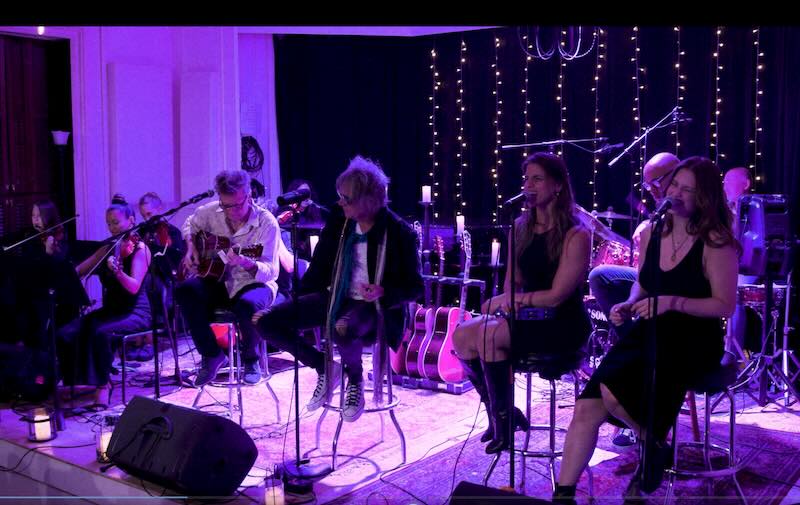
Russ: There were several goals when selecting the venue for this special evening. The space needed to convey an intimate vibe, somewhat reminiscent of classic MTV Unplugged shows of the 90s and 2000s, but also something new we could customize to enhance the atmosphere of having a distinguished string section accompany us. And of course, the room needed to sound good for the recording!
Some of us have a relationship with the Conservatory; I’m a former Chairman and Board Member, Konrad is a current board member and Mary Jo is an instructor there, so we were familiar with that storied institution and the space. I felt that room had the right vibe to help us embrace different interpretations of our catalog: stripped down, acoustic, intimate and personal.
Good Hours: When you’re used to playing songs with the energy and volume of a rock show, what becomes exposed when you strip some of that away? Was there a song that suddenly revealed something you hadn’t noticed in it before?
Russ: Absolutely! Playing with an acoustic instrumentation brings the songs back to their core where it’s more about melody, vocal harmonies and arrangements, rather than the raw power, volume and distortion of a traditional rock show. The songs are usually written on acoustic guitar or piano, so in a way, this show brought them back to their original form. Also, this instrumentation created a bit more space in the songs, allowing our vocal harmonies to shine a bit more, as well as providing room for Mary Jo to expand the piano’s role in the songs.
To your second question of whether a particular song revealed something we hadn’t seen before, I’ve heard people say the vocal harmonies in “Who’s Sorry Now” took on a more soulful, almost gospel quality, while the acoustic format inspired Molly to come up with the sultry vocal intro to “Do As You Please”.
Hanz: While most of our songs are heavy rock songs, we have often worked out arrangements—and definitely vocal harmonies—by doing them acoustically. We worked out some of our earliest material with just Russ on guitar and me on vocals. Russ often sends me demos he’s made of new material, one with his scratch vocal track and one without. And I sometimes found it helpful to teach myself the basic chord structure on acoustic guitar and sing along with it to put my own spin on his melodies before singing along with the scratch track. A good song is a good song, whether played on acoustic guitar or piano, or when played with full amplified instrumentation.
What the Strings Changed
Good Hours: Violin, viola and cello became part of songs that already had an identity of their own. How did you approach the arrangements without simply making the existing songs sound “bigger”?
Russ: That was fairly intimidating if I’m honest. I had a serious case of imposter syndrome, as I’d never worked on string arrangements before. A dear friend and amazing musician from the Conservatory, Brian Drye, introduced me to Dana Lyn, who’s an incredible orchestral arranger. I had some ideas where I felt strings would work, what parts they should play, etc. Dana took those ideas and ran with them, expanding and enhancing them into proper, beautiful arrangements.
Of course I wanted strings to help broaden choruses, making the songs “breathe” more dynamically and become larger at points. But I also wanted the strings to reinterpret instruments from the studio versions of the material, such as the guitar solos, horns and organ parts. Most importantly, the strings would emphasize the emotive aspect of the songs: in some sections, they would evoke a dark, almost foreboding mood, while in other sections, they would add beauty and light.
Good Hours: Was there a moment during rehearsals when the strings did something to one of your songs that made everyone in the room stop and rethink it?
Russ: It’s funny you mention that. After the string parts were drafted, Dana created MP3’s of them played on a MIDI keyboard, which doesn’t quite represent the nuances accurately. So I went into our first rehearsal with the string players not having really heard the parts yet. I remember being very nervous in the room with these world-class string players, who play in Broadway pits and have recorded and toured with major A-list artists – I didn’t know if it would sound remotely like it did in my head when envisioning it, or if it wouldn’t work at all. However, halfway through the first song, I looked around the room and the looks on band members faces said it all. Everyone’s eyes were wide open with big smiles, loving how the string orchestrations worked so well.
Hanz: I had every confidence that adding a string section would be an interesting way to present our songs. But I had no idea that the majority of our catalog would actually work in that format. At the first rehearsal, it was kinda hard to sing with my jaw hanging wide open in amazement at how well everything clicked.
Seven People, Different Musical Histories
Good Hours: The band brings together people with backgrounds ranging from clubs and touring to Broadway pits and conservatory training. How do those very different musical histories show up when you’re actually in a room working together?
Russ: This will likely sound cliche, but it’s such a rare and unique privilege to have 7 people in a band who all get along so well, that’s really the best part – everybody’s just a wonderfully nice person. On top of that, the diverse lifestyles and musical backgrounds are icing on the cake. Everybody approaches songs and performances from a different perspective and brings different ideas to the music. It makes us what we are.
Hanz: They show up wonderfully when we are working out parts for a live show. I come from a straightforward rock band background, so I tend to try to inject a lot of rawness and grit into our material. But folks with more classical training, like MJ and Nicole, tend to be more melodic, and think of harmonies and little bits that provide a wonderful counterpoint to my delivery—in addition to a lot of class. I like to hope that I push them to add a bit of soulful sass and “stank” to their vocal parts. As chief songwriter, Russ is masterful at writing music and lyrics that reflect the attitudes and strengths of the band members—which makes it easy to translate live. Konrad’s influences in 80s pop and alternative music also provide live directions where a more stereotypical rock or blues bassist might not go. And Spiros’ obsessive love of old-school classic rock despite playing all styles of music really helps literally drive our material home during shows.
Good Hours: A loud rock performance allows for a certain kind of abandon. An intimate performance can make every pause, breath and small mistake feel much more visible. Did playing this way require a different kind of confidence from the band?
Russ: We’d rehearsed acoustically previously when working on vocal harmonies, so we had some experience with it. When we decided to do this show, we rehearsed acoustically a bit more, enjoyed it and felt it could work. Mary Jo and I also worked a bit specifically on how the guitar and piano played off each other differently than we would during a traditional full electric show. All in all, we were fairly well-rehearsed acoustically.
Hanz: Dynamics has always been critically important to us, in songwriting, recording and performance. And, as previously stated, sometimes by design and sometimes by necessity, we are used to rehearsing “unplugged.” So we are all really comfortable with that format, and so we just likely did “more” of it for this gig–which I guess translated into a level of confidence that other hard rock artists may not have.
Leaving the Imperfections In
Good Hours: Because this was recorded live rather than assembled piece by piece in a studio, how much did you have to surrender control and accept the particular evening you were having?
Russ: We didn’t have a requirement to include the entire show on the album, so if there were a few songs that weren’t solid performances, we could simply leave them off the record. But once the show began, we were in the flow of it, having a great time, and didn’t think about the recording process. Except for 2 covers we excluded for licensing reasons, we wound up including the entire show for the album. There were a couple notes here and there that weren’t perfect, but leaving them in made the recording more authentic, organic and “live”. There’s beauty in the imperfections.
Hanz: We talked about it in advance, so were prepared to let things just happen and “capture the moment.” I was a huge fan of a number of “live” albums that came out in the 1970s, and only later learned how many of them had significant overdubs added in the studio later. We discussed considering that for this record. And I actually forgot to sing the first two lines of a verse in one of our songs. I opted to leave it as is as it kinda works well despite being a mistake—and we can be proud that we have a truly LIVE recording and film we can be proud of.
“There’s beauty in the imperfections.”
Russ, Hazel Gaze
Good Hours: Daniel Alba recorded and mixed the project. When you’re trying to capture something as intangible as the atmosphere of a room and the interaction between musicians, what conversations happen between the band and the person behind the recording desk?
Russ: Daniel’s so easy-going and collaborative, he made the process easy. He mixed our previous studio album (Hazel Gaze II), so was familiar with the band and material. He also participated in planning of the show months in advance; visiting the venue, helping select recording equipment, etc. So we were fully aligned on the target aesthetic by the time we did the show.
Given the acoustic setting, we wanted it to sound as organic and natural as well as integrating some of the ambient room and audience into the mix. Since all 11 of us were packed tightly onstage, bleed between mics was a challenge, but in the end, I think it actually helped capture the live atmosphere of the performance. To me, absolutely pristine recordings can sometimes be a bit sterile, so, in my view, the mic bleed we struggled with originally, actually helped positively capture the live energy in the room. When it came time for mixing, I wanted to ensure the vocals, strings and piano were showcased. We’re really happy with the end result sonically.
When the Room Takes Over
Good Hours: The performance was also filmed in full. Were you conscious of the cameras once you began playing, or was there a point when the room, the musicians and the music took over?
Russ: The videographer did a great job of being fairly stealthy and we were so excited for this show, I don’t think we were too conscious of the video recording occurring. Once we started playing, we were in a groove and that took over.
Hanz: It’s funny. Now that you mention it, I have no memory of paying any attention to the cameras at all during the performance despite seeing them before the show started. I was focused on the audience and my bandmates.
Good Hours: After hearing your own catalogue transformed in this way, has it changed how you play any of these songs when you return to a conventional Hazel Gaze show?
Russ: We’re continuing to integrate aspects of this into our live shows going forward. Creating an intimate, stripped down moment in the middle of an energic rock show provides a nice dynamic contrast, instead of everything being loud the entire time. We’re planning on doing a few songs acoustically with string accompaniment at an upcoming show Oct 2 at one of our favorite venues: the iconic Bitter End in NYC.
Hanz: We have periodically played at least one of our mellower songs with stripped down instrumentation at gigs. But I think we may want to do it more often, and with different songs, after hearing all of them done that way.
What the Recording Doesn’t Show
Good Hours: Years from now, when you think back on the evening at the Conservatory, what do you imagine you’ll remember that someone listening to the album or watching the film might never know happened?
Russ: 3 things:
(1) During the show, we actually missed the first few seconds of the opening song on the recording, so we had to play it again at the end of the show, just to capture the first 3-4 seconds and mix it in!
(2) House lights were brought on after the opening act finished their set, but someone forgot to lower them again when we came on. I didn’t notice it at the time, but the house lights were on during our entire show, which somewhat negates the quiet, intimate mood we wanted, but oh well, such is life.
And finally, (3) We rented top quality recording gear for the show, but ran into all kinds of issues setting everything up, taking hours longer than expected. We planned to record an extensive soundcheck, listen back to see what mics needed adjustment, etc.. all to ensure we’d capture a great live recording. None of that was possible due to the extra time it took to set everything up. We had to delay opening the venue doors on-time because we weren’t done setting up. I remember being a bit stressed at the time – Hanz’s wife, Martha, saw me franticly working with the engineers and said “you do NOT look happy!” We played 2 songs for a quick soundcheck, no recording, no playback, no review, no mic adjustments, nothing! We simply didn’t have time – we just had to hope for the best! But it all worked out – we’re so happy with the way it came out.
The story behind Strung Out ends up mirroring the record itself. Hazel Gaze went into the evening looking for intimacy and control over a carefully arranged performance, only to encounter missed seconds, house lights left on, microphone bleed and a soundcheck reduced to two songs. Instead of disappearing from the finished project, some of those imperfections became part of its character.
What remains is not simply a quieter version of Hazel Gaze. It is a record of musicians listening differently: to strings occupying spaces once filled by guitars and organ, to harmonies given more air, to the room around them, and to the small accidents that can make a live performance belong to one particular night.
Hazel Gaze and Strung Out: Frequently Asked Questions
What is Strung Out: Live & Unplugged at the Brooklyn Conservatory of Music?
Strung Out is a 15-track live project in which Hazel Gaze reworked their rock songs for an acoustic setting with string accompaniment. The performance was also filmed.
Where did Hazel Gaze record Strung Out?
The performance took place at the Brooklyn Conservatory of Music. Members of Hazel Gaze already had connections to the institution, and Russ says the room was chosen in part for its intimate atmosphere and suitability for recording.
How did Hazel Gaze change their songs for the performance?
The band stripped back its usual amplified instrumentation and placed more emphasis on melody, vocal harmony, piano and acoustic guitar. String arrangements also reinterpreted parts originally played by instruments including guitar, horns and organ.
Who arranged the strings for Strung Out?
Russ brought his initial ideas for the string parts to orchestral arranger Dana Lyn, who developed them into the arrangements used for the performance.
Who recorded and mixed the project?
Daniel Alba recorded and mixed the project. He had previously mixed Hazel Gaze II and was involved in planning the live recording before the performance.
Did Hazel Gaze correct mistakes from the live performance?
The band chose to retain imperfections from the evening rather than make the recording unnaturally pristine. Hanz says he even left in a moment where he forgot the first two lines of a verse because it worked within the performance and reflected the genuinely live nature of the project.