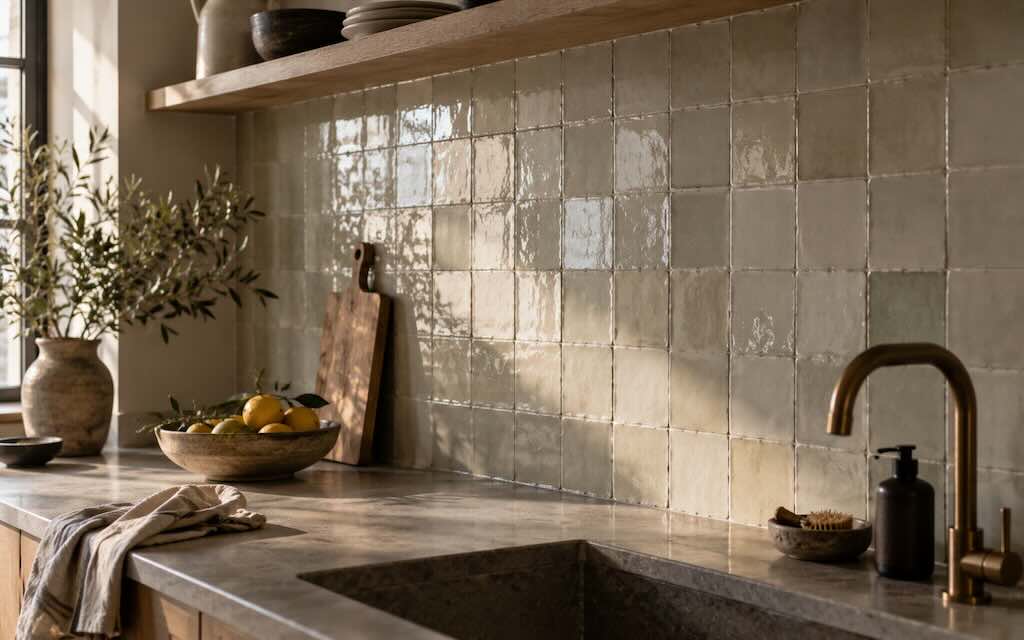
Put a row of zellige tiles beside one another and they may not behave like a row at all.
One catches the window. The next looks darker. An edge sits slightly differently from its neighbour. The glaze can gather, thin or shift across the surface, so what appeared to be a single colour on a sample becomes several once it reaches a wall.
With an industrial tile, some of these differences might be reasons to reject a piece. With handmade zellige, variation is part of what gives the finished surface its character.
That distinction matters if you are considering it for a kitchen, bathroom or another part of the home. Zellige can look beautifully simple in a photograph: a wall of small squares, often in one colour. Living with it is less uniform than the photograph suggests.
Zellige is a craft before it is a look
Zellige belongs to a long Moroccan tradition of architectural tilework. It appears in historic Moroccan architecture as elaborate geometric compositions made from cut glazed ceramic pieces, rather than simply as the square tiles now familiar from contemporary interiors.
UNESCO’s documentation of the Medina of Marrakesh identifies zellige among the traditional building crafts sustained through conservation and restoration work in the historic city. Historic examples also show how sophisticated the tradition can be: geometric tilework has been used across walls, fountains, courtyards and architectural decoration.
The handmade character is not incidental. In its discussion of historic Islamic tilework, The Metropolitan Museum of Art notes that handmade tiles can have variations in thickness and backs that are not perfectly flat. Historically, a mortar bed could accommodate those differences.
Contemporary square zellige may be visually quieter than an intricate historic mosaic, but it still carries an important part of that material logic: individual pieces do not have to be identical for the surface to work.
One colour rarely stays one colour
This is perhaps the easiest quality to underestimate when choosing zellige from a small sample.
A white wall may move between chalk, cream and something slightly grey depending on the glaze and the light. Green can become deeper in one tile and brighter in another. Even when the underlying colour is similar, differences in the surface change the way each piece reflects the room.
Morning light can pick out tiles that seemed indistinguishable the evening before. Under artificial light, another set of irregularities becomes visible.
This is why zellige is particularly effective when the aim is to make a relatively restrained surface feel alive. You do not necessarily need a complicated pattern. A single field of colour already contains movement.
It also means that choosing it by looking for the one perfect sample misses something important. The better question is what a group of tiles looks like together.
The wall will not behave like graph paper
There is another kind of variation that becomes apparent during installation.
Handmade tiles can differ slightly in dimension, thickness and edge. That makes installation a different exercise from laying highly calibrated machine-made tile where identical pieces can produce an exceptionally regular grid.
This does not mean craftsmanship during installation is unimportant. Quite the opposite. An experienced installer has to work with variation rather than assuming it is absent.
Before ordering, it is worth discussing the particular product with both the supplier and installer. Ask what degree of dimensional and colour variation to expect, whether tiles should be mixed from different boxes before installation, what spacing is appropriate and how edges and corners will be handled.
Those conversations are more useful than arriving with a photograph of a finished room and expecting an exact copy. With a materially variable product, the particular batch, room, light and installation all become part of the result.
Irregular does not mean indestructible
There is a temptation to interpret a visibly handmade surface as inherently forgiving. Chips, uneven edges and tonal differences already exist, so perhaps nothing needs to be treated too carefully.
That is the wrong conclusion.
Variation in manufacture is different from damage, staining or an installation problem. Suitability and maintenance depend on the tile, glaze, location and conditions in which it is used. A kitchen splashback does not face the same demands as a shower, floor or exterior surface.
Before buying, follow the specific manufacturer’s or supplier’s guidance for installation, sealing where required, grout, cleaning and intended use. This is one area where generic advice about “zellige” is less useful than the instructions for the actual tile going into your room.
Order the variation, not just the colour
If you like the idea of zellige but find yourself sorting through samples for the most even glaze, straightest edges and closest colour match, it may be worth reconsidering what you want from the surface.
There is nothing wrong with wanting regularity. Precisely manufactured tile can produce calm, beautiful rooms, and in some spaces its consistency is exactly the point.
Zellige offers something else.
Its appeal becomes clearer across a larger area, where small differences stop looking like isolated flaws and begin to affect the whole surface. Light breaks differently. Colour refuses to remain completely flat. The grid is present without feeling mechanically exact.
You still choose the colour, scale and place where it will go. You still care about the quality of the installation.
You just leave some room for the material to look like itself.