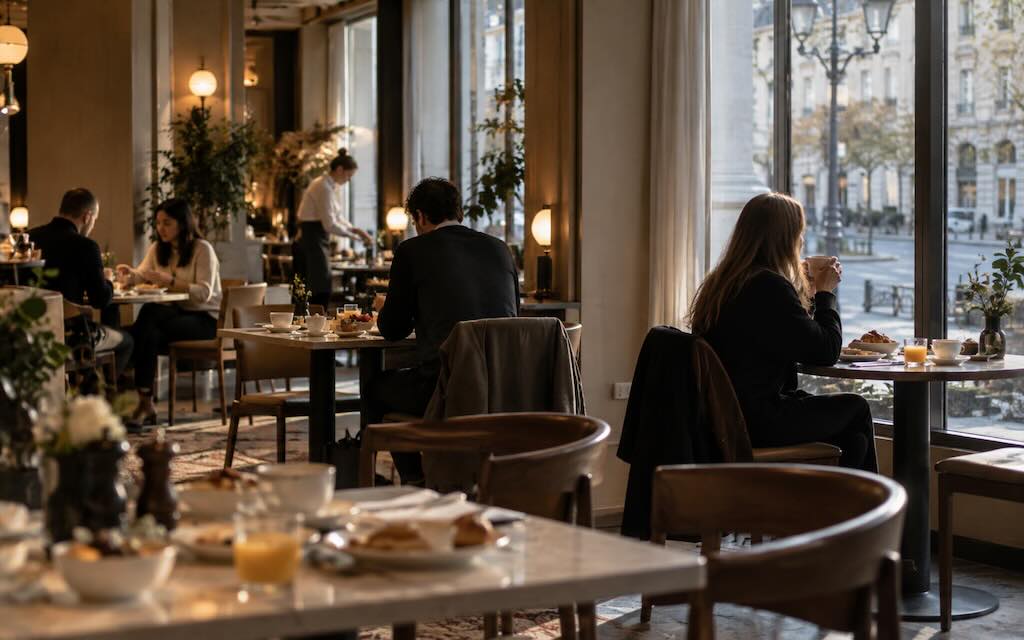
At seven in the morning, a hotel breakfast room can feel like the only place in the city that has opened too early.
The lights are on. Coffee has been made. Bread is waiting in baskets and small glasses have been arranged beside jugs of juice. Beyond the windows, pavements are still relatively quiet. Shops are closed. Whatever people travelled here to see has probably not opened yet.
Inside, everyone is already going somewhere.
A hotel breakfast is one of travel’s peculiar shared rituals. People who have nothing in common except the building where they slept arrive in various states of readiness and sit down together for twenty minutes.
There are people dressed for meetings beside people dressed for museums. Someone is checking the time between mouthfuls. Someone else has clearly decided that breakfast is the first event of the day and there is no reason to hurry through it.
Then everyone disappears.
You can often tell who has somewhere to be
Travel changes breakfast because breakfast suddenly has consequences.
At home, it can be something eaten while standing in the kitchen or carried towards a desk. In a hotel, breakfast sits between sleeping and whatever has brought you to another place.
For some people, this makes it almost logistical. Coffee. Something quick to eat. Check the phone. Look at the watch. Coat over the back of the chair because putting it properly away would imply a level of commitment to the table that nobody intends to make.
Early trains produce their own kind of breakfast. So do airport transfers, conference schedules and children who have been awake since an hour nobody wants to discuss.
Other tables operate on holiday time. Another cup of coffee appears. Somebody returns for something they did not notice the first time. A map may be opened, or the day’s plans discussed without much urgency. There is time to wonder whether the weather will improve rather than simply accepting whatever is happening outside.
The room contains both versions of travel at once: the journey as timetable and the journey as temporary freedom from one.
Breakfast makes strangers unusually easy to read
Hotels are full of people whose lives remain mostly hidden from one another.
You pass somebody in a corridor. Share a lift for three floors. Hear a door close late at night. The building contains dozens or hundreds of private journeys, but there is little reason for them to overlap.
Breakfast changes that slightly.
Not because people suddenly become intimate. Usually the opposite. Morning conversation between strangers is rarely what anyone came downstairs for.
But routines reveal things.
One person reads while eating. Another places everything they need on the table before sitting down. Someone makes several small journeys. Someone knows immediately what they want. A couple negotiates the day. A solo traveller can take a table by the window without negotiating anything at all.
None of this tells you very much about a person, and that is part of its appeal. Travel contains plenty of encounters that do not need to become stories. Sometimes another person can simply be the stranger at the next table buttering toast while you try to remember the name of the street you wanted to visit.
The room has its own morning
The guests experience breakfast as one small part of their stay. For the room itself, it is a daily transformation.
It begins prepared. Cups aligned. Tables reset. Chairs in their places.
Then people arrive and the evidence accumulates: spoons left in saucers, chairs turned slightly towards one another, crumbs, empty coffee cups, a napkin beside a plate. Tables are cleared and become available to strangers again.
By the busiest part of breakfast, the room no longer belongs to any one kind of traveller. The person leaving early overlaps with the person who has just come downstairs. One table is discussing checkout while another has not decided what to do after breakfast.
Hotel staff work across these different speeds. Coffee is replenished. Tables disappear back into order. The room has to remain ready for somebody arriving at the beginning of their morning while somebody else is already halfway through theirs.
It is an ordinary piece of hospitality, repeated so efficiently that guests can easily experience it as though breakfast had simply appeared.
Then the city takes everyone back
There is a point when a hotel breakfast room begins to lose its temporary population.
Coats go on. Room keys are picked up. Bags appear. People check whether they have everything and leave through the same doorway towards entirely different days.
Outside, the city has caught up.
Cafés are opening. Delivery vans have arrived. Pavements have filled. The places people marked on maps the night before are becoming available to them.
By then, the strangers from breakfast have dispersed into it. One might be standing in a museum queue. Another is already in a meeting. Someone is on a train out of town. The person who took a second coffee may still be upstairs deciding what to wear.
Tomorrow morning, other people will sit at many of the same tables.
For a little while, before the city asks anything of them, they will have the room in common.