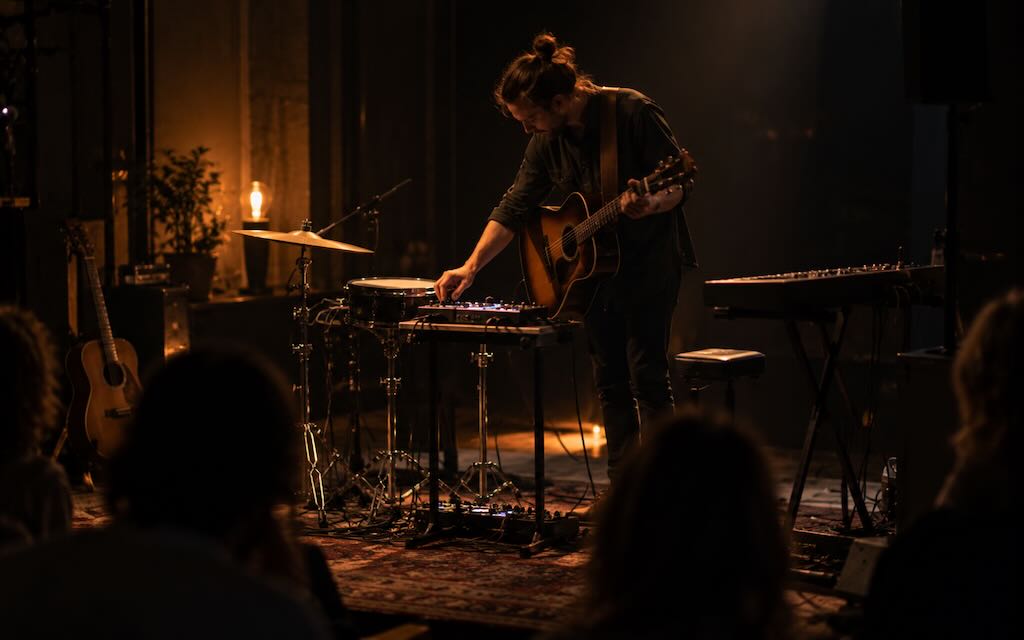
Before James Dean begins building a song, there is a brief condition that will not return for the rest of the performance.
Nothing is playing.
Then comes a kick drum and rim shot, played by hand on a drum pad. A shaker follows. Dean records what he plays and sends it back into the room as a loop. The rhythm continues without him. His hands are now free to introduce something else.
Usually that means guitar, then bass. Keyboards, synthesizers, horns or other textures may follow depending on the arrangement. Eventually Dean stops building the accompaniment and begins playing melody over it. What sounded at first like an isolated rhythmic figure has become something closer to an ensemble, although there is still only one musician on stage.
Dean calls the process “painting with sound.” It is a useful description, but what makes live looping interesting is not simply the accumulation of colours. It is that an audience gets to encounter them separately.
A conventional arrangement can conceal much of its own construction. Bass, percussion, chords and melody arrive already in relationship with one another. With live looping, those relationships have to be made in public.
The first sound has to exist before the second one knows what it is joining.
This feature is based on an earlier Divine Magazine interview with Dean about his live-looping process. Dean was not re-interviewed for this article.
The first loop is already a decision about the future
Dean does not begin each performance without knowing the song. In our earlier interview, he explained that the basic structures are rehearsed: form, tempo, chord progression and the layers he intends to build are generally established in advance. Live looping leaves room for decisions in the moment, but it is not the same as inventing an entire arrangement from nothing.
The interesting constraint begins once that plan becomes sound.
Dean’s looping setup allows him to work with three separate loops, with two able to synchronize to the length of the first. He uses that structure to create different sections, often something resembling a verse or bridge and a chorus.
Once a rhythmic foundation has been recorded, it is no longer merely something Dean has played. It becomes something he must play with. Guitar enters beside it. Bass joins a structure that already contains rhythm and harmony. Every additional part inherits decisions made by the parts before it.
Before arranging a song, Dean listens to its rhythm, melody, chord progression and mood. With instrumental covers, he has said he tries to preserve enough of the original character for recognition while changing the arrangement through his own phrasing, tone and musical choices.
Live looping makes those choices unusually exposed. A bass line that might pass almost unnoticed inside a full arrangement gets, for a moment, to arrive as new information. A guitar part can be heard before the listener knows what will eventually sit above it.
The audience hears not only the parts, but their order of arrival.
Repetition stops being background
Recorded music has made repetition so ordinary that it is easy to stop noticing it.
A drum pattern repeats. A bass figure returns. Four bars of accompaniment come around again. The repetition becomes part of the song’s architecture, and our attention moves elsewhere.
Live looping briefly reverses that relationship because somebody has to create the repetition in front of you.
A phrase is played once as an action and then returns as structure.
You have heard the percussion before the bass existed. You know the guitar part was once the newest thing in the room because you heard it enter. As the arrangement becomes denser, earlier layers may recede from conscious attention, but their beginnings remain unusually legible.
Dean told Divine that looping has changed the way he writes away from the stage too. He can record a groove, chord progression, bass line or melody and immediately hear what another part does beside it. The process has made him more conscious of what complements an arrangement, what provides contrast and what may be unnecessary.
A technology built for adding layers also creates a reason to notice when another one is not needed.
A mistake can keep coming back
There is an obvious danger in recording something that is about to repeat.
The wrong note does not politely disappear.
Dean told us mistakes are more likely with newer arrangements, while he is still learning how the layers fit together. If he records an imperfect part, he removes the layer and records it again when possible, keeping the song moving. A technical problem that cannot be corrected may require a restart, although he said that is rare.
From the audience, the process can appear seamless. His experience of the same moment can be considerably less serene. In the original interview, Dean described the thought running through his head as: “I hope I get this right,” while trying to make the performance appear effortless.
A conventional performance contains recovery too: musicians miss notes, lose cues and make adjustments. Looping changes the duration of the problem. A faulty phrase can become part of the machinery of the next few seconds unless the performer intervenes.
The skill is therefore not only accuracy. It is maintaining enough attention to hear the whole arrangement while remaining ready to act on one small part of it.
At some point, building has to become playing
There is a tempting version of live looping in which the achievement is measured by quantity.
One person sounds like three musicians, then five, then eight. Another instrument enters. Another loop begins. The accumulation itself becomes the spectacle.
Dean’s description of his writing process suggests a more useful measure: whether each addition still has a job. He has said that every layer needs to contribute while leaving space for the parts that follow.
He builds the foundation and eventually reaches a point where the loops can carry the accompaniment. Then he plays melody over them in the role a singer or soloist might occupy above a rhythm section.
The machine is capable of continuing to repeat. That does not mean the arrangement needs to continue growing.
In our earlier interview, Dean described a difference between his own shows and private events. At his shows, where listeners are there specifically for the live-looping performance, he can give the construction more attention. At weddings and corporate events, people may be talking, moving through the room or concentrating on the occasion, so the completed atmosphere matters more than watching every layer arrive.
The technique remains broadly the same. What changes is whether the construction itself is part of what the audience has come to see.
Live looping allows them to hear a song before it is a song.
There is rhythm without bass. Bass without melody. A guitar phrase whose eventual importance is still unknown. Each addition changes the meaning of what was already there until the individual parts become difficult to hear separately.
Then the construction is finished, at least for now.
Dean plays the melody.
The loops continue underneath him, repeating phrases that the audience remembers being played for the first time only minutes earlier.
James Dean is a multi-instrumentalist and live-looping performer. This feature was developed from Good Hours’ earlier interview with Dean, originally published by Divine Magazine. All descriptions of Dean’s process and comments attributed to him here come from that archival conversation; no new interview was conducted for this feature. More information about his current work is available through his official website.