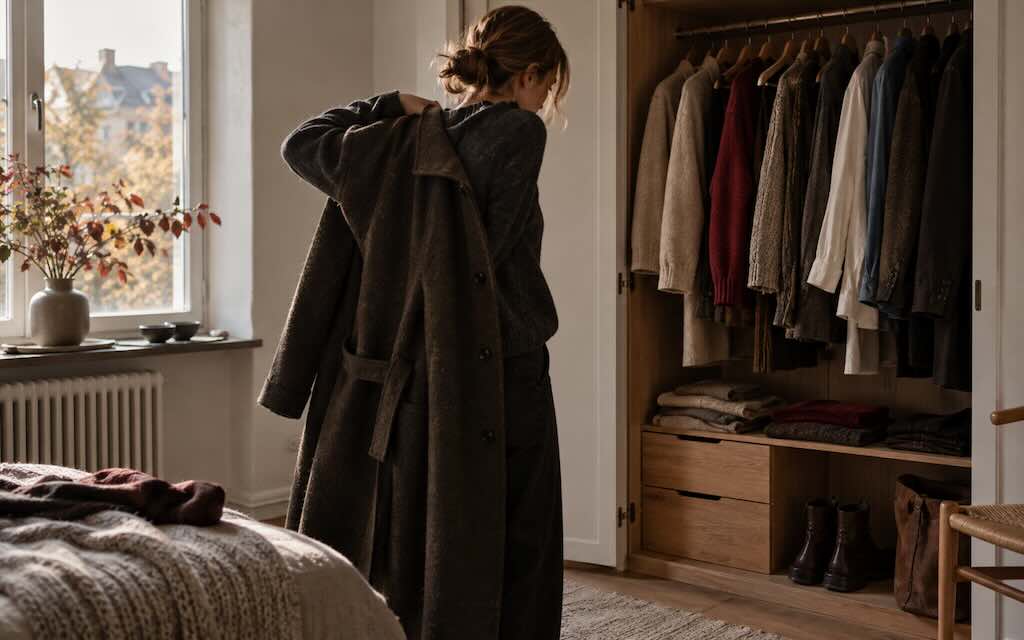
The first cold morning of autumn has a way of exposing a wardrobe.
You reach past the things that technically belong to the season and find the same wool coat you wore last year. The same trousers. The knit that works under almost every jacket. The boots you can walk in when the pavement is wet. Within a week, a small group of clothes has quietly taken over.
This is the useful idea hiding inside the capsule wardrobe. Not that everybody needs ten perfect pieces, or thirty-three, or whatever number is currently being prescribed. Simply that most of us already have a smaller wardrobe inside the larger one.
Autumn is a good time to find it.
Start with what survived last autumn
Before making a list of what the new season apparently requires, look at what you wore when it was cold six months ago.
Not what you hoped to wear. What actually left the house.
The difference can be considerable. There may be a beautiful coat that stayed on its hanger because it was too heavy for the car and too awkward on the train. A pair of boots that looked right with everything but hurt after twenty minutes. Three sweaters in almost identical colours, one of which was somehow always the first choice.
Those repetitions are useful information.
A wardrobe becomes easier when it is built around real behaviour rather than an imagined version of daily life. Someone who walks to work needs different outerwear from someone who drives. Someone who spends most days in a relaxed workplace may get more use from good denim and knitwear than another blazer. If your autumn involves rain, dark mornings and carrying groceries home, those facts deserve more influence than a seasonal mood board.
Build around the difficult days
It is easy to dress for the pleasant autumn afternoon: dry pavement, fifteen degrees, enough light to make a jacket feel optional.
The wardrobe earns its space on the other days.
Think about the morning when it is raining and you are already late. The day that begins cold, becomes unexpectedly warm at lunch and turns cold again before you get home. The evening when you need to look reasonably put together but have no interest in changing everything you wore during the day.
Clothes that can handle those transitions tend to become the useful ones: an outer layer with enough room beneath it, trousers that work with more than one kind of shoe, a shirt that can sit under knitwear without becoming uncomfortable, a sweater warm enough to matter but not so bulky that it dictates the rest of the outfit.
This is where a compact wardrobe becomes less about minimalism and more about reducing small annoyances.
Do not make everything match
The traditional capsule wardrobe can become so disciplined that every outfit starts looking like a variation of the same Tuesday.
A narrow colour palette is useful if it reflects colours you genuinely wear. It makes combinations easier and reduces the number of pieces that only work with one other thing. But compatibility does not require a wardrobe of beige, navy and black.
Autumn 2026 is a particularly good reminder of that. Current runway coverage has moved beyond the idea that looking considered requires looking quiet. Familiar shirts, tailoring and practical layers are still present, but so are richer surfaces, stronger colour, altered proportions and individual pieces that interrupt an otherwise straightforward outfit.
For an everyday wardrobe, that can mean something much smaller than following a trend. A cobalt knit among grey trousers and dark coats. A patterned scarf worn with clothes you have owned for years. A jacket with a shape that changes the proportions underneath it. One thing that prevents the rest from becoming uniform.
The useful question is not whether every item matches. It is whether every item has company.
Texture does more than another colour
Autumn clothes become interesting at close range.
Brushed wool beside smooth cotton. Corduroy catching light along its ridges. A heavy knit beneath a cleaner coat. Worn leather against denim. The season naturally gives clothes more surface, which is useful when much of the wardrobe sits within a relatively narrow range of colours.
It also explains why two outfits made from almost the same palette can feel completely different.
This does not require buying a collection of special fabrics for autumn. Often the texture is already there, particularly in older pieces. A wool coat that has softened after several winters can sit more comfortably beside a new shirt than something pristine. Leather boots usually become more convincing once they stop looking untouched.
A wardrobe gains character through wear as well as acquisition.
The best layer is the one you can remove easily
Autumn dressing is mostly temperature management disguised as style.
A cold walk to work can be followed by an overheated train and an office that seems to belong to another climate. By afternoon, the sun is through the window. By six, the temperature has dropped again.
Layering works when each part can survive without the others. A shirt should still feel finished after the sweater comes off. The sweater should work when the coat is left behind. The coat should have enough room for both without turning the whole arrangement into a struggle.
This is a more useful test than creating elaborate combinations in front of a mirror. Wear the clothes through an ordinary day. Sit in them. Carry a bag. Take the coat off in a café. Walk twenty minutes. Autumn exposes impractical clothes quickly.
Give the strange piece a normal outfit
One reason small wardrobes can become boring is that the unusual clothes are often treated as separate from the sensible ones.
The patterned jacket waits for an occasion. The bright shirt needs the right trousers. The old brooch stays in a drawer because it somehow feels too deliberate on a normal morning.
Try the opposite. Put the strange thing with the clothes you wear without thinking.
Wear the bright knit with the trousers that have already proved themselves. Put the brooch on the coat you use for the supermarket. Wear the slightly formal jacket over a T-shirt. Current Fall 2026 collections have made much of this kind of contrast — familiar wardrobe pieces shifted by styling, accessories or unexpected proportions — but the idea works without buying into a season at all.
Personal style often becomes clearer when the interesting piece has to function on an ordinary day.
Photograph the outfit that worked
There is a peculiar amount of forgetting involved in getting dressed.
An outfit works perfectly on Thursday. Two weeks later, standing in front of the same clothes, you cannot remember what you wore with the trousers.
A quick photograph solves this more effectively than another wardrobe system. Keep the combinations that worked, particularly the boringly useful ones: what you wore on a rainy workday, what fit comfortably beneath the coat, which shoes survived an evening involving more walking than expected.
After a month, patterns appear. Certain pieces keep returning. Others require so much negotiation that they rarely make it past the bedroom.
That is your autumn wardrobe taking shape.
Buy for the gap, not the season
Once you know what you are actually wearing, shopping becomes more specific.
You may discover that you do not need “autumn knitwear.” You need one lighter sweater because everything you own is too warm indoors. You do not need new boots. You need to repair the pair you keep choosing. The missing piece might be a rainproof outer layer, trousers that work with your existing shoes or a bag that fits over a winter coat without sliding off your shoulder.
This is less exciting than declaring a seasonal reinvention, which may be precisely why it works.
By late autumn, the wardrobe will probably be smaller in practice than it looked in September. The same coat will appear by the door. A familiar sweater will spend more time on the back of a chair than folded neatly away. The good trousers will be in the wash again.
Those are the clothes worth paying attention to.
FAQ
How many clothes should be in an autumn capsule wardrobe?
There is no number that works for everyone. Climate, work, laundry habits, social life and how often you repeat outfits all affect what is practical. Start with the clothes you wear frequently and add only where a genuine gap appears.
What should an autumn wardrobe include?
For many people, useful foundations include adaptable outerwear, knitwear, shirts or other base layers, trousers or jeans and footwear suited to local weather. The exact pieces matter less than whether they work together and suit your actual days.
Does a capsule wardrobe need a neutral colour palette?
No. Repeating a few colours can make dressing easier, but those colours do not have to be neutral. A wardrobe built around green, burgundy, blue or another colour you regularly wear can work just as well.
How can you make a small wardrobe feel less repetitive?
Change proportions, texture, accessories and layering rather than relying only on additional clothes. An unusual jacket, scarf, piece of jewellery or stronger colour can alter familiar combinations without requiring an entirely separate outfit.
When should you buy something new for autumn?
Wait until you can identify a specific problem your existing wardrobe cannot solve comfortably. That might be weather protection, warmth, footwear, a missing layer or a piece needed for a recurring part of your life.