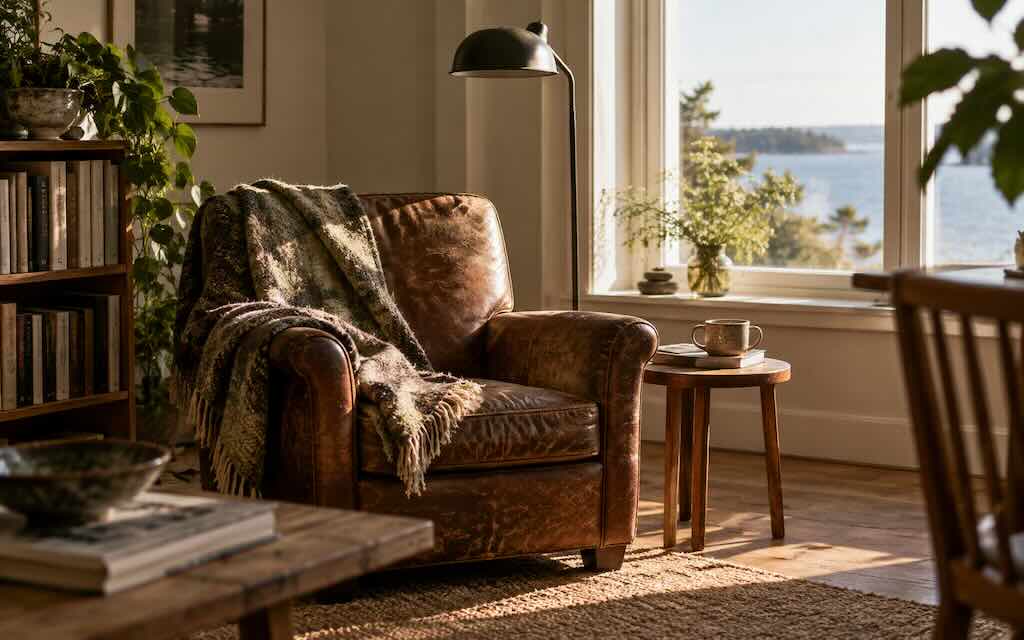
There is usually a chair in a home that belongs to someone.
Not officially. Nobody bought a small brass plaque for it. But everyone knows. It might be the armchair beside the window, the kitchen chair with the best view of the room, or the slightly worn seat at the end of the table. Other people can sit there, technically. It just feels a little strange when they do.
We become attached to certain chairs in a way we rarely do with other pieces of furniture. A table is useful. A shelf holds things. A lamp changes the atmosphere of a room. But a chair receives us. Over years, it becomes associated with the particular shape of our days.
A place becomes yours through repetition
Most attachments to objects are built quietly. We use something again and again until familiarity begins to feel like preference, and preference eventually becomes affection.
A chair is especially good at this.
You drink coffee there every morning. You sit there while talking on the phone. You read three pages of a book before falling asleep. You watch rain against the window. Someone sits opposite you and tells you something you remember years later.
None of these moments needs to be significant on its own. Their accumulation is what matters.
The chair becomes a physical coordinate for a particular version of everyday life.
Our bodies remember before we do
There is also something unusually intimate about sitting. A chair meets the body at several points at once: feet against the floor, weight through the seat, shoulders against a backrest, perhaps an elbow resting on a familiar arm.
After enough repetition, we know a chair almost without looking at it.
We know which cushion has softened. We know the angle that works for reading. We know that one wooden chair needs a small shift backwards before it feels right. We know where to put our legs.
This familiarity can make an objectively imperfect chair more comfortable than a technically superior replacement. Comfort is not simply softness, ergonomics or expensive upholstery. Sometimes comfort is knowing exactly what will happen when you sit down.
The body likes recognition.
Chairs give us a small territory
Homes are shared environments, even when we live alone. Rooms have purposes, objects move around and daily life rarely stays perfectly arranged. A favourite chair offers something smaller and more manageable: a territory approximately the width of one person.
From there, the room has a particular perspective.
Perhaps the afternoon light is better. Perhaps you can see through the kitchen into the hallway. Perhaps the radiator is close enough to warm your feet in winter. Perhaps you can look out without being directly visible from the street.
These details influence where we settle more than we might realise. Some chairs have even been designed around the idea of creating a small world for the sitter: the V&A describes Eero Aarnio’s Ball Chair as a kind of enclosing micro-environment, separating the person inside from the room around them.
Eventually, choosing the chair stops feeling like a decision. You enter the room and move towards it.
The best chair may not be the best-looking one
Interior photographs tend to present furniture as composition. Chairs are selected for proportion, material, colour and the way their silhouette works against a wall or beside a table. Yet a chair has always presented designers with a more complicated problem than appearance alone. The Design Museum notes that a chair has to work visually both occupied and empty, while remaining comfortable and suited to what someone actually does in it.
Living with furniture is different.
The chair that matters most might be the least impressive object in the room.
Its fabric has faded where sunlight reaches it. One arm is smoother from years of contact. The seat has developed a slight hollow. There might be a scratch that would reduce its value in a shop but increases its familiarity at home.
Wear changes an object from something manufactured into something specific.
This is one reason old furniture can be difficult to replace. A new chair arrives without evidence. It has no preferred corner, no softened edge, no history of Saturday mornings or late-night conversations. It may be beautiful, but initially it is only furniture.
Some chairs contain other people
Then there are chairs we associate with somebody else.
A grandfather’s armchair. The stool where a parent always sat while cooking. The chair a partner pulls towards the window. A particular seat at a friend’s dining table.
Once a person repeatedly occupies the same place, the object can begin to stand in for them.
This becomes clearest when they are absent.
An empty chair can be surprisingly expressive. It shows the shape of someone not being there. After a death, a separation or simply a child leaving home, an ordinary piece of furniture can suddenly feel charged with memory.
Getting rid of it may then feel less like clearing furniture and more like disturbing something.
We arrange our lives around small rituals
A favourite chair is often part of a larger sequence.
Put the kettle on. Open the curtains. Carry the cup across the room. Sit down.
Or return home, take off your shoes, turn on one lamp and lower yourself into the same corner.
Rituals do not have to be ceremonial to give structure to a day. Their usefulness often comes from being ordinary enough that we barely notice them. A familiar chair can mark the transition between work and rest, company and solitude, morning and evening.
In that sense, furniture does more than fill space. It helps divide time.
A room is partly a collection of habits
We often think of a home as walls, objects and decoration. But much of what makes a home feel like ours is invisible.
It is the route we take through the kitchen in the dark. The drawer we open without looking. The window we check when we wake up. The place where keys land. The side of the sofa we choose automatically.
And the chair we sit in.
These repeated movements gradually turn architecture into personal geography. Two people can inhabit the same room while experiencing it differently because each has developed their own routes, viewpoints and resting places.
Furniture has long been shaped by these different ways of living. Reclining chairs, for instance, have moved between ideas of health, leisure and travel; the V&A traces the deckchair from ocean liners to Modernist homes, showing how something as ordinary as sitting reflects where and how people spend their time.
This may explain why moving house can feel disorienting even when the new home is objectively better. The rooms are there, but the habits are not yet.
You have to live somewhere for a while before you know where you belong inside it.
Keep the chair
There is a tendency to look at worn possessions as problems awaiting replacement. Sometimes they are. Chairs collapse, joints loosen and upholstery eventually reaches its limit.
But age alone is not necessarily a flaw.
If there is a chair you always choose, there is probably a reason, even if you cannot explain it through design terminology. Maybe the proportions suit your body. Maybe the light falls differently there. Maybe you have simply spent enough of your life sitting in it.
Not every object needs to remain forever. But neither does everything need to be replaced as soon as something cleaner, newer or more fashionable appears.
Some furniture becomes valuable through use rather than preservation.
A favourite chair may be scratched, faded and slightly misshapen. That is partly the point. Over time, you have changed the chair, and the chair has taken its place in your routines.
Then one evening you walk into the room, sit down without thinking and recognise the particular comfort of being exactly where you usually are.
FAQ
Why do we become emotionally attached to furniture?
Furniture can become connected to routines, people, places and memories through repeated use. An everyday object may eventually carry associations that extend far beyond its practical purpose.
Why do people have a favourite chair?
A favourite chair often combines physical familiarity with habit and location. Its comfort may come from the way it fits the body, where it sits in a room and the activities repeatedly associated with it.
Why is it difficult to throw away old furniture?
Older furniture can hold personal associations with periods of life or people we care about. Discarding the object can therefore feel different from making a purely practical decision about whether it still functions.
Can furniture affect how a home feels?
Yes. Beyond appearance, furniture influences how people move, rest, gather and spend time within a room. Familiar arrangements can become part of the routines that make a space feel like home.