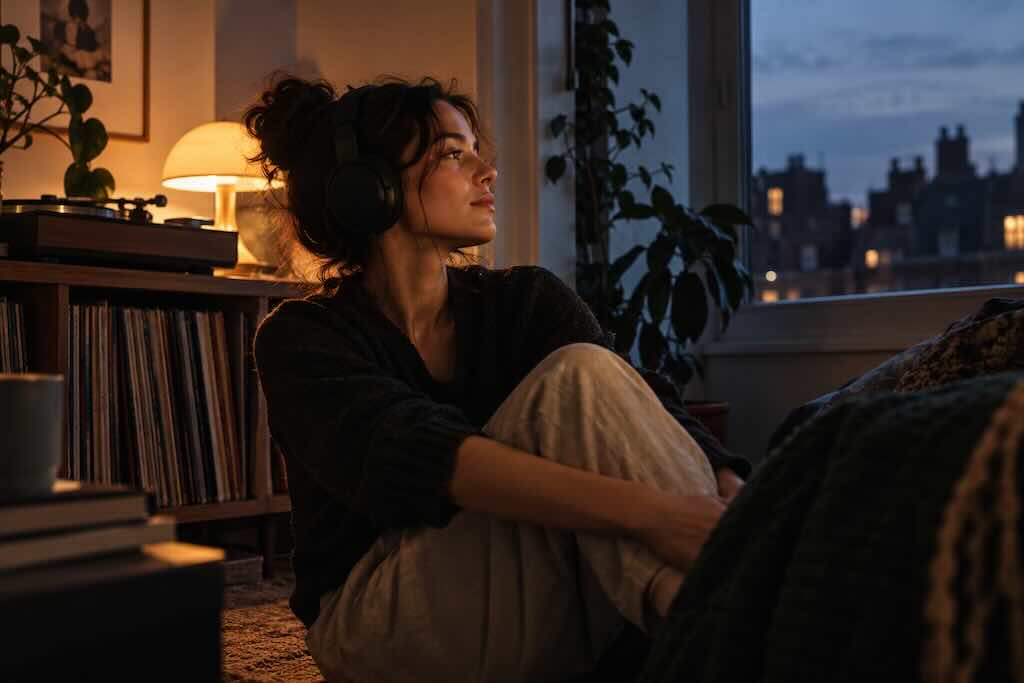
Some songs seem to change the moment you put on headphones.
A harmony that barely registered through the kitchen speaker suddenly becomes obvious. There is a guitar somewhere off to the left that you had never properly heard before. The singer takes a breath between lines. A sound appears for two seconds in the background and disappears. Bass that seemed to belong to the room now feels as though it is happening somewhere much closer.
It is still the same recording. But it is not quite the same listening experience.
Headphones do more than make music portable or keep it from bothering the person in the next room. They change the physical relationship between listener, recording and surroundings. Music no longer has to travel from a speaker across a room before reaching you. Left and right channels are delivered separately to your ears, the acoustics of the room become far less important, and the outside world can recede.
For some songs, that difference can feel unusually intimate.
Headphones put the recording unusually close to you
A loudspeaker exists somewhere in the room.
You can point toward it. The sound leaves it, interacts with the space and reaches both ears along with reflections from walls, furniture, floors and ceilings.
Headphones create a stranger arrangement.
Instead of the music occupying the room around you in the usual way, the transducers sit directly beside or inside your ears. Research into auditory spatial perception describes one consequence as sound internalization: conventional headphone reproduction can make sounds seem to originate inside the head rather than from a physical source somewhere beyond it.
That would be a disadvantage if the goal were to reproduce perfectly the experience of musicians performing several feet in front of you.
For music listening, however, the unnaturalness can sometimes be part of the appeal.
A voice does not necessarily seem to be coming from the other side of the living room. It can feel almost impossibly close. Sounds can occupy positions across an imagined left-to-right space without needing to correspond to anything you can see.
Music becomes less like an event occurring in the room and more like a private space you have entered.
Tiny production choices become harder to ignore
There are recordings you can know for years before headphones reveal something you had missed.
Not necessarily because the headphones are expensive or because you have suddenly developed better hearing.
Listening conditions have changed.
A song playing through speakers while you cook is competing with cupboards closing, water running and whatever else is happening in the room. Even in a quiet space, room acoustics contribute to what reaches your ears.
With headphones, some of those variables disappear. The quieter details of the recording can become easier to attend to: backing vocals, reverberation trailing behind a word, percussion placed far to one side, fingers moving on strings, an electronic texture underneath the chorus.
These details are not necessarily meant to be consciously catalogued. Often they are simply part of what gives a recording depth.
But once you notice one, it can be difficult to stop hearing it.
Left and right can become part of the song
Stereo recordings contain spatial information.
A producer can place elements toward the left or right, keep others near the center, spread sounds widely or make them seem narrow. Differences in the timing and level of sound reaching each ear are among the cues the auditory system normally uses when working out where sounds are located.
Headphones give each ear its respective channel very directly. That can make stereo decisions particularly noticeable.
Put on a recording with an unusually wide mix and the experience can be almost architectural. A guitar sits to one side. A keyboard answers from the other. The vocal remains in the middle. A sound crosses between them.
Older recordings with dramatically separated stereo can make this especially obvious, although modern production can use the space much more subtly.
There is an irony here. Headphones can make the left-to-right organization of a mix strikingly apparent while making natural external localization more difficult. A recent review of auditory localization notes that poor externalization — perceiving sound as inside the head — is a typical problem with headphone playback. Room reverberation, individualized spatial cues and relative movement between the listener and sound source can all help make reproduced sound seem more external.
In other words, headphones do not simply reproduce a miniature concert between your ears.
They create their own kind of space.
A voice can feel different when nobody else can hear it
Technical explanations only get us part of the way.
There is also the simple fact that headphone listening is usually private.
Play a vulnerable song through speakers with somebody else in the room and their presence becomes part of the experience. You know they can hear the lyric. Perhaps you wonder what they think of your choice. Perhaps you talk over it.
Put on headphones and that social layer changes.
An exploratory study comparing headphone and loudspeaker listening described some of these differences, noting that headphones can create a private listening “bubble” and may encourage feelings of intimacy and introspection, although experiences vary between listeners and situations. The researchers also found that participants moved more while listening to the rhythmic material through headphones than through speakers, a reminder that playback method can affect more than our description of the sound.
The privacy matters.
You can listen to the embarrassing favorite, the devastating breakup song, the recording associated with someone you no longer know or the track you have played 400 times without having to make any of it public.
There is nobody else in the listening room, even when you are standing on a crowded train.
Headphones can turn a walk into something else
Music through headphones has an unusual relationship with movement.
Leave the house without music and the street provides its own soundtrack: traffic, footsteps, conversations, birds, construction, a bus braking at the corner.
Add headphones and two environments begin occupying the same moment.
The visual world remains outside, while much of the audible world has been replaced by something you chose.
Researchers studying music and urban walking have used the idea of an “auditory bubble” to describe the phenomenon. Studies suggest that music can alter aspects of how outdoor surroundings are perceived, although it does not simply erase the environment.
Another experiment found that the tempo and character of music heard through headphones could influence people’s walking speed, while the visual characteristics of the route continued to matter too.
This helps explain a familiar experience without needing to romanticize it too much.
The right song on an ordinary walk can change the pace and emotional texture of the journey. A street you have walked a hundred times remains the same street, but the music introduces another rhythm against it.
For three and a half minutes, the walk home can feel newly edited.
Some recordings reward close listening more than others
Not every song becomes better through headphones.
Some music wants air.
A dance record through large speakers can involve the room and the body in ways headphones cannot reproduce. Low frequencies from loudspeakers can be experienced physically as well as heard. Music shared with other people also carries a social energy that private listening deliberately removes.
Other recordings seem to invite inspection.
They contain layers tucked behind layers. A vocal performance depends on tiny shifts in breath and distance. Instruments appear briefly at the edges. Sounds have been positioned carefully enough that changing the listening setup reveals another version of the arrangement.
There can be pleasure in discovering how much was hiding inside a song that previously seemed simple.
This is one reason returning to an old album with headphones can occasionally feel more rewarding than finding a new one.
You are not hearing a different recording.
You are paying attention to a different part of it.
The room disappears — but something is lost with it
The intimacy of headphones comes with a trade-off.
Speakers allow recorded music to become part of an actual physical space. Sound interacts with the room. You can move toward it or away from it. Another person can enter and hear what you hear. Bass can be felt beyond the ears. The music belongs, temporarily, to the place.
Headphones largely privatize that relationship.
This distinction is significant enough that experimental research has found measurable differences between headphone reproduction and a three-dimensional sound field. In one study involving pipe-organ and acousmonium music, the presence of a surrounding three-dimensional sound field affected reported emotion, mood and respiration compared with headphone reproduction.
Neither form is therefore the neutral way to hear music.
They are different situations.
A record filling a living room can make the room itself feel different. The same record through headphones can make the room almost irrelevant.
Private listening changed where music could belong
Once music became comfortably portable, listening no longer had to be organized around a place where music was playing.
It could accompany the bus journey, the supermarket, the lunch break, the walk across town and the hour when everybody else in the house was asleep.
That freedom is so ordinary now that it can be difficult to notice how peculiar it is.
You can stand among hundreds of people while listening to something none of them can hear. Two people sitting beside each other can occupy entirely different musical environments. A song can become strongly associated with a particular street even though it was never once played aloud there.
Headphones allow music to attach itself to places without becoming part of those places for anybody else.
That may be one reason headphone memories can feel so personal. The rainy train platform, the night bus, the walk home after something changed: the location was shared with strangers, but the soundtrack wasn’t.
Sometimes a song needs the smaller room
There is no universal hierarchy in which headphones reveal music properly and speakers merely approximate it.
A song can need both.
Through speakers, you may understand its scale. Through headphones, you notice its construction. Played loudly with friends, you understand why the chorus works. Heard alone late at night, a line you barely registered before suddenly becomes the entire song.
What headphones offer particularly well is concentration combined with privacy.
They reduce the distance between the recording and the listener while increasing the distance, at least temporarily, between the listener and everyone else.
And occasionally that is exactly the size of room a song needs.
Frequently asked questions
Why can music sound different through headphones?
Headphones deliver the left and right audio channels directly to the ears and greatly reduce the influence of the room compared with conventional loudspeakers. This changes spatial perception and can make particular details in a mix easier to notice. Headphone design, fit and frequency response also affect the sound, so different headphones can present the same recording differently.
Why do vocals sometimes feel more intimate through headphones?
Conventional headphone playback can make sounds seem internalized rather than located at a physical source in the room. Combined with the privacy of headphone listening and the close presentation of quiet vocal details, this can make a voice feel unusually immediate or intimate to some listeners.
Are headphones better for hearing details in music?
They can be, particularly when headphones reduce competing environmental noise and allow focused listening. Details such as backing vocals, reverberation, subtle percussion and stereo placement may become more noticeable. However, good loudspeakers in a suitable room can also provide highly detailed reproduction, so headphones are not inherently superior.
Why does music feel different when walking with headphones?
Headphone listening replaces some of the surrounding soundscape with chosen music while the visual environment remains present. Research suggests that music can influence aspects of environmental perception and walking pace, creating an experience in which the music and surroundings interact rather than the music simply blocking the outside world.
Do songs sound better through headphones or speakers?
Neither is universally better. Headphones offer privacy, portability and a particularly direct presentation of stereo recordings. Speakers allow sound to occupy a physical room, provide more natural external spatial cues and can produce bodily sensations that headphones reproduce differently. The preferable experience depends on the recording, equipment, surroundings and listener.