
Andrea Whitt moves easily between sound and image. A musician and visual artist, she has spent the past three years touring with Moby, while her recording credits include Kendrick Lamar’s To Pimp a Butterfly and DAMN. and Kamasi Washington’s The Epic. Somewhere along the way, another practice emerged backstage: turning the nightly setlist into a hand-drawn record of the city surrounding each show.
Music × Visual Art
Andrea Whitt
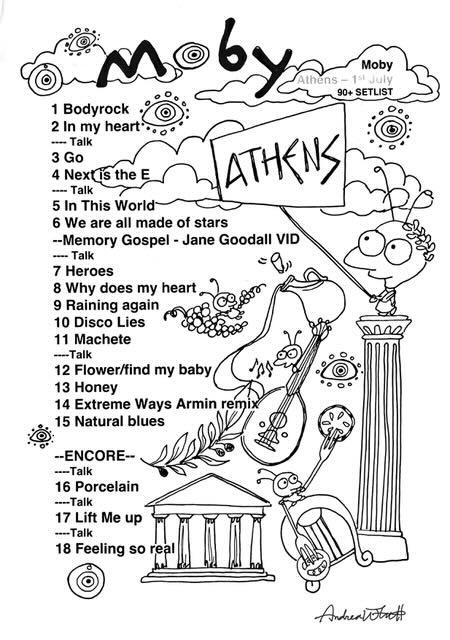
Andrea Whitt turns the practical object at the side of a stage into a record of place. Her illustrated setlists gather landmarks, local details, inside jokes and fragments of days spent exploring between soundcheck and showtime — preserving not only what was played, but something of where the music happened.
The Setlist Series
Good Hours: What was the very first setlist you drew, and do you remember why that particular night felt worth keeping?
The very first one I drew was in London, at the O2 Arena with Moby in 2024. I was sitting in the dressing room, ready early, just looking at the setlist with one of my favorite pens in my hand, and I started doodling on it. I thought, what if I add Moby’s Little Idiot? So I drew the Little Idiot character and put one of those big furry black hats on him — the ones the guards in London wear. Then I started adding a telephone box, Big Ben, all of it. One thing led to another and I did the whole thing pretty quickly, backstage. I just got into it. It was one of those moments, and at the end I looked at it and thought: this is cute — I’m going to see if I can crank one out for every show.
Good Hours: Walk us through the actual process — are you drawing during soundcheck, after the show, from memory the next morning?
Typically after the show, or the next morning if I have time. I prefer to get it done before we’re in the next city. On this run, though, we’ve had some pretty intense travel days, so sometimes I’ll group them and do a couple on a day off. I do like doing them quickly, as soon after the show as I can. The whole process of getting ready before a show — makeup, hair, dinner — is usually on a tight timeline, so I save the drawing for after the show or the next day.
Good Hours: What’s the least honest document on tour?
That one I do know the answer to: Master Tour. We used to have something on tours called the tour book, and it has always been referred to as “the book of lies.” The tour book was printed weeks before the tour started with all the hotels, dates, travel, itinerary, every detail — and then as you go along, things change. Hotels switch. Something happens with a flight. That was the physical copy; now we have the digital version, Master Tour. Anyone who’s been touring since the paper days still calls it the book of lies.
Good Hours: Has knowing you’re going to draw it changed how you experience a show while you’re playing it?
No, definitely not. The setlists come out of my experience of the city, not the show itself. When I immerse myself in a place — especially if we have a day off — I really try to check all the boxes and see everything the city has to offer. If we don’t have a day off, I’ll get out of the hotel early before soundcheck, find a vegan restaurant, explore a different part of town. That exploration is what influences the setlist. Not what happens while I’m playing — everything around the show. I’ll take photos of landmarks, or even little knickknacks I see in a souvenir shop that say something about the city and its culture.
The setlists come out of my experience of the city, not the show itself.
Good Hours: Is there a night in the 29 you’d never sell a print of — one you’re keeping for yourself?
No. There are ones I like better than others, but absolutely not. I’m trying to finish them all shortly so that every one is available — so anyone who was at any of these shows, who had a special connection to that city or that night, can have that setlist.
Setlists and Souvenir Culture
Good Hours: What did setlist culture look like from the audience side, before you were the one making the setlist?
I went to my first show when I was 12 — I’d been playing music since before that. Going to shows in that culture in the 90s, you were always looking to get some kind of souvenir from the stage. A guitar pick, a setlist, anything. It was such a special thing to collect. And that’s still true for me: my favorite band is Smashing Pumpkins, and I managed to sneak a setlist off the stage at a recent show in LA. That one’s getting framed. So I still have that connection to these objects myself. Being both a performer and a fan, I understand exactly why it matters to take one home.
Good Hours: Archivists in that world are obsessive about accuracy — has that rubbed off on how precise you try to be with these?
One hundred percent. I draw them on my iPad — it’s a long tour and keeping a lot of loose-leaf paper around is tricky, so the iPad is faster and easier. I have a template of the songs we play, and every night I reference the actual physical setlist and go down it to make sure the drawn version is exactly right. To the letter. The order, which songs we actually played, the talk cues between songs, the venue name, the spelling. I pay really close attention to make sure the setlist is 100% accurate.

Reading a City on Tour
Good Hours: Does the instrument you’re playing that night change what you notice enough to draw?
On Moby’s tour I’m playing fiddle — electric violin. But the instrument doesn’t affect the setlist at all. What affects it is the surroundings: the city, what we did that day, little inside jokes the band has. I try to work those in. It’s everything around the show — what the city offered us, the people who are there, all the staff working. That’s what ends up on the page.
Good Hours: Any city or venue on this run that’s produced a setlist page you’re especially proud of visually?
Istanbul. It’s such an iconic city, and there’s so much that is unmistakably Istanbul, so it was really fun to choose what to draw. The girls and I had an amazing day off there — a Turkish bath, tons of Turkish coffee, the Grand Bazaar, the spices, the jewelry, the kitties, because there are feral cats everywhere. Lanterns hanging everywhere, everything so ornate. And a whirling dervish — I’d never seen a whirling dervish before. So many landmarks, the Blue Mosque. Culturally it’s very different from a lot of the rest of Europe, and because the city is so distinct and so iconic in its own right, it was a lot of fun to illustrate.
Where the Setlists Go Next
Good Hours: Do you see this becoming a book, an exhibition, something beyond prints — or is 50-per-show and done the whole idea?
I like the 50-per-show idea for now — keeping it a limited edition is what makes it special. But a book is a different thing from prints. You can have a series of 50 limited-edition prints and also make a limited-edition book, which is a very different object from something you hang on your wall. So yes, I do see a book. I love that idea — a book of setlists. And an exhibition. I’d love to do an art exhibition of the setlists I’ve designed across all the artists I’ve played with. Moby would make up the majority of it, but I’ve done one-off shows here and there with other people too. A whole show of setlists from previous tours — I think that would be so fun.
Good Hours: Does putting your own drawing on the wall feel different from playing on someone else’s record?
Yes, absolutely. I’ve been drawing and painting since before I started playing music. It’s a different outlet — but both give me my own kind of meditation. A lot of times when I start drawing and really get into something, I completely lose track of time. I’ve had projects where I started at 9pm and stayed up until 6am on one drawing or painting, just because it’s so exciting and so fun and I don’t want to be doing anything else. It’s the same with music — if I’m practicing, I’ll get right into it the same way. So in that sense they’re similar: they’re both creative outlets, and they’re both things I’m very proud of, in different ways. They’re two different art forms, but in both of them I feel like I’m leaving my mark and my voice. It feels different because the mediums are different, and it feels the same because I’m putting myself into both.
They’re two different art forms, but in both of them I feel like I’m leaving my mark and my voice.
What began with a pen, an O2 Arena setlist and a Little Idiot in a London guard’s hat has become its own record of life between stages. For Whitt, the finished pages hold more than a running order: they preserve the streets walked before soundcheck, the objects noticed in shop windows and the character of places that might otherwise pass quickly on tour.
Andrea Whitt: Frequently Asked Questions
Who is Andrea Whitt?
Andrea Whitt is a musician and visual artist who has toured with Moby and recorded with artists including Kendrick Lamar and Kamasi Washington. Her visual art includes work in ink, watercolor and oil.
What is Andrea Whitt’s setlist series?
Whitt illustrates setlists from shows she plays, incorporating details inspired by the city, local culture and experiences surrounding each performance. The idea began backstage at London’s O2 Arena during a Moby show in 2024.
How does Andrea Whitt create the illustrated setlists?
Whitt draws them on an iPad, usually after a show or the following morning. She references the physical setlist to reproduce the song order, talk cues, venue details and other information accurately.
What inspires the drawings?
The drawings are informed less by what happens onstage than by Whitt’s experience of each destination. She looks to landmarks, food, local objects, culture, days off and moments shared with people on tour for visual details.
Could the setlist series become a book or exhibition?
Whitt says she can see the work becoming both a limited-edition book and an exhibition bringing together setlists she has designed across different artists and tours.