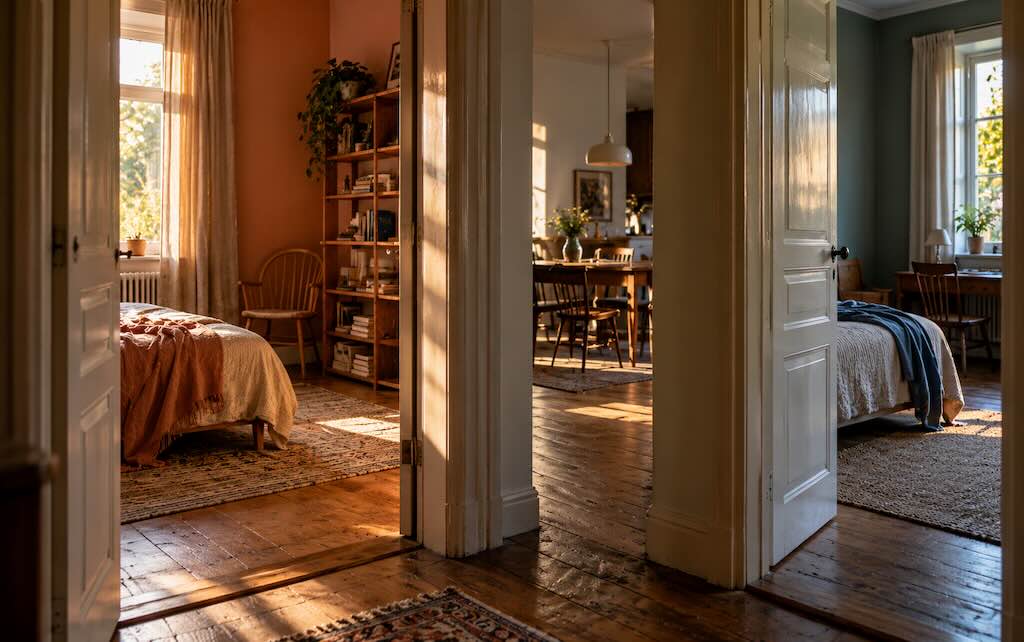
Ask two siblings about the house they grew up in and, at first, you might get something close to agreement.
The kitchen was small. There was a cupboard under the stairs. Someone always left shoes by the back door. The television was in that corner. The dog slept there.
Keep talking and the house begins to divide.
One person remembers dinner as the fixed point of family life; another remembers everyone eating at different times. A holiday recalled for years as one of the good ones turns out to have been miserable for somebody else. An argument that one sibling can still reconstruct almost word for word barely exists in another’s memory.
Even the physical details become unreliable. Was the bedroom blue or green? Did that chair always sit by the window? Did you really visit your grandparents every Sunday?
Eventually somebody says the sentence that appears in countless family conversations:
That’s not how I remember it.
They may both be telling the truth.
Memory is not a recording
It is tempting to imagine memory as an archive. An experience happens, gets stored somewhere in the mind and is retrieved later, perhaps a little faded but fundamentally intact.
Memory does not work quite like that.
Decades of psychological research have shown that remembering is reconstructive. We retain information from an experience, but recalling it involves rebuilding something from what remains. Details can disappear. Later knowledge can become involved. The stories we have heard since can influence the version that comes back.
That does not make ordinary autobiographical memory useless or inherently false. It makes remembering an active process rather than simple playback.
The psychologist Elizabeth Loftus became particularly associated with research showing how information encountered after an event can affect later recollection. Her work is often discussed in relation to eyewitness testimony, where the consequences of memory error are unusually serious, but the underlying point reaches into less dramatic parts of life too: what we remember can be influenced by what happens after the original experience.
Family life provides plenty of “after”.
There are photographs. Retellings. Jokes. Parents explaining what happened. Siblings correcting one another. The holiday story told every Christmas. The incident that gradually acquires a perfect opening line and a dependable ending.
Eventually, the remembered event and the family story about the event can sit very close together.
You were not the same age
Even siblings who grew up under the same roof did not experience an identical household.
A three-year age gap is small between adults. During childhood it can mean living through the same family event with completely different capacities to understand it.
When one child is nine and another is twelve, they have different freedoms, fears, friendships and awareness of what the adults around them are doing. A house move might be an adventure to the younger child and a social catastrophe to the older one. A parent’s period of unemployment may register for one child as an unusual amount of time together while another is old enough to notice the worry around money.
And families themselves change.
Parents have more experience with later children. Money can become tighter or easier. Work changes. Relationships change. Rules loosen. A family can move house, lose relatives, acquire pets, alter routines and become more or less anxious about things that once seemed important.
The phrase “we had the same childhood” starts looking rather approximate.
Some memories belong to the family
Then there are the stories everyone knows.
The time the car broke down on holiday. The birthday cake that collapsed. The child who wandered away in a department store. The terrible haircut. The Christmas somebody accidentally ruined.
Family storytelling is one of the ways experiences acquire meaning beyond the person who originally had them. Research into parent-child reminiscing has found that the way families talk about past events is connected with how children develop autobiographical memory. Researchers including Robyn Fivush have spent decades studying these conversations and the role they play in constructing personal and family narratives.
Which produces a peculiar category of memory: the event you know intimately without being entirely sure how much you independently remember.
Perhaps you were too young. Perhaps you remember the photograph. Perhaps you have heard the story so often that its images now arrive with the familiarity of recollection.
Families are good at making certain stories durable.
Others quietly disappear.
The ordinary things can be the most private
The largest family events are often the ones most thoroughly discussed. Everyday childhood can be harder to compare because nobody thought to document it.
What did the house sound like when you came home from school?
Who was usually in the kitchen?
Which room felt safest? Which adult seemed strict? What happened when somebody was upset? Did weekends feel slow or busy? Were you lonely?
There may be no photograph that settles any of this.
Two children can inhabit the same rooms while paying attention to entirely different things. Temperament matters. Relationships within the family differ. One sibling may spend more time outside the house; another retreats to a bedroom. One notices tension between adults that another does not understand until years later.
What survives is partly a record of what happened and partly a record of what mattered to the person noticing it.
Then somebody produces a photograph
Family disagreements about the past have a familiar escalation.
Someone goes looking for evidence.
A photograph can settle the colour of a wall. A date written on the back may prove that the holiday happened in 1998 rather than 1999. An old address book, school report or home video can restore details everyone had misplaced.
But photographs have their own limits. They record what entered the frame.
A photograph of four smiling people at a picnic can establish that four smiling people were photographed at a picnic. It cannot tell you what the morning felt like, what happened in the car afterwards or whether the twelve-year-old just outside the picture was furious about being there.
Evidence can correct memory without fully explaining experience.
Family roles can become memories too
Every family accumulates shorthand.
The sensible one. The difficult one. The funny one. The quiet one. The child who never ate anything. The one who was always losing things.
These descriptions can begin as observations and harden through repetition. Years later, a story is funny partly because everyone already knows which sibling is supposed to occupy which role.
Sometimes adulthood complicates the casting.
The supposedly fearless child remembers being anxious. The difficult teenager remembers rules nobody else seemed to have. The sibling described as independent remembers learning not to ask for much.
No single recollection necessarily overturns the family version. But hearing another person’s account can reveal how much of a shared history has been compressed into convenient characters.
You do not always have to decide who is right
There are situations where factual accuracy matters enormously. Families can disagree about events involving harm, responsibility or behaviour where “everyone remembers differently” would be an inadequate and potentially damaging response. Memory research should not be used to dismiss somebody’s account simply because recollection is reconstructive.
But many disagreements about childhood are smaller.
Was Mum always late, or only sometimes? Did we spend every summer at that cottage? Was Dad strict? Were Sunday dinners enjoyable? Did we have a happy house?
These questions often contain interpretation as well as fact. Two answers can conflict without one person deliberately rewriting history.
That can be uncomfortable. It can also be useful.
Ask a sibling what they remember about the house you grew up in and you may hear about rooms you barely entered, conversations you missed and routines you had forgotten completely.
They may remember you differently too.
Not incorrectly, necessarily.
Just from another room.