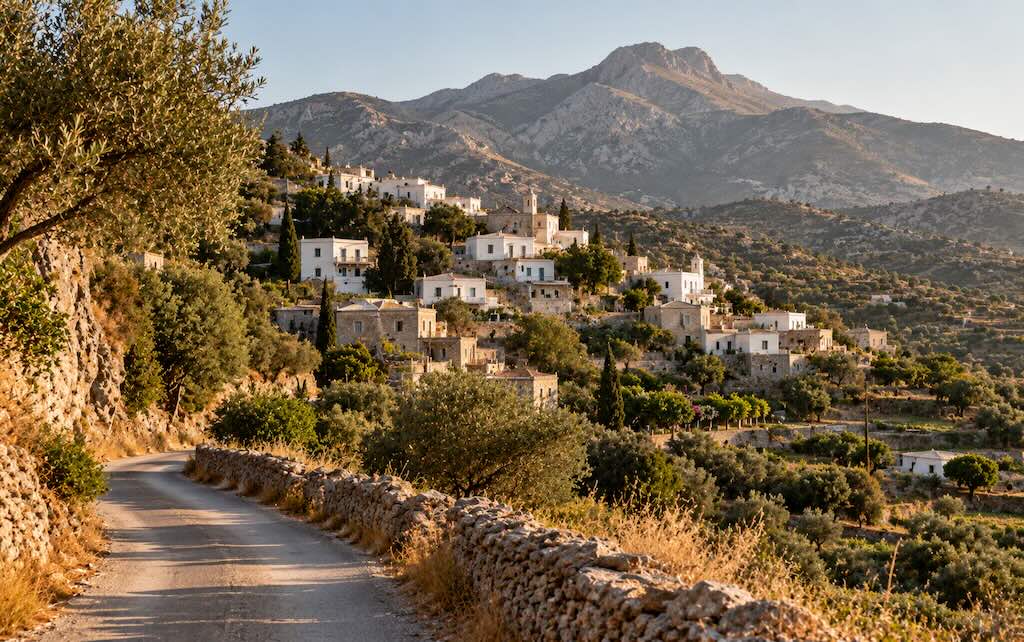
It would be entirely possible to spend a week on Naxos moving between a very good beach, a taverna and somewhere to sleep.
There are worse ways to spend a holiday.
The western side of the island makes the arrangement particularly easy. South of Naxos Town, Agios Prokopios, Agia Anna and Plaka form a succession of long swimming beaches, while the coast continues towards Mikri Vigla, Alyko and quieter stretches further south.
Stay there and the island can begin to feel beautifully simple: sea in front of you, dry Cycladic landscape behind.
But Naxos is unusually good at complicating that picture.
Turn inland and the island rises. Roads enter valleys and mountain villages. Sheep replace sun loungers. Potatoes, vines and citron grow in a landscape fertile enough to give Naxos a food culture closely tied to what is produced there. At the centre is Mount Zas, reaching 1,004 metres and standing higher than any other mountain in the Cyclades.
If you come only for the coast, in other words, you have not chosen the wrong Naxos. You have simply seen one version of it.
Start where the ferry leaves you
For many visitors, Naxos begins properly from the water.
The ferry approaches Chora, usually called Naxos Town in English, with the Portara standing near the harbour: the enormous surviving doorway of an unfinished ancient temple of Apollo. Behind the waterfront, the town climbs towards its Venetian-era castle through narrow lanes, arches and older stone buildings mixed into the white Cycladic town.
It is worth not treating Chora merely as somewhere to collect a rental car.
Walk uphill away from the port and the geography becomes clearer. The harbour is one part of town rather than the whole of it. The castle occupies higher ground. Streets narrow. Then, looking beyond the buildings, there is considerably more island behind you than the first arrival suggested.
Naxos is the largest island in the Cyclades. That scale matters once you begin travelling through it.
The road inland changes the island quickly
The useful thing to do is almost embarrassingly straightforward: leave the beach for a day.
Not because swimming is somehow a less serious way to understand Greece. It isn’t. The coast is central to Naxos, and a hot afternoon is capable of defeating the best intentions to go sightseeing.
But an inland route towards Halki, Filoti and Apeiranthos reveals why Naxos feels different from the flatter, more austere image people often carry of the Cyclades.
Halki sits in the Tragea valley, an agricultural area in the island’s interior. Filoti is larger and more animated, built across the slopes of two hills below Mount Zas. According to the island’s official tourism information, the village has around 1,800 residents and the surrounding area remains strongly connected to livestock farming.
That last fact is more useful than another list of sights.
It explains something about what appears later at lunch.
Lunch makes more sense away from the beach
Naxos is one of the most fertile islands in the Cyclades. Its agricultural landscape produces potatoes, grapes and citron, while livestock farming supports a substantial cheese tradition. Graviera Naxou has protected designation of origin status; other local cheeses include arseniko and xinotyro.
None of this requires turning lunch into a gastronomic research project.
Quite the opposite. The pleasure is in seeing the distance between landscape and plate become unusually short. Potatoes stop being the anonymous side dish beside something grilled. Cheese is no longer simply “local cheese” on a menu. Goat and lamb belong to a mountain economy you have just driven through.
The island’s official tourism material describes Filoti in particular as known for livestock products including lamb, goat and several cheeses. Halki, meanwhile, remains associated with kitron, the citron liqueur produced on Naxos.
Stay on the coast and you can eat all of these things, of course. What changes inland is the context.
Filoti is somewhere to stop, not tick off
There is a temptation on island drives to collect villages.
Twenty minutes here. Coffee there. Photograph the square. Continue.
Filoti rewards a slower hour. Its main square sits beneath a large plane tree with cafés and places to eat around it, while streets climb into the neighbourhoods above. This is not a preserved village waiting solely for visitors; the official local tourism site describes a library, cinema, cultural centre and continuing local festivals alongside the tavernas and shops.
That ordinary activity is part of the reason to be there.
Have coffee. Walk uphill without trying to complete a route. Sit down again.
A place becomes easier to notice once you stop attempting to finish it.
Then the mountain starts asking for more time
Mount Zas rises immediately beyond Filoti. At 1,004 metres, it is the highest point in the Cyclades.
There are hiking routes in the area, including a path towards the Cave of Zeus on the mountain’s western slope. This is where a casual inland drive and a walking day become two different plans. Anyone intending to hike should treat the mountain as a hike rather than an extension of sightseeing: start early in warm weather, carry water, use suitable footwear and check current local conditions before setting out.
You do not need to reach the summit to understand what the mountain does to Naxos.
It gives the island an interior.
The other coast feels further away
If there is time for a longer drive, continue through the mountainous interior towards the eastern coast.
Here Naxos rearranges itself again.
Moutsouna sits on the island’s natural eastern harbour. Its relationship with the mountains was once industrial as well as geographical: an aerial cableway carried emery from mines around the mountainous villages down to the port until the 1970s. Remains of those installations are still part of the harbour landscape.
South of Moutsouna, the road continues past small coastal settlements and beaches towards Panermos.
You have reached the sea again, but it does not feel like returning to the place you left that morning.
How to give Naxos an inland day
You do not need an ambitious itinerary. In fact, an ambitious itinerary rather defeats the point.
From Chora or the western beach resorts, drive inland towards Halki and spend some time walking around the village. Continue to Filoti for coffee or lunch. If you are interested in walking, give the Mount Zas area its own proper block of time rather than squeezing it between stops. Apeiranthos can extend the route deeper into the mountains; Moutsouna turns it into a much longer cross-island day ending at the eastern sea.
If you are travelling without a car, check the current KTEL Naxos bus timetable rather than assuming every inland connection runs frequently throughout the year. Services and frequencies can change with the season.
And leave something out.
The aim is not to replace a beach checklist with a village checklist.
Go back to the water afterwards
There is no prize for spending a Greek island holiday avoiding the beach.
Go back to Agia Anna in the late afternoon. Swim at Plaka. Sit somewhere near the water until dinner. The sea may feel even better after a day of hot roads, village squares and mountain air.
What changes is the island behind it.
The cheese on the table belongs to somewhere. So do the potatoes. The mountains on the horizon are no longer scenery at the edge of a beach photograph. There are villages between you and them, farms, roads climbing through valleys and another coastline on the far side.
You can still spend most of the holiday swimming.
Just give Naxos one day to show you what is behind the beach.
Planning an Inland Day on Naxos
Is Naxos worth visiting if you want more than beaches?
Yes. Naxos has a substantial mountainous interior, agricultural valleys and inhabited villages as well as its well-known beaches. Mount Zas, the highest mountain in the Cyclades, rises to 1,004 metres in the centre of the island.
Which inland villages should you visit on Naxos?
Halki and Filoti work well together for a relatively simple inland trip. Apeiranthos can be added if you want to continue further into the mountains, while Moutsouna on the eastern coast makes for a longer cross-island route.
Do you need a car to explore inland Naxos?
A car gives you considerably more flexibility, particularly if you want to combine several villages or reach the eastern coast. Public buses also connect Naxos Town with inland destinations, but routes and frequencies vary by season, so check the current timetable before planning the day.
Can you hike Mount Zas?
Yes. Hiking routes lead into the Mount Zas area, including towards the Cave of Zeus and the summit. Treat it as a proper mountain walk: check current route and weather information, start early in hot conditions, carry sufficient water and wear suitable footwear.